Last time: I saw some judo and learnt where my national loyalties lie.
Netball
On the penultimate day of Glasgow 2026, we travelled there once more. And, once more, we went to the SEC—but this time to the Ovo Hydro.
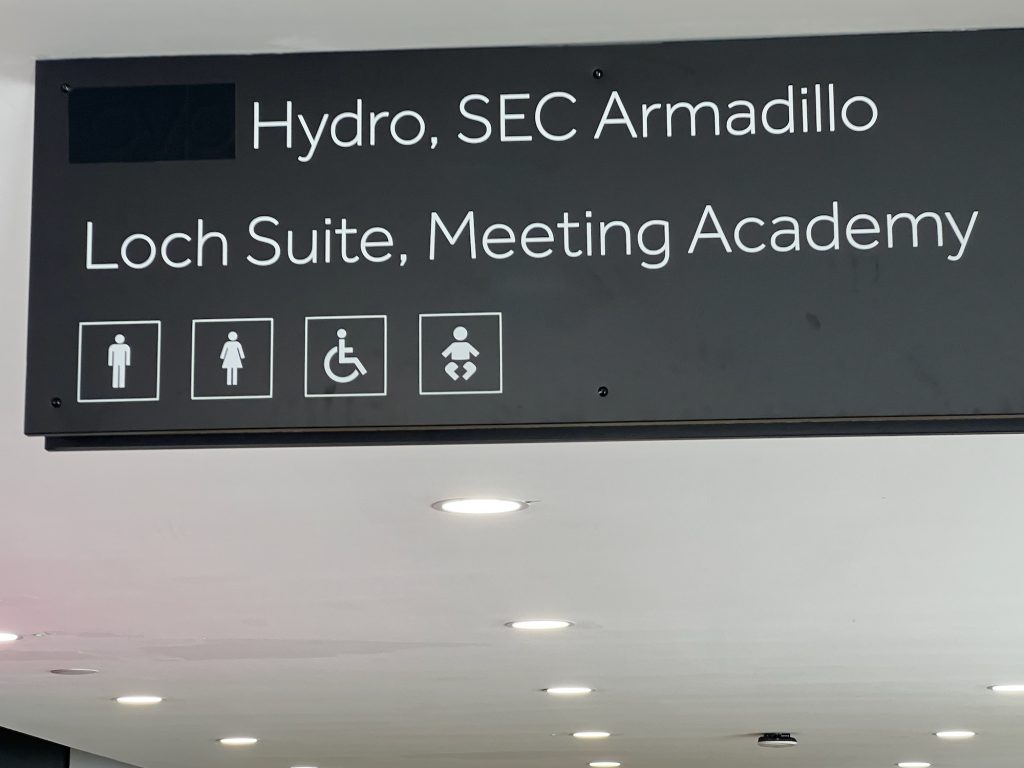
Sorry, I should say “to the Hydro”. Or perhaps “to the REDACTED Hydro”. See, FIFA haven’t been the only ones this summer busy debranding venues. Back in 2014, when SSE was a Games sponsor, they were perfectly happy to call it “the SSE Hydro” (as it was then). But for Glasgow 2026 EDF was the “Official Principal Energy and Utilities Partner”, so the name had to go. It was quite funny how thorough they were about this: on all the signs throughout the venue, a little black sticker had been put over the name of the venue’s normal sponsor, lest the wrong electric company imprint itself on the minds of any unsuspecting sportsgoers.1
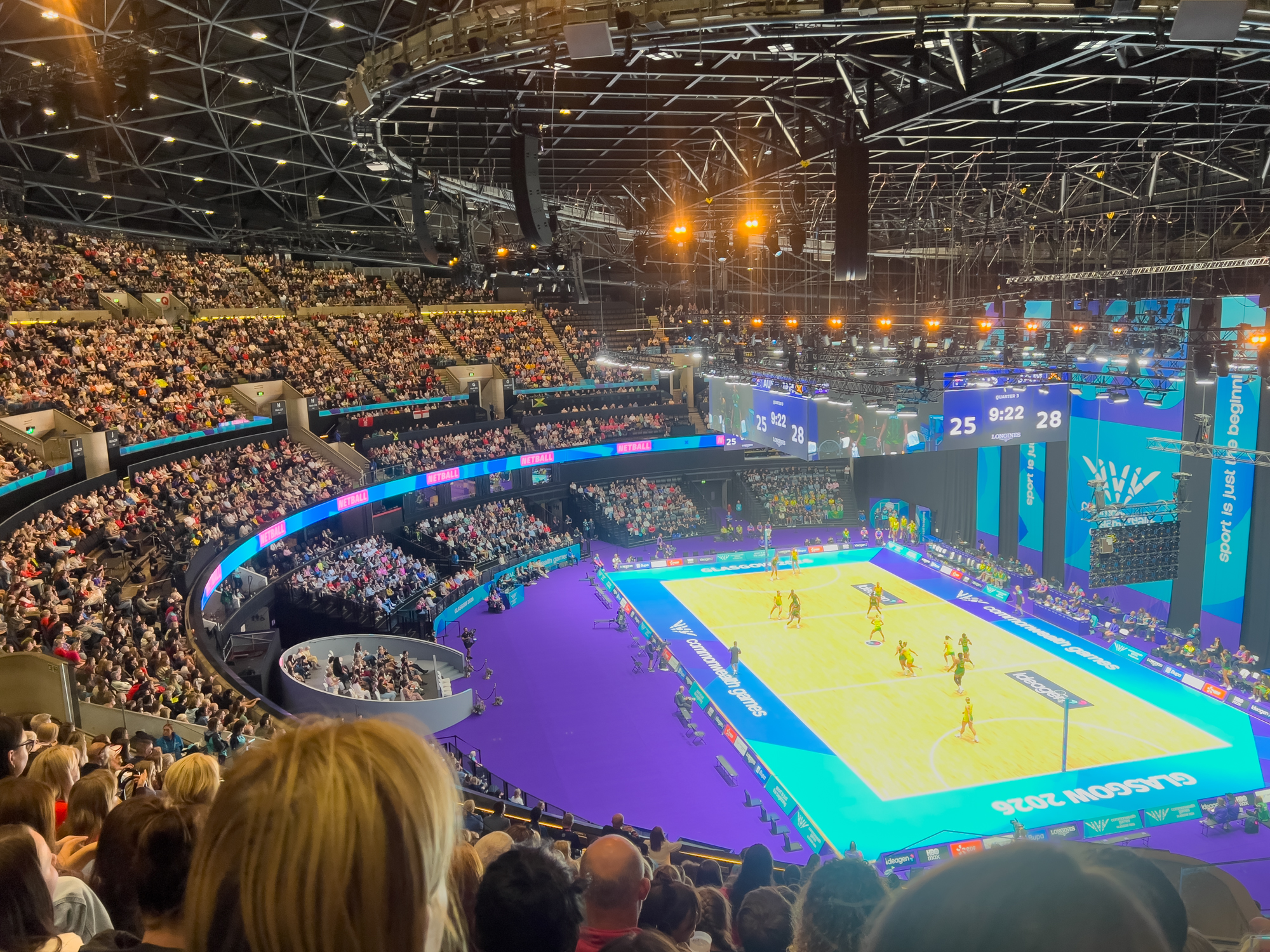
The sport this time was netball. This made it the second time in the week that we’d seen a sport for which the Commonwealth Games are, for most practical purposes, the pinnacle of the sport— because the sport isn’t in the Olympics, and very few countries outwith the Commonwealth play it to any significant degree.2 I knew this beforehand, along with the following other facts about what we were about to see:
- It’s primarily played by women, and indeed at the Commonwealths is only played by women.
- It’s a bit like basketball, but you can’t move when you have the ball.
- The adverts for it that had been dotted around Edinburgh used the slogan “She plays big”, so I expected to see someone playing big.
- What was, at the time, the most-recent Fringe show we’d seen—on the last day of the 2025 festival—was a musical called Lady Macbeth Played Wing Defence, which was about an Australian high school netball team.
This was, arguably, insufficient knowledge to appreciate what was going on, and so once again I found myself hurriedly Googling the rules during the first five minutes of play.
We had tickets to the second semi-final. The first had taken place that morning, with England being knocked out by New Zealand; we would be watching Australia play Jamaica. These, incidentally, have been the four teams in the Commonwealth semi-finals every time, with only one exception.3 I didn’t know this at the time; I thought we’d just been really unlucky to miss a home nation appearance by picking the wrong semi-final, rather than missing something we could have seen in Birmingham four years ago.
We absolutely picked the right semi-final, as it happens. Arguably the wrong seats, though.
Let me explain.
As neutrals, we weren’t sure who to pick to support as we entered the Hydro. By the time we sat down on our assigned row in the upper-upper balcony, we knew. Not because of any depth of feeling, I hasten to add—it was just something about seeing the Australian flag being held up by the group to our left, and the green-and-gold attire complete with inflatable kangaroo of the people to our right, that suggested that we didn’t have much choice in who we supported if we wanted to leave the arena alive.
I’m exaggerating, of course. But there is something weird, when you don’t much care either way, about being in an extremely partisan section of an extremely partisan crowd. And that’s especially true when the section and the wider crowd don’t agree with each other.
Oh, did I not mention? The people of Glasgow, packed to the metaphorical rafters of the Hydro, were firmly behind the Sunshine Girls of Jamaica.
This is speculation, to an extent, but I think I eventually worked out the main reason for the crowd’s preference. One thing I didn’t mention about those four teams that have dominated Commonwealth competition is that one of them, based on historical results, sits above the other three: Australia’s track record is of appearing in every World Cup final, and every Commonwealth Final, ever.4 So, as good as Jamaica were, the crowd were doing what neutral crowds always do: backing the underdogs.
Not that there was any real way, based on the match, to tell that they were the underdogs. Jamaica took an early lead and, while the match remained close throughout, they always seemed to have the edge. Australia had a chance to get a last-second equaliser, which would have taken the match into overtime, but it was not to be: after sixty minutes of (to quote the poster) “playing big”, Jamaica won and guaranteed themselves at least a silver medal. For the first time ever, Australia found themselves fighting for, at best, a bronze.5
Given our position in the crowd, it was tricky to join in the general enthusiasm. But when our rowmates made their swift exit shortly after the final whistle blew, we could join in the standing ovation.
Bowls, again (or not)
After this, we weren’t quite sure we were ready for our Games experience to end. But, as I said last time, interest in the event seemed to have grown since it started, and almost everything else running at the SEC was sold out. The only thing left was the bowls, and even then the tickets were on the more expensive side. Having already seen that sport, we decided we’d wait and see if any of the £3 charitable donation tickets were made available, that we’d heard about the previous week; we were told that they might be, if there were any to sell, fifteen minutes after the session began.
We should have known from the long queue to buy these tickets at the neighbouring full-price box office that there would be none to release. But we were thrown slightly by misinformation: the people already in the £3 queue when we joined it had been told that there were no more tickets to buy “normally”, and the discount queue was their only chance to get in. This seemed weird, because half an hour earlier at the box office outside we had been offered tickets. But, based on that, I assumed it had now sold out. I further assumed that everyone in the other queue was buying tickets for the next day—perhaps for the Closing Ceremony, which still had plenty of tickets available even then. But we all know what happens when one assumes.6
These people told us that they were there to watch someone they knew compete in that afternoon’s event, so they’d been perfectly happy to pay full whack—and they were understandably frustrated when they were told that they’d been misinformed, and they could have been in the whole time. But their loss was our gain: we had a really nice chat with them in the queue, about their life back home, their time at the Games and their plans for the rest of their trip to the UK.
The best part? They were from Norfolk Island.
We didn’t go to the bowls. Instead, we went home, and watched the rest of the Games on television. We saw the Norfolk Islander win a medal. We watched both the netball medal matches. And we witnessed the Games being officially closed, and passed on to what will hopefully be a normal edition of the event in four years’ time.
These Games nearly weren’t, but I’m very glad that they were.
- What makes this particularly funny is that “Hydro” is itself a sponsored name: the arena was planned as the “Scottish Hydro Arena”—as in, hydroelectric power—and it acquired its current name after successive rebrandings of that company. ↩︎
- Lawn bowls was the other case. You will be shocked to hear that judo does, in fact, have a following elsewhere in the world. ↩︎
- That exception was the very first time it was included, in the 1998 Games in Kuala Lumpur, in which South Africa replaced Jamaica in the list. They came fourth that year, so it is still only the four currently dominant countries that have ever medalled. ↩︎
- Apparently, the Netball World Cup didn’t have a single “final” in its early iterations, being decided by the standings in a round-robin. Nevertheless, Australia appeared in the top two in all of those as well. ↩︎
- And, indeed, this is exactly what both teams would get the next day: Jamaica went on to lose to New Zealand in the final, while England left Glasgow without a medal. ↩︎
- You make an ass out of U and 2-(N-morpholino)ethanesulfonic acid. ↩︎
Leave a Reply