This summer, the Fringe isn’t the only major international event taking place in Scotland.1 At the other end of the M8, Scotland’s biggest city is hosting the Commonwealth Games, the international multi-sport event for (broadly speaking) countries and territories that once were part of the British Empire. It’s Glasgow 2026, and you might not have even been aware it was happening.
Time to put that right.
A bit of background: the Games have had a problem with finding hosts for the last couple of editions. The 2022 edition was originally awarded in 2015 to Durban, which would have been South Africa’s first hosting of the Games. Two years later, though, the Commonwealth Games Federation (as it was then known) withdrew the hosting rights due to financial issues, and awarded them instead to Birmingham, which had initially hoped to host in 2026. England2 thus hosted the games for a third time instead.
Birmingham 2022 was, until fairly close to its Opening Ceremony, not all that far away from lacking someone to hand over to in its Closing Ceremony. But, in April of that year, the 2026 Games were awarded to the Australian state of Victoria. Victoria planned a new model for the Games, where they would take place spread across various regional cities, instead of being centred on a single hub—the only event planned for Melbourne was the Opening Ceremony. But, the following year, due to cost overruns, the Victorian government withdrew as host. You can argue—and people did—about why the projected cost of Victoria 2026 became so much larger than planned. But, whatever way you looked at it, the 2026 Games were once again in jeopardy.
In 2024, Glasgow, who had hosted a decade earlier, stepped in as host. Like Victoria, Glasgow also planned a new model for the Games. But in this case, the new model was “slimmed down”. To keep costs to a minimum, the number of sports was cut from at least3 16 to 10, and all the sports took place in pre-existing venues within the boundaries of Glasgow City. The Games would take place with essentially no public funding—well, no UK public funding. A large chunk of the money, you see, came from the compensation payment made to Commonwealth Sport when Victoria withdrew.
And so Scotland is hosting the Games, right now, for the fourth time, second only to Australia.4 Had you noticed? That’s a genuine question, because the media attention has been pretty low-key, even here in Scotland. I think that’s largely because there’s been very little coverage on free-to-air TV.5 The Opening Ceremony was shown live on Channel 5, and there’s been a highlights show every night. Otherwise, you can only watch the Games live on S4C and BBC Alba, with commentary in Welsh or Scottish Gaelic. Other live events have been on TNT Sports, accessible through HBO Max, but I don’t recall seeing that advertised much—again, even here in the host nation.
The Games close tonight,6 but I’ve been to them. Three times, in fact, over the last week, to see three very different sports. And, over a series of three blog posts, I’m going to tell you about them.
Bowls
I’ve been trying not to compare these Games too much to Glasgow 2014, of which I have very fond memories. Those Games were full-scale, with seven years to prepare instead of two. But for this one I’m going to make an exception, because, uniquely of the three sports I saw, this is the one I’d seen live before. And I saw it in the same city.
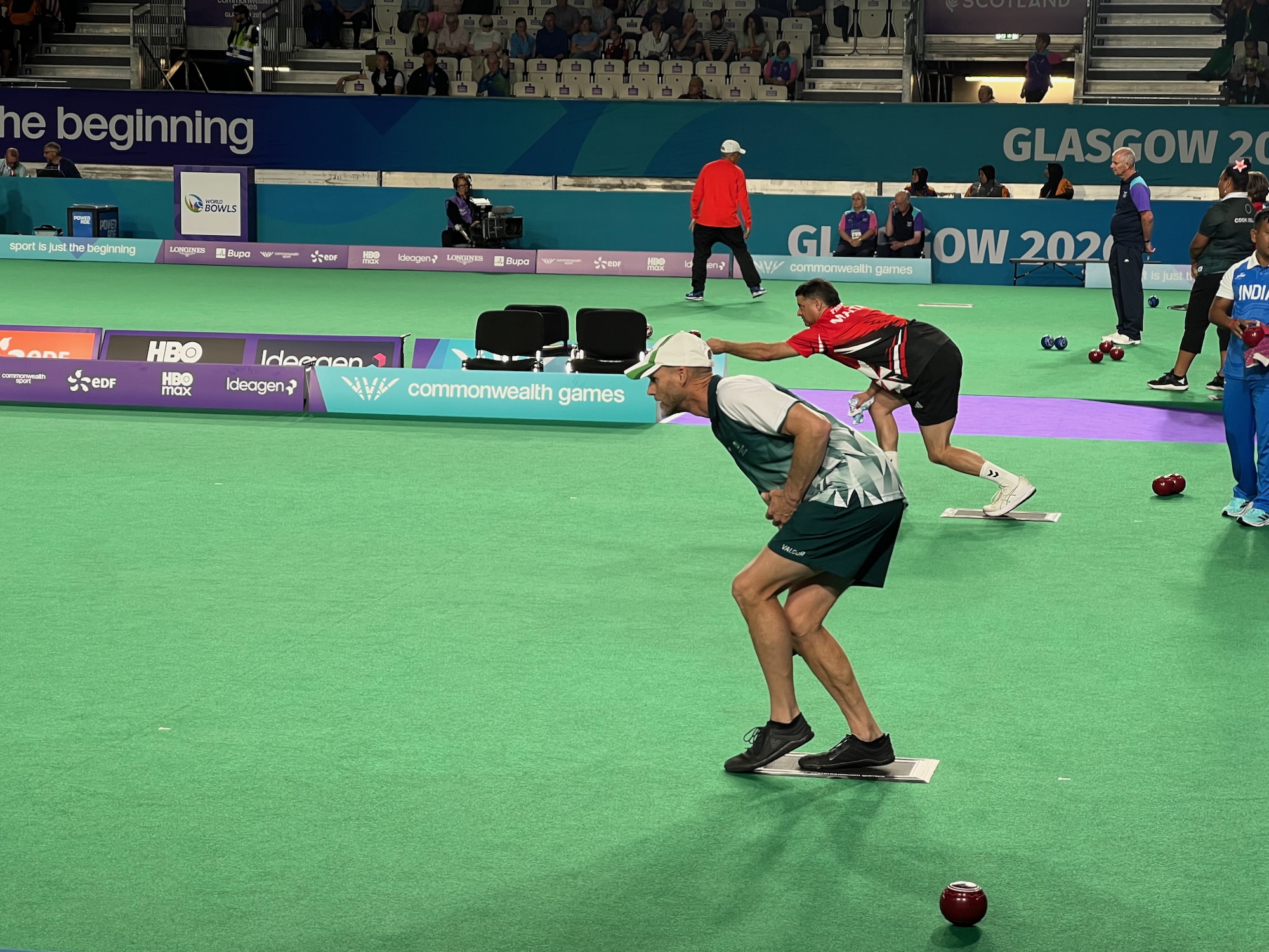
In 2014, the lawn bowls competition took place at Kelvingrove Park. This time, the word “lawn” was dropped, because there was no lawn involved: for the first time, the bowls was played indoors, on artificial turf, in a hall of the SEC Centre. It was also much faster-paced, having a shot clock, and a jack7 that was set by an official to the preference of the lead bowler, rather than (as normal, at least on grass) being bowled first to set the distance.
We decided to go to the bowls because it was a tense Sunday: I’d had a jury citation for the week about to start, and I was waiting to find out if I’d have to serve.8 We thought a trip to the Games might be a good distraction, and chose bowls out of the two sports for which £10 tickets were available.9
Bowls isn’t seen as a particularly exciting sport, but I disagree—although, as we’ve established, I’m hardly one to judge as someone who likes watching snooker. Then again, it’s essentially the same thing as curling (no ice, no brushes, but the scoring basically works in the same way), and we all seemed to get behind that at the Winter Olympics. Also, any competition can be engaging if you pick a side to cheer on, and I knew which was mine for the first match we saw as soon as I got a glimpse of the order of play: the bowler from Norfolk Island.
Norfolk Island is an island of around 2,000 people in the Pacific Ocean; it’s nearly a thousand miles off the eastern coast of Australia, of which it is a dependent territory. So why them? Again, this goes back to 2014, when we went to the first Commonwealth Games in Glasgow and saw (I think) their women’s doubles competing valiantly in the badminton. It’s always more fun to cheer on the underdog, so we did, and we did again the next day when they happened to be playing in the lawn bowls session we had tickets for—except they’re not quite so much underdogs in that, having won several bronze medals at previous editions.10 That’s it, really—somewhat arbitrarily, I’d decided that, of all the small teams at these Games, this one was mine.
Sadly, that bowler didn’t win, and nor did any of the other sides I picked to support over the course of the three matches we saw. It would have been great to stay for the last two, but we needed to get a train back to Edinburgh in time to go to work the next day.11 That was a shame for a number of reasons: we didn’t get to see any of the para-sport, for one. But another was that it was unfortunate to leave such an empty arena, and deprive it of any further support.
Certainly on Sunday, and certainly in the bowls, the 2026 Games really didn’t seem to have captured the city like they did 12 years previously. Indeed, if you had a ticket for another event that day, you could get a ticket for the bowls session we were watching in exchange for a £3 charitable donation, and that still wasn’t enough to get many people through the doors. Given the wider uncertainty over the future of the competition, this didn’t seem to be a good sign.
But, for those who were there, it was still a joyous occasion; one that lived up to the Commonwealths’ supposed nickname of “the Friendly Games”. There’s something rather wonderful about watching a session of sport, going for something to eat in the venue restaurant, and spotting the bowlers from Malta and the Falklands that you’ve just watched compete eating in the same place, choosing from the same menu. Even if I was too worried about bothering them to go over and ask for a selfie.
And fortunately, it does seem to have picked up over the subsequent week. And I’ll tell you about what it was like at a later session, and for a more popular sport, another time.
To be continued…
- Actually, that’s true every summer: there’s the Scottish Open golf tournament, the Hebridean Celtic Festival, the various Highland Games, plus all the other Edinburgh festivals, including the Tattoo. Plus every other year there’s the Glasgow International art festival, last year there were the Tall Ships races in Aberdeen, and occasionally you get something like the 2005 G8 summit at Gleneagles. But why let the facts get in the way of a half-decent opening sentence? ↩︎
- At the Commonwealth Games, the home nations, the Crown Dependencies, and the various British, Australian and New Zealand dependent territories compete separately. ↩︎
- The final list for Victoria hadn’t been confirmed when it was cancelled. ↩︎
- This is a joint second place, along with Canada and, weirdly, Switzerland. ↩︎
- The legal requirement is only that highlights be made available for free. ↩︎
- I just checked, and, unlike the Opening Ceremony, I don’t think that’s getting any live airing for free either. ↩︎
- The target ball. ↩︎
- For readers outwith Scotland: here, the jury system is a little bit different, which I think is ultimately a consequence of Scotland’s distinct judicial system that it’s retained since the Acts of Union. One feature of that is that getting a letter doesn’t mean you actually serve on a jury, in part because there’s a ballot taken out of potential jurors shortly before the case is heard. ↩︎
- We ended up seeing the other one anyway, on my third trip to Glasgow this week. ↩︎
- As I write this, I’m watching a bronze medal match from earlier today with Norfolk involvement. No spoilers, please. ↩︎
- I phoned after the second match to see if I needed to do anything, and I was told just to await a phone call. At 5pm on Monday, I phoned again as instructed and was told my citation had expired, so I indeed did not serve on a jury. ↩︎
Leave a Reply