Last time: we went to the bowls, and I got very excited about supporting Norfolk Island.
Judo
Once I’d been told, on a Monday afternoon, that I wouldn’t be needed for jury service, the Friday of that week—since January, my non-working day—was mine again, to do with as I pleased. And so, if a Commonwealth Games in Glasgow was by now a twice-in-a-lifetime event, it seemed only right to go a second time.1
This time, the sport was judo. I had never seen live judo before; I’d watched it a bit on TV at previous multi-sport events, but that’s about it. I knew it was a combat sport, originating in Japan, and fought in close contact. I also knew that its name sounds a bit like the title of a song about a cat, which kept getting stuck in my head all day for what felt like no reason until I realised. Other than that, I was pretty much in the dark about what I was going to see.
The first thing I saw on arriving at the SEC was that it was… busy? On the Saturday, for the bowls, the spectator plaza outside the venues2 was bustling, providing a much more lively backdrop (I presume) to the TNT Sports coverage nearby. Not that I spent much time there: I headed straight to the venue to take my seat, where I found someone else’s bag. As I’d booked seat 2 of the row, I moved out of the way, assuming it had been sloppily put down by the person in seat 1. But eventually I became to doubt myself, and realised I’d made an off-by-one error on the row lettering. So I moved one seat further back, but that still left the matter of the unattended bag.
After I’d checked with the only other people nearby if they’d seen whose it was (they hadn’t; they hadn’t even noticed it was there, because of the raked seating, until I asked them). I then told the nearby member of the security personnel, who called various people as they worked out what to do. Eventually, just as the bag was about to be taken away, its owner returned from the food concession to a telling-off from security. I looked straight ahead at the ongoing venue setup and crowd warm-up, and hoped he wouldn’t suspect that it was me who’d dobbed him in.
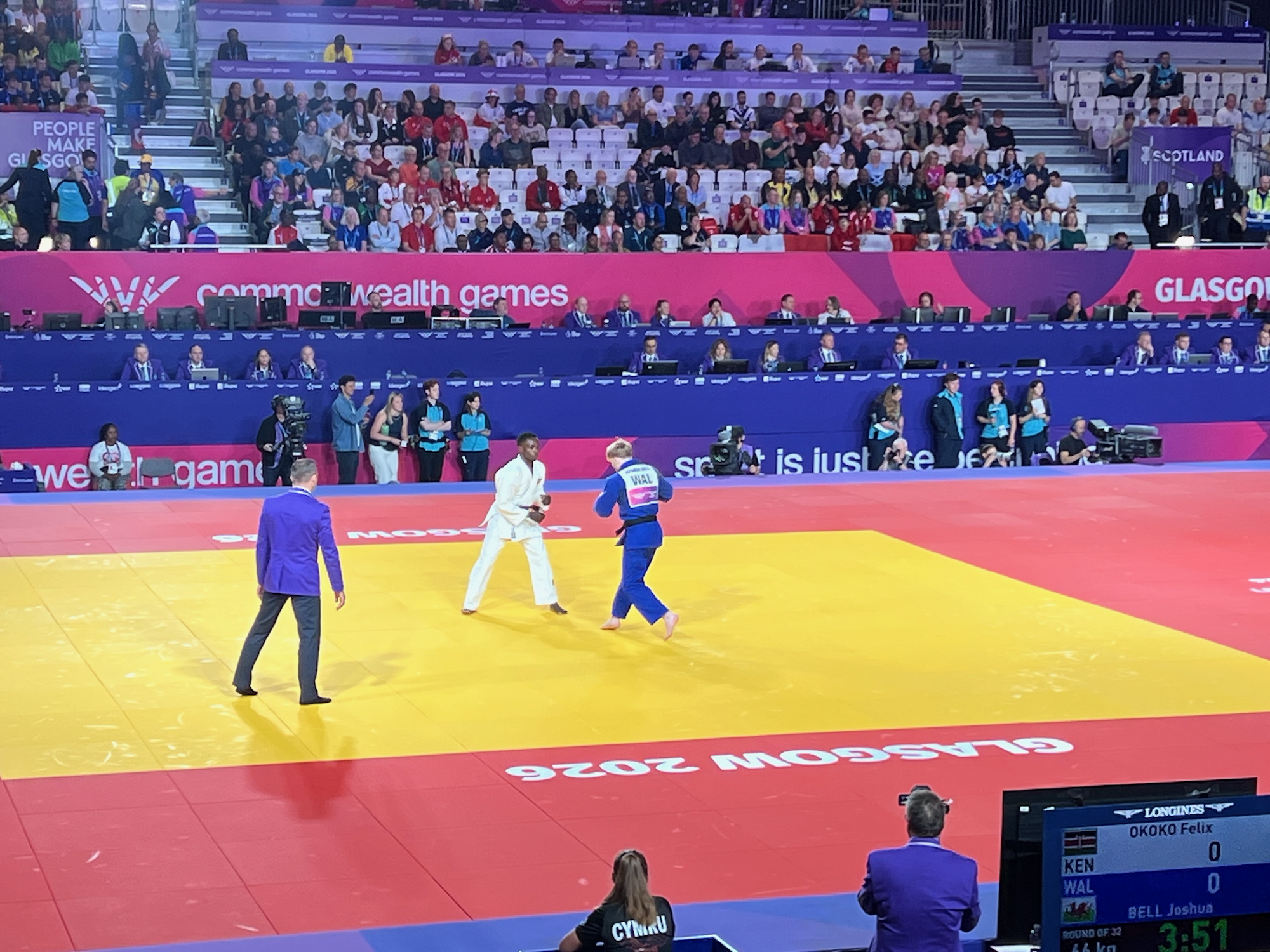
So, the sport. I’ll briefly describe it, but only briefly, because this is almost entirely based on what I picked up from watching. Judo is a martial art originally from Japan, often translated as ‘gentle way’.3 The ultimate aim is to execute a clean throw of your opponent onto their back, to pin your opponent for 20 seconds, or to force them to submit. For doing this, you score an ippon,4 and win. A lesser achievement (a less-clean throw, or a 10-second pin) scores a waza-ari,5 two of which together count as an ippon. A lesser achievement still is called a yuko,6 which was recently reintroduced to the scoring system; you can’t combine yukos to get either of the higher scores, but they do serve as a tiebreaker. There are various penalties, called shido,7 for things falsely attacking or being overly defensive; these don’t count towards the scoring at all, but if you acquire three of them in a match you’re disqualified and your opponent wins by default.
In Glasgow, there were two mats on which fights could take place, and successive bouts took place across both simultaneously, progressing through all stages of the competition except the medal matches for each gender and weight class (which would take place that evening). That included a ‘repechage’ for the quarter-final losers, the winner of which would face a semi-final loser in a bronze medal match.8 Matches took as long as they took: the standard length is four minutes, but if someone scores an ippon the match ends early; conversely, if the contest is tied after four minutes, it goes into “golden score” for an indefinite period, until the first point of any kind takes the win.
The crowd was more animated than for the bowls, but broadly speaking just clapped respectfully to welcome the judoka to the arena, and to congratulate the winner. That is, unless there was a home nations participant. At that point, the crowd became highly partisan, as you might expect from an audience in Glasgow, and this was particularly true when the participant was Scottish. They were especially vocal for Aiden Moffat, in the men’s under-66kg category, who had come out of retirement to compete in Glasgow; sadly, although he won his first bout, he lost in the quarter-finals and the repechage, and so didn’t reach the medal matches. There was more home-field success in the women’s under-48kg, in which two Scottish judoka made it to the bronze medal matches: Summer Shaw, who lost her semi-final, and Eva Ewing, who won her repechage. (Shaw would go on to take a bronze medal that evening.)
But it was a different Scottish fighter I whose match I want to end on: Neil Macdonald, in the same weight class as Moffat, who won his round-of-32 bout against Kehinde Aremu of Nigeria. He went on to the round of 16, where he faced Michael Fryer—from England.
I was genuinely surprised by the crowd’s willingness to support an English fighter in general, given the joke from football that a Scottish person’s second-favourite team is whoever’s playing England. But there was no doubting who was the crowd’s favourite in a cross-border match-up. They were pretty evenly matched, scoring only one yuko each in regular time; in golden score time, it became a war of attrition, with neither party scoring for nearly five minutes. Eventually, the bout ended when Macdonald was disqualified for a third shido—a somewhat unsatisfying result to watch, and the crowd were not shy about making known their displeasure.
Now, before it started, this fight presented me with a test of loyalties. I was born in England, and have lived there most of my life. On the other hand, my home is now here in Edinburgh. As the two men prepared to fight, I wondered who I would choose to support, weighing up the reasons to align with either fighter, and considering whether I should just watch it as a neutral observer with no partisan feeling. But I was misguided. This isn’t a rational exercise; it’s an emotional one. And the question was answered for me within the first minute, when I felt compelled to call out in support on one competitor over the other.
“Come on, Neil!”
To be continued…
- I was there on my own for this one, my husband being at work. ↩︎
- These are: the main exhibition centre, previously called the SECC until they decided one C was enough; the Hydro arena, normally called the “Ovo Hydro” for sponsorship reasons but de-branded for the occasion because EDF was the “Official Energy and Utilities Principal Partner” for the Games; and the venue that, back in 2014, I’d been to as the “Clyde Auditorium” for the weightlifting, but they eventually stopped swimming against the tide and officially renamed it after its nickname, “the Armadillo”. ↩︎
- But, as you’ll see in the following footnotes, translating from Japanese into English is hard, because they’re languages with completely different vocabularies and grammars from completely different language families. Based on what the announcer said at the beginning, the intended sense is along the lines of ‘pliable’, in the sense that you win by yielding to your opponent’s strength and using it against them. ↩︎
- From the Japanese 一本, which very roughly speaking translates as “one”, in the sense of scoring one point. ↩︎
- 技あり, which the OED gives as meaning “feat accomplished (but not with complete success)”. ↩︎
- 有効; I’m really struggling to find a good source for the translation of this, but it seems to meaning something like “having effectiveness”. ↩︎
- 指導, “guidance”. ↩︎
- You may have, astutely, noticed that this doesn’t add up: there are four quarter-final losers, so two repechage winners, and two semi-final losers to fight them for the bronze. So which of them gets the medal? The answer is simple: both of them. ↩︎
Leave a Reply