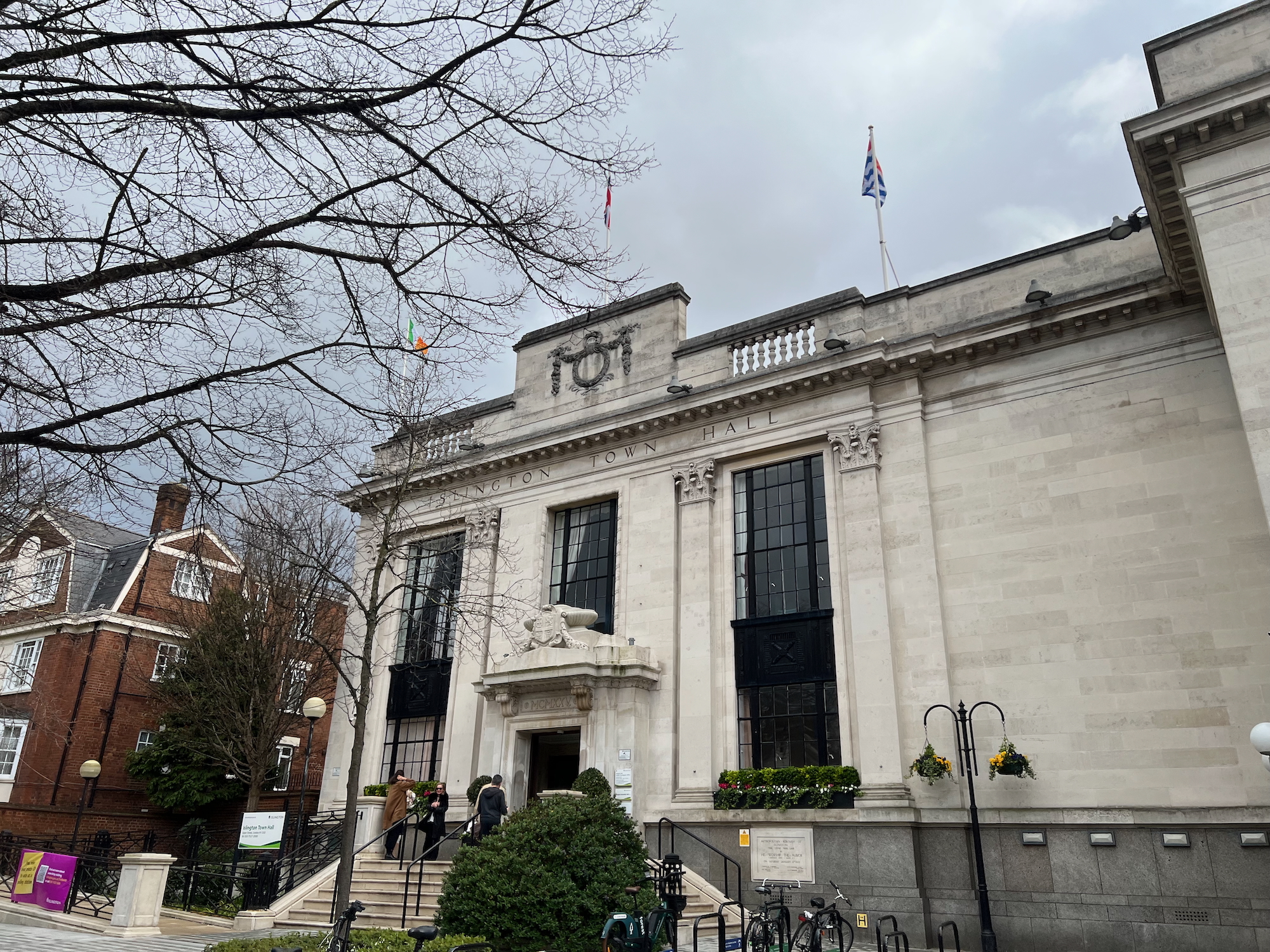
A two-storey Portland stone building. The building has an ornate portico above the front door, approached by a short flight of steps (the stonework up to near the bottom of the porch is, in fact, grey). Above the door are Roman numerals giving the date of construction as 1925. Atop the pediment over the doorway is an ornate coat of arms, carved in relief in stone. There is a large window to either side of the door, and there are three large windows on the upper floor: one is above the porch, and the others are joined by black-painted panels to the windows below. There are four shallow Corinthian columns carved into the stone to either side of the two columns of windows. The architrave above all of these has engraved text reading "Islington Town Hall". Above this is a colonnade, with a taller section above the door displaying a wreath. There are three flagpoles on the building, displaying (from left to right) the flags of Ireland, the United Kingdom, and Kiribati. The building continues to the right of the ornate frontage, but is a much plainer wall, that towards the edge of the image steps out towards the camera. There is a dedication plaque beneath the right-hand window. Several people are gathered on the top step in front of the porch. There is a sign identifying the building to the left of the steps. A three-storey red-brick building is next along the street to the left. The bare branches of a tree overhang the scene.

Welcome to the London Borough of…, part X

Last time: I ticked off six more boroughs, stroked a cat, visited a bathroom, and left my quest there for the day.

Twenty-seven weeks ago, I started telling you about my quest to find all the London borough signs. Today, that journey ends.

Or rather, in early 2024, that journey ends. I had three boroughs left to do on this visit to London; two of them were easy, because there was a signposted boundary between them, not far from a Tube station. So I hopped on the Piccadilly line to Bounds Green, and bagged Haringey…
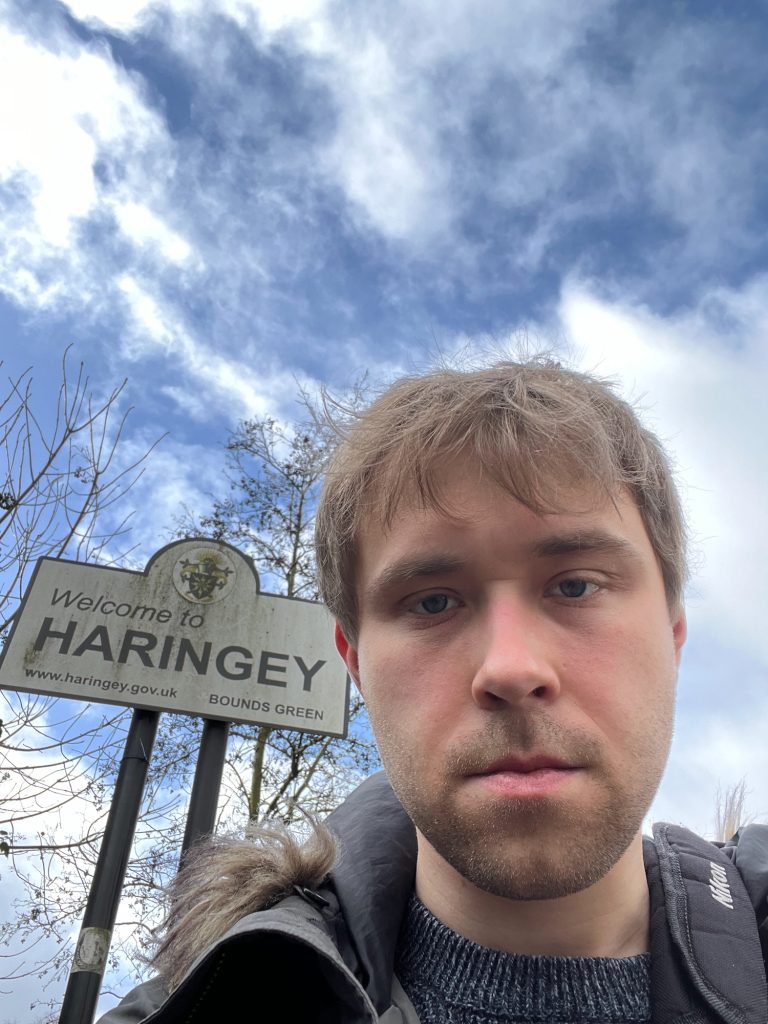
A selfie of the blog's author, wearing a thick coat and with a camera bag over his shoulder, standing in front of a sign. The sign is supported by two closely-spaced black poles. The sign itself is a rectangle, with a semicircular "bump" protruding from the midle of its upper edge; it is white, with a black border. Within the bump is a coat of arms, on a circular sticker with a white background. Below that, in black text, the sign says "Welcome to HARINGEY". Underneath again is the borough's web address, bottom-left, and "Bounds Green", bottom-right. Behind the sign are some trees with few-to-no leaves. The sky is mottled blue and white.
I think you can see how ready I was to be done with this.

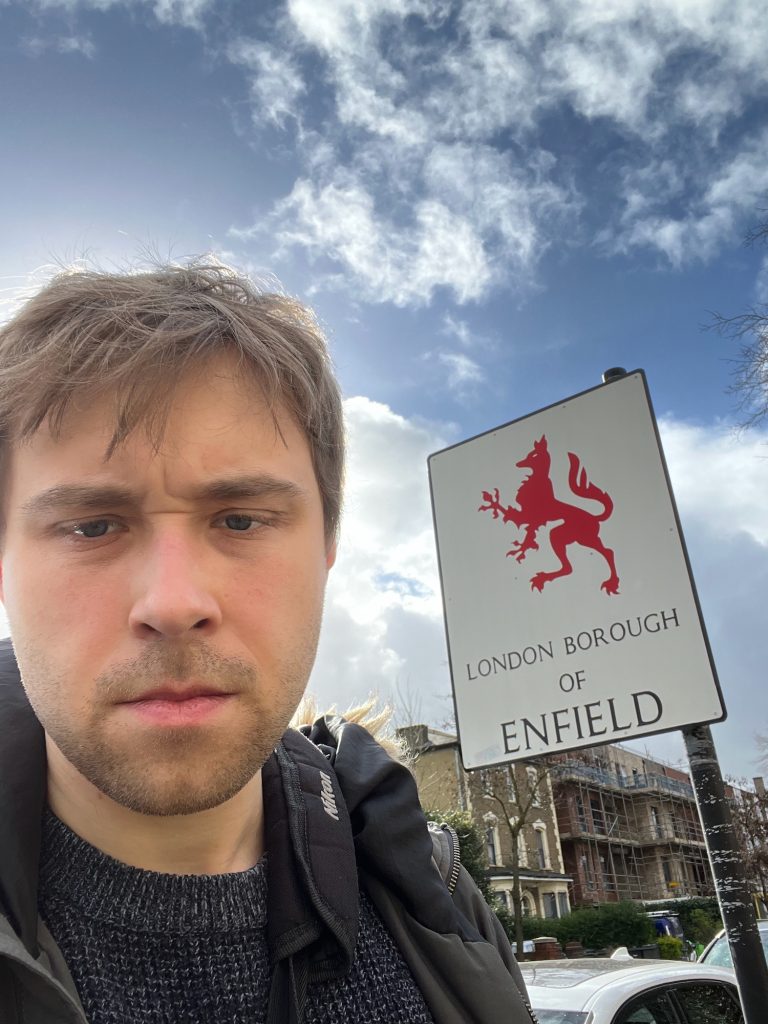
… and Enfield.

A selfie of the blog's author, next to a sign. It is a portrait-orientated rectangle with rounded corners, placed off-centre on a black pole (the pole is at the right-hand side of the sign). The sign is white with a black border. A large silhouette image (in red) of a heraldic beast takes up most of the sign; it is known as an "enfield", and has a fox's head, an eagle's forelimbs, a greyhound's chest, a lion's body, and a wolf's tail. Beneath the image are the words "London Borough of ENFIELD", in black. Behind the sign is a street with cars parked along the near side, and property visible on the far side—a yellow-brick Victorian house, and a building partly obscured by scaffolding. The sky is partly cloudy.
The heraldic beast on the sign is, appropriately enough, called an “enfield”.

That left Islington. Like Southwark, way back in part II, Islington is one where I have (what I presume is) a false memory of a sign: in my head, there’s one on Pentonville Road, near where the boundary between Islington and Camden runs along the side of King’s Cross station. If there ever was a sign there, there certainly isn’t now; indeed, Islington is the last of the three boroughs that doesn’t appear to have any signs at all. For Hammersmith and Fulham, you may remember, I’d solved that problem by going to the council’s HQ; for Camden, I’d resorted to a pun (often my approach in times of crisis). What would I do for Islington?

The second option wouldn’t work, because as far as I know nothing to do with Henry Wellcome has an obvious enough sign in that borough.1 So I tried a repeat of the first, taking the Tube back to Highbury and Islington and proceeding to the Islington Council offices on Upper Street. Alas, I found nothing usable.

I trudged around the neighbourhood for a while, looking for inspiration. I don’t know what I was expecting would hit me, after nine months of trying to think of something, and indeed those additional minutes achieved nothing further. In the end, I decided the best I could do was to find any photo with the words “Welcome” and “Islington” somewhere in it. And, fortunately for me, the fates showed me a sign. I wish they’d shown me it earlier, because this was right opposite the Tube station where I’d started. But it was something.
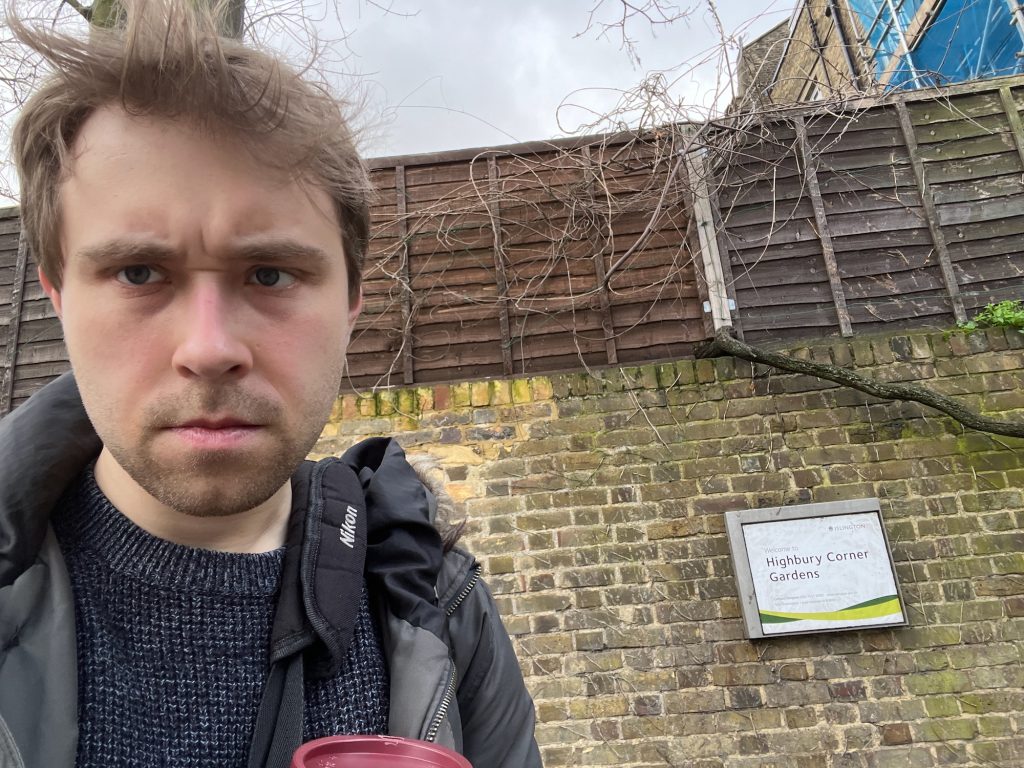
A selfie of the blog's author, now holding a Pret coffee cup. He is standing in front of a brown-brick wall, which is topped by a wooden fence. On the wall is a small sign, which is barely legible, but you can make out that it says "Islington" at the top-right", and "Welcome to Highbury Corner Gardens" below. There are branches growing up the wall and the fence. Behind the fence at the upper parts of some buildings and a tree.
I promise it does say both of those words.

I thought I’d better bank this one, but I really wasn’t satisfied with it. Partly this was because it was the weakest of the three cheats, but not entirely. The remaining reason becomes clear from a wider view of Highbury Corner Gardens:
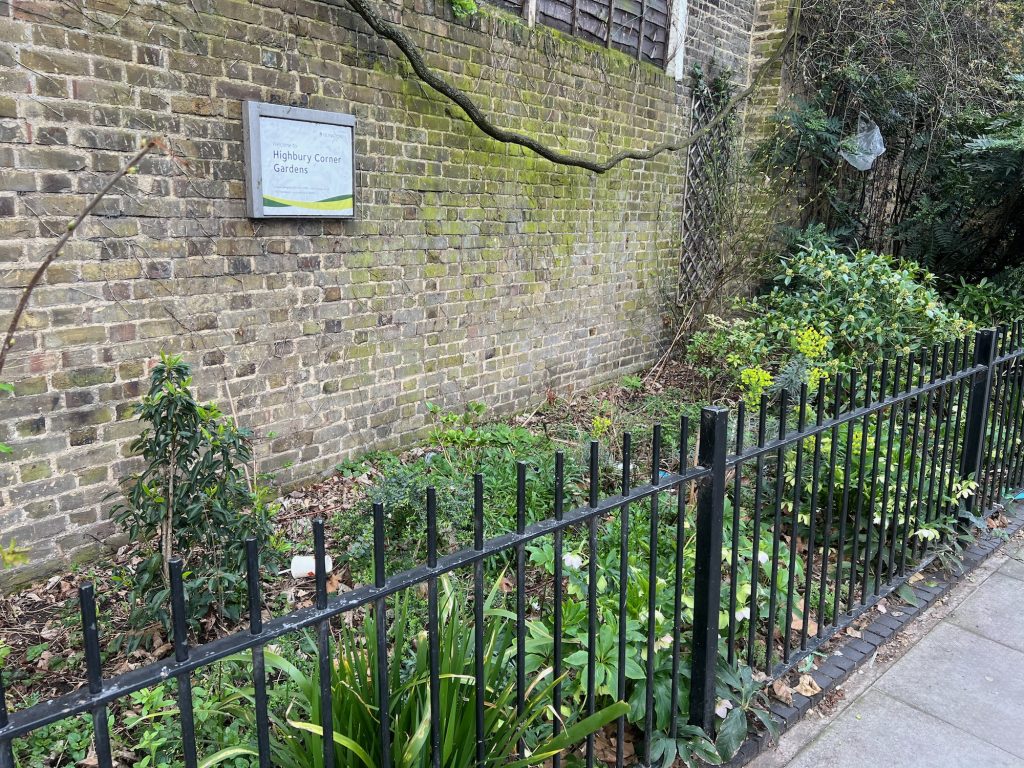
The wall from the previous image, showing the sign, now seen at an angle. A black fence, about a metre high, is almost parallel to the wall, being somewhat closer to it at the front than at the back. Between the two are a variety of uninspiring plants, with dead leaves covering the ground between them. A McDonald's cup, complete with straw, lies abandoned close to the sign, and a plastic bag is caught in a tree to the rear.
This isn’t selective photography; it really is a picture of (almost) the whole thing.

I think my next approach must have been to try the old Islington Town Hall, which took me along Upper Street for the third time.2 This building was, at least, interesting enough to photograph. Unfortunately, while it had several signs to tell me about its current and previous uses, none of them (in a very literal sense) was particularly welcoming.
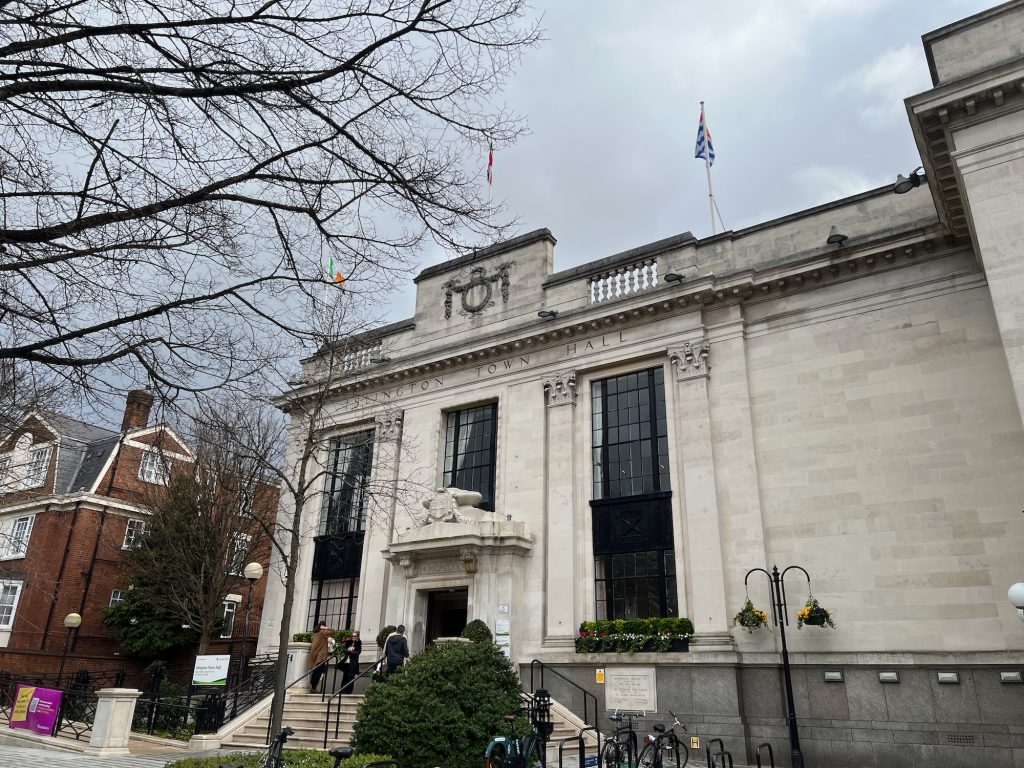
A two-storey Portland stone building. The building has an ornate portico above the front door, approached by a short flight of steps (the stonework up to near the bottom of the porch is, in fact, grey). Above the door are Roman numerals giving the date of construction as 1925. Atop the pediment over the doorway is an ornate coat of arms, carved in relief in stone. There is a large window to either side of the door, and there are three large windows on the upper floor: one is above the porch, and the others are joined by black-painted panels to the windows below. There are four shallow Corinthian columns carved into the stone to either side of the two columns of windows. The architrave above all of these has engraved text reading "Islington Town Hall". Above this is a colonnade, with a taller section above the door displaying a wreath. There are three flagpoles on the building, displaying (from left to right) the flags of Ireland, the United Kingdom, and Kiribati. The building continues to the right of the ornate frontage, but is a much plainer wall, that towards the edge of the image steps out towards the camera. There is a dedication plaque beneath the right-hand window. Several people are gathered on the top step in front of the porch. There is a sign identifying the building to the left of the steps. A three-storey red-brick building is next along the street to the left. The bare branches of a tree overhang the scene.
I’m pretty sure the flag on the right is that of Kiribati. I’m not sure why they were flying the flag of Kiribati.

I was now walking in the right direction to give up and go back into central London. Which I fully intended to do, until I realised that the walk would take far longer than I had thought, and the best thing to do would be to go to the nearest Tube station. This was still Highbury and Islington, and so it was with a growl of frustration3 that I turned around, to once more tread the pavement of Upper Street. And this time, freed from the hunt for a better sign, I started actually taking in my surroundings.

I found a few things (presented in reverse chronological order, for reasons that will become clear):

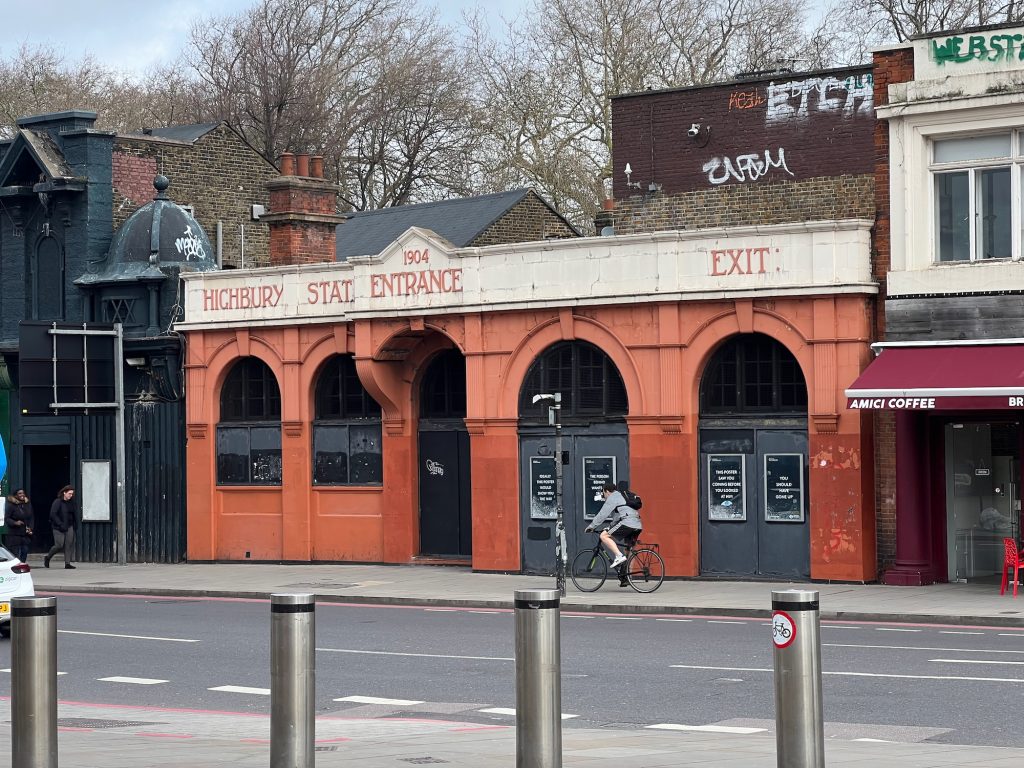
A low building whose frontage consists of five terracotta arches, above which is a white-painted architrave. The arches are rounded, with a prominent keystone; the two on the left are walled up to about a metre (with windows above), and the others contain doors, although these are firmly sealed. Above each of the three arches on the left is a word on the architrave: "Highbury", "Station", and "Entrance". (Above the word "Entrance" is the date 1904, within a triangular pointed part of the roofline.) Above the rightmost arch, again on the architrave, it says "Exit". The doors in the two right-hand arches have black posters displayed on them, with white writing. A variety of other, slightly taller, buildings, surround the station on three sides. The frontages faces a road, where someone cycles past the station on the pavement outside it. On the near side of the road are four metal bollards.
Would this be my blog if I didn’t show a picture of a disused Tube station?
  • Union Chapel, a rather beautiful Congregational church and music venue that was attended by two Prime Ministers.4
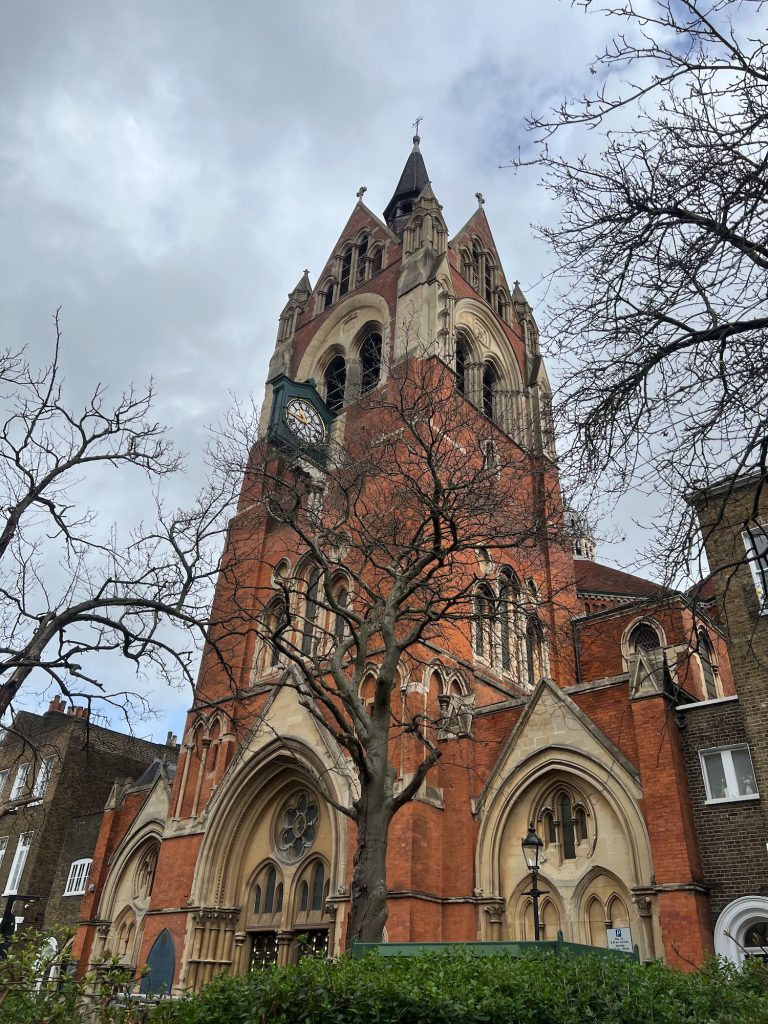
A Gothic church building, built of red brick and yellow stone. There are three recessed gothic arches, at ground floor level, with further arches recessed inside them and a pediment above each; these are about two storeys high. The rest of the fascia of the building is then dominated by a broad central tower. In the next section above the main frontage are some small windows; there is then a gothic arch on each face of the tower above that, each arch containing two arches windows. A triangular roofline tops each face of the tower, topped with a cross, and there is a spire with another cross on it behind those. There is a clock face below the big arch near the top of the tower on the front face; the clock is perpendicular to the wall of the tower. On either side of the building a houses built of brown brick. In the foreground are some trees without leaves, and a hedge. The sky is mostly grey.
I took two almost-identical pictures of this. When preparing this post, I spent far too long trying to decide which was better. I hope I made the right choice, but if I didn’t you’ll never know.
  • A non-negligibly-sized park, complete with its own welcome sign.
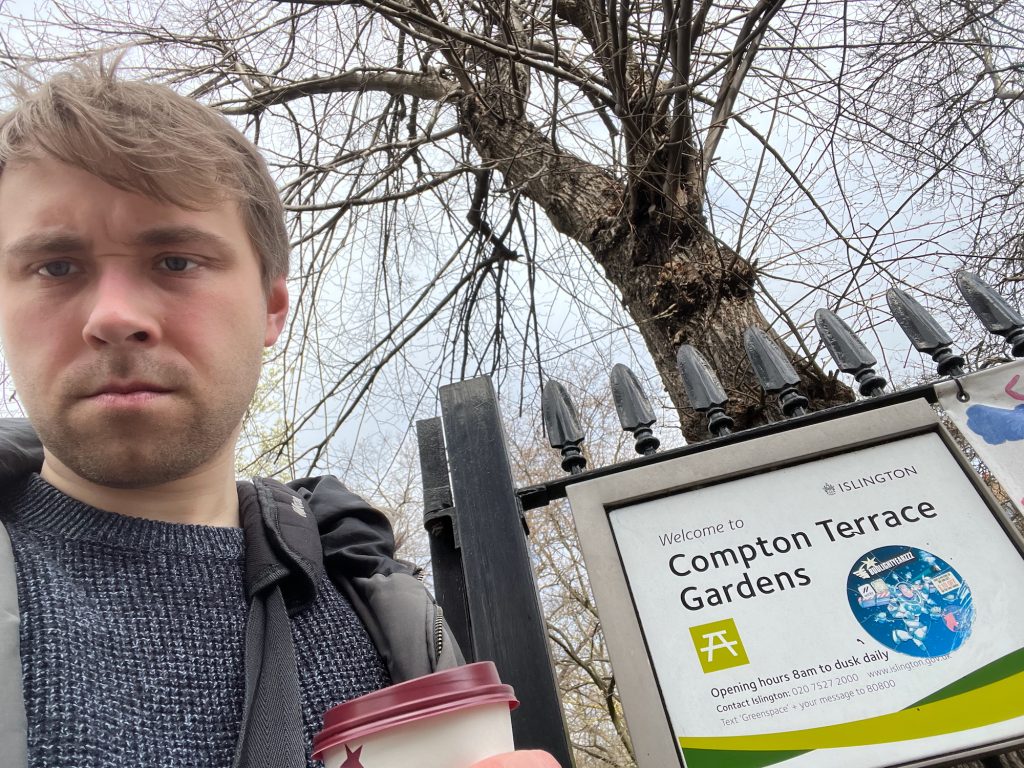
A selfie of the blog's author, still holding a coffee cup. He is standing next to a black-painted railing, to which is attached a sign, with a plain metal frame that is wide on the upper and left-hand edges and narrow on the other two. The rectangular sign inside the frame is white, with black text. At the top-right is says "Islington", to the right of a small outline drawing in black of the council's coat of arms. Slightly below that, to the left, it says "Welcome to COMPTON TERRACE GARDENS". Beneath this is an icon for a picnic table, shown in white on a lime-green square. Underneath, the sign reads "Opening hours 8am to dusk daily", and then gives contact details fo rthe council. There is a decorative lime-green "swoosh" across the bottom of the sign, with two other swooshes in darker green appearing to disappear behind it. Someone has attached a large, circular sticker with a picture of Buzz Lightyear on it to the sign. Behind the railing is a leafless tree, with a grey sky above.
In other details I didn’t spot until I was making this (like the Kiribati flag), there’s a sticker on this sign with a picture of Buzz Lightyear on it, that appears to offer you £10 off something. Sounds good, but it’s less and less useful when the prices go to infinity and beyond.

I was able to get much closer to this sign, so hopefully you can actually see it now. But it’s still, I think, the weakest of the three cheats, having neither the actual wording “Welcome to Islington” nor a mildly amusing justification behind it.

Or at least, I thought. Because, as I’ve written this post, I’ve decided that in fact it has both.

There’s a concept in film marketing called ‘diagonal billing’. This is sometimes used when there are two actors who both want to claim top billing, and the dispute can’t be settled in favour of one or the other. The idea is to place one of their names below and to the left of the other; this means that if you read top-to-bottom one of them appears first, but if you read left-to-right the other does.

If you read the first two lines of this sign top-to-bottom, as I think was intended, you are welcomed to the gardens. But if I were the agent of the words “Welcome to…”—and after ten blog posts and thousands of words about them, I’m going to claim that position for myself—I’d say that they deserve top billing. Read the sign left-to-right, and it says “Welcome to Islington”.

And with that, my quest was complete. After at least 30 welcomes—and arguably 33—it was now time for a singular goodbye.

London borough count: 33/33
London borough count without cheating: 30/30

If you missed any instalments of this series, you can find them all linked from the “tag” page. And if, for some reason, you want to see 33 pictures of me scowling in front of signs in London, I’ve collated them all into a single page for your delight.

  1. Nor, sadly, does anything once owned by his cousin, Mary Yuarnowentring. ↩︎
  2. I don’t remember this rationale, but I definitely went there, and it’s the only explanation I can think of for the route I took. ↩︎
  3. This is dramatic licence. I don’t remember what sound I made, if any, this being one of the pitfalls of writing from memory and a few photos about something that happened over two years ago. Imagine me yowling like a cat, if you prefer. ↩︎
  4. At least, according to a sign I took a photo of that doesn’t cite a source, and according to Wikipedia but with “[citation needed]” next to it. When I was looking this up, I found a blog post that seems authoritative so I suspect it’s true, although neither of the two men in question—H. H. Asquith and William Ewart Gladstone—was PM at the time of their attendance. ↩︎

One response to “Welcome to the London Borough of…, part X”

Privacy and cookies

By leaving a comment you acknowledge that you have read and agreed to the privacy policy. If you tick the box marked “Save my name, email, and website in this browser for the next time I comment”, a cookie will be saved in your browser so that this information can be saved; by ticking the box you consent to this necessary cookie.

Leave a Reply

Your email address will not be published. Required fields are marked *

This site uses Akismet to reduce spam. Learn how your comment data is processed.