The Fringe has now started, but it only officially started two days ago, so I don’t have much to say about it yet. Actually, it started today as I’m writing this, so I’ve seen a grand total of one show.1 There’s therefore time before the chaos begins to tell you about another board game I found in a charity shop. This one has aged surprisingly well, but also unsurprisingly badly.
Battle of the Sexes
Yeah, I mean, the title doesn’t give you much hope, does it?
Battle of the Sexes was released in 1986. I found it in a charity shop in Saltaire, just up the road from the one that sold me Octogo and Multiplay, and I almost didn’t buy it, because I was embarrassed to take it up to the till. Indeed, I felt the need to clarify very pointedly to the person behind the counter that I had a habit of buying bad board games to write about. I therefore reduced the risk that they’d judge me for buying this board game in particular, at the cost of increasing the risk that they’d judge me for my hobbies more generally.
This is one of those games with the same basic conceit as Family Fortunes or the bit of Play Your Cards Right that doesn’t involve playing (your) cards (right): they asked 100 people something, and you have to guess how they responded.2 In fact, Battle of the Sexes is something of a mix between the formats: in Family Fortunes you have to say the thing the most people said, while in PYCR you have to guess what percentage of people gave a certain answer to a binary question. In this, it’s always a true-or-false question, but you just have to say which answer was the more popular. The gameplay loses something for this; since there are three statements on each card, we ended up (because we weren’t following the actual board game rules anyway) playing it as a quiz where you had to rank the statements in the order of how many people agreed.
So what are these statements? Well, there are three packs of cards, of which two were the main event, so to speak. In one of these packs, every card starts with “Men think…”, and, in the other, every card starts with “Women think…”. (We’ll come on to the third pack later, but if you’re hoping it relates to what non-binary people think I’m afraid you’re going to be disappointed.) I assume at some point these two packs contained the same number of cards, but by the time it made it to me—despite the “Complete” sticker on the box—there were a lot more in the “Men think…” box.3 The statement was then an opinion men/women might stereotypically have, along the lines of “Women think… When ‘push’ comes to ‘shove’, a man will support his mother over his wife.”4
Some of these were a little hard to interpret, precisely because of the preamble: when it says “Men think… Men today still see domestic duties as a woman’s responsibility”, are we being asked if men think women should do all the housework, or if men think that’s what men think? I assume the latter, but in that case did the men in question understand that they were supposed to be commenting on the fellow members of their gender? If 60% of men agreed with that statement—which they did—does that mean that that percentage of men were sexist, or that that percentage thought that other men, in general, were sexist? In which case, what did they think?
The thing about that question, incidentally, is that it’s a bit of an outlier. You see, most of the questions in this game (for both men and women) boil down to “Do you believe in traditional gender roles?” And, in general, the answer of the majority seems to have been “No, actually”.5 Did women think that “A woman’s most instinctual need is to have children”, or that “The only way to truly get a man’s attention is to throw something at him”? In general, they didn’t (64% and 81% disagreed, respectively). Did men think that “There is room in the Football Association for a female referee”, or that “Working mothers are just as important role models for their sons as working fathers”? Yes, in fact (74% and 80% agreed, respectively). Generally speaking, the women’s questions are more interesting from today’s lens than the men’s: a decent chunk of them are about how they are treated by society, rather than about how they think they should be treated. But, even so, picking the more (for want of a better word) “enlightened” answer will see you right most of the time.6
Granted, it was sometimes narrow, but the game doesn’t have time for such nuances: if 51% of women thought that “Most women will sign a marriage contract, if faced with the prospect of losing the man if it is not signed”, then it’s “TRUE”, and who cares if the answer would have been the other way if two different people had picked up the phone?7 But, statistical niceties aside, this reveals that playing the game in 2026—as opposed to when it came out—is basically about our perceptions of the past. And anyone who’s expecting to play this and discover a past we can lazily point and laugh at—like me—is going to be disappointed.
Like I said, we didn’t try and play the actual game, but it looked like some sort of roll-and-move thing. We didn’t try and play partly because we weren’t interested, but also partly because the rules were not supplied. (That “Complete” sticker has a lot of explaining to do.) This also means I’m not really sure what you were supposed to do with the third pack of cards, which were labelled either “Countdown” or “Showdown”. Here’s an example of one of the latter: I genuinely don’t know what you’re supposed to do with this.
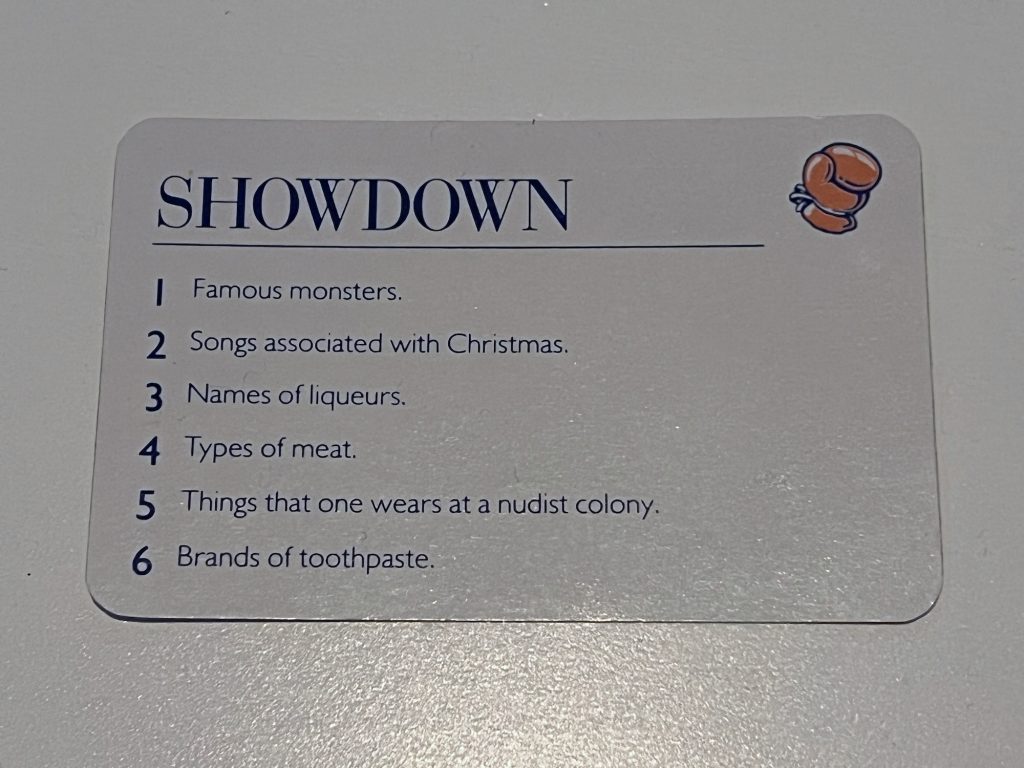
The obvious answer, given the survey theme, is that this is an even closer parallel to Family Fortunes. But that can’t be it, because nowhere does it say what answers were most popular. Perhaps the two teams—because of course you were supposed to split into male and female teams to play this—are supposed to compete to see who can list the most of them. So is this a gendered thing still? I get how “Famous monsters” might be seen as a masculine topic and “Brands of toothpaste” as a feminine one, but “Songs associated with Christmas” seems fairly gender-neutral to me. And “Things that one wears at a nudist colony” is just bizarre, given the obvious answer.
It’s easier to infer how you’re suppose to use the “Countdown” cards: they all ask you to “Name the famous [something]”, and then give you three clues that get easier as they go along. Well, in theory: here’s a “Name the famous couple” one:
A. Their son once got lost during a motor race.
B. Her father was a grocer.
C. She is nicknamed “The Iron Maiden”.
Did you get it? It is, of course, Margaret and Denis Thatcher… except that Mrs Thatcher’s nickname was “the Iron Lady”, so arguably that’s the hardest clue of them all because it’s not true.8 Anyway, the main conundrum here is why these cards have the name “Countdown”, because that’s already a game: one that’s somehow both simpler and more complex than this appears to be. The only clue I have to the true meaning is an icon used in the top-right corner of each card, this being a cartoon bomb. I don’t think it’s meant to be taken literally—but this game is “complete”, after all, so I can’t be sure.
In the spirit of this game, I thought the best way to sum it up would be with a survey of 100 people. Sadly, I don’t have the budget for that sort of thing, so I knocked a couple of zeroes off the sample size, and put this statement to them:
Men think… Everyone should have a copy of this game in their home.
My answer, which forms 100% of responses, is FALSE.
- It was called Depths of Wikipedia, and it was really fun. ↩︎
- For reasons that will become clear, I don’t have any details on which population was surveyed. Based on the questions that were asked, though, I’m guessing that the sample in this case was in the US. ↩︎
- Insert your own joke about “men having all the cards” here. ↩︎
- 61% of people disagreed with this, but I’m more intrigued by what those quotation marks are doing there. There are two grammatically correct options: that “push” and “shove” are euphemisms of some kind, upon which I’m not going to speculate further; or that we’re talking about the words “push” and “shove”, and this is some sort of absurdist follow-up to the “If I could rearrange the dictionary…” chat-up line. ↩︎
- Although it’s worth saying that, even if a majority of people weren’t awful, the minority who disagreed is still often concerningly high. This is particularly true for the questions asked to the men. ↩︎
- I don’t have anywhere to fit this in neatly, but I was intrigued that one of the statements was “Men think… There will be a black U.S. President before there will be a woman U.S. President.” In 2008, it became clear that two-thirds of respondents had been correct. ↩︎
- This is, incidentally, a genuine problem with the reporting of opinion polls. Returning to the topic of US Presidents from the previous footnote: in 2016, most nationwide opinion polls “got it wrong” by saying that Clinton would win the US election. In 2012, they “got it right” by predicting an Obama win. But if you look at the vote share they were predicting, they were actually slightly more wrong when they were “right”. ↩︎
- For anyone curious about “A”, and especially anyone picturing a child disappearing into the crowd at Silverstone (like I was), this refers to an incident in 1982 involving the then–28-year-old Mark Thatcher, who disappeared for three days in Algeria during the Paris–Dakar rally. ↩︎
Leave a Reply