
This week I’ve been going through my bibliography of sources about Octogo Games Limited.1 In the process, I tried to find my review of Counterstrike, one of the company’s three early abstract strategy games, and realised that I never wrote one—despite having owned it for months now. Here we go, then…
Counterstrike
Like Octogo and The Game, and unlike any connection with reality, the box for Counterstrike suggests this is some sort of sci-fi-themed game.2 Indeed, it’s probably the most sci-fi of the lot of them: while the other two vaguely suggest that their pieces are floating in the depths of space, the game we’re discussing today advertises itself with a much more specific futuristic setting. It represents the game board at the bottom as a Tron-like battlefield, except, instead of bikes zooming across, there are cylinders standing sentry on the squares, awaiting orders from their superior officers. The generals of this battle are the two wireframe hands that float over the battlefield, each glowing to match its units, and the two simultaneously firing out a colour-coded to vaporise one of its opponent’s footsoldiers.
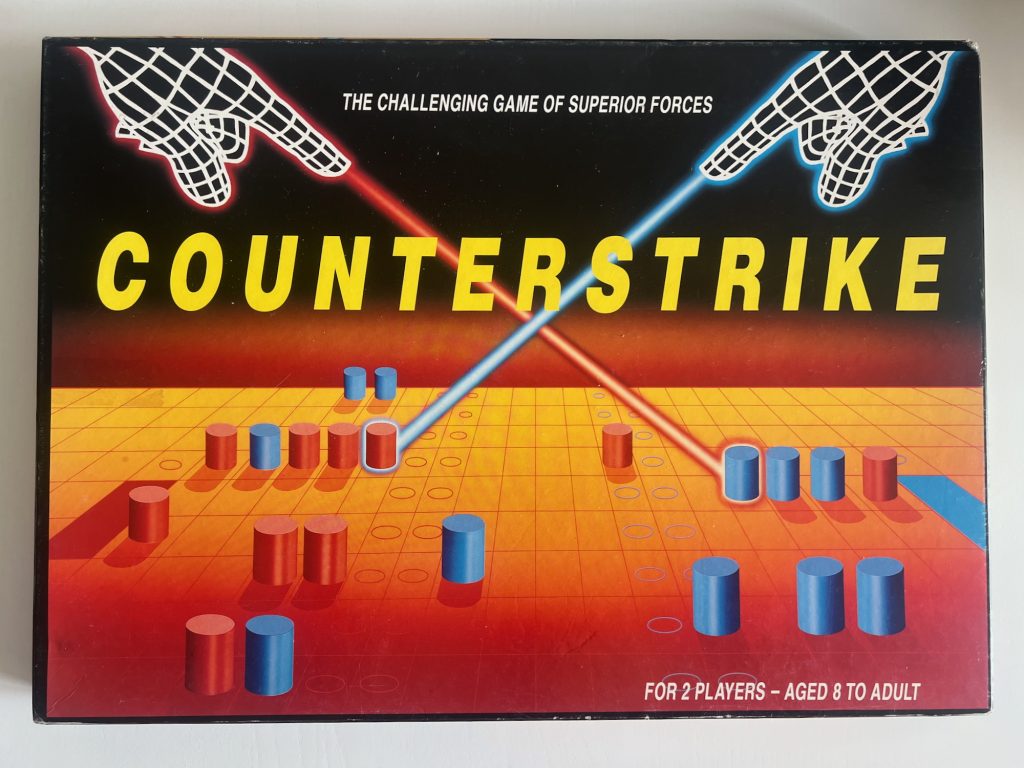
I don’t suppose you’ll be all that shocked when I tell you that this overstates the technological complexity of this game. For a start, while the box does contain little cylinders, they’re made of wood; this is charming, and from a modern perspective much preferable compared to the smorgasbord of plastic that was Octogo, but it hardly screams “This is from the future”. There’s no light-emitting component either, laser or otherwise. And, okay, let’s address the floating wireframe elephant in the sky. Clearly, this game is just played with your ordinary hands, and you don’t get to zap the pieces out of existence. Instead, you capture the pieces as normal by picking them up.
But only if you want to cheat.
Yeah, I was also surprised to learn, when I read the rules of this game,3 that not only do you not destroy your opponent’s pieces, you don’t even take them off the board.4 You get to push them around, but that’s it.
Let’s get into the mechanics. A move in this game consists of pushing one of your pieces one space in any of the eight conventional directions, like a king’s move in chess. Whether or not a move is legal depends on what’s already in the square that you’re pushing that piece into:
- If you’re pushing a piece into an empty square, it’s legal.
- If you’re pushing the piece directly into one of your opponent’s pieces, it’s not legal.
- If you’re pushing the piece into one of your own pieces, it potentially starts a chain reaction, shoving all the pieces along in a line. This succeeds if the last piece in the chain is being nudged into an empty space.
- If, instead, the line would be pushed into one of your opponent’s pieces, the chain reaction might be able to continue, shoving all their pieces along one space as well. This works if and only if your line of pieces being moved is longer than your opponent’s. Think of this as a sort of reverse tug of war,5 where the stronger force is able to push the weaker one along in its wake.
- Notwithstanding all of the above, you can’t cause any pieces to be pushed off the edge of the board.
I’m not sure I’ve explained that well. I am reasonably sure, though, that I’ve explained it better than the official rules. Those, see, have realised that pushing a whole line of identical pieces along is, in practice, a waste of effort—you can just move the one at the back of the line to the front. This means that any move only has to involve physically moving at most two pieces: one of yours, and potentially one of your opponent’s. Unfortunately, this makes this abstract strategy game even more abstract than it would otherwise be: since they don’t ever refer to it in terms of shoving lines of pieces, you’re left wondering why this battle involves the soldiers playing synchronised leapfrog.
The goal of the game is to occupy with your pieces the two squares representing your opponent’s base camp, holding both at the same time. Whoever does this first wins. Based on our play-through, this may take a while to achieve. I can’t help but feel that there’s a reason that designers generally find it more exciting, when making a game of this nature, to have pieces be captured. If nothing else, that feels more like you’re fighting a deadly battle, and less like you’re fighting the other kids in the school playground.
You may recall that when I wrote about Octogo I did a deep dive into the company. Some of those articles mention the other early output of the company, but references to Counterstrike are thin on the ground. Most of the mentions of it that I can find are in a set of competitions that appeared near-simultaneously in local newspapers throughout the country, offering it as a prize alongside four other Octogo games.6 (With so many of them having been given away as prizes, you can’t help but wonder how they ever made any money…) But then it does get mentioned in the Financial Times,7 so I guess that counts for a lot:
[…] strategy games were being outmanoeuvred in the market by faster-selling more light-hearted family games. […] As a result Counterstrike and The Game were consigned to the rubbish bin and a programme begun to develop other games.
Oh.
Honestly, that’s a shame: Counterstrike doesn’t deserve the rubbish bin.8 It’s actually quite a fun, and pleasantly simple, concept for a battle game, that I suspect someone with more patience than me could work out quite a deep strategy for. And it’s certainly novel. Octogo may have been “a cross between chess and draughts”,9 and The Game may have been “more exciting than backgammon”,10 but Counterstrike defies you to describe it using lazy comparisons like these. On that basis alone, it succeeds.
Financial Times, consider that my counterstrike.
- Don’t ask why I’ve been doing this… ↩︎
- After all, this was the eighties: the TV quiz show Blockbusters pulled a similar trick with its opening titles. ↩︎
- Which didn’t come with the copy I bought online. Thankfully someone who has a copy has uploaded them to BoardGameGeek. ↩︎
- I shouldn’t have been that surprised, because the back of the box says “you never lose any of your pieces.” ↩︎
- Or the game “Everest” on Gladiators. ↩︎
- As well as the ones already mentioned, there was a newspaper-themed game called Front Page Splash, and a playing-card-themed game called Tenacety [sic]. ↩︎
- I can’t easily link to this article because of paywalls, but it’s an article called “Puzzling out a game plan” by Nick Garnett, that appeared on 10th November 1990 on page VI. ↩︎
- The Game, on the other hand… ↩︎
- According to John North, writing in The Northern Echo. ↩︎
- According to its own box. ↩︎
Leave a Reply