
When is a board game review not a board game review? Well, when it’s a long digression on the subject of logic puzzles, for one. But also, I’d argue, when the game irritates the “reviewer” so much that they become consumed with frustration, such that their writing is less of an objective assessment and more of a rant. This can happen, for instance, when the game is so bad, so fundamentally broken, that it isn’t even “so bad it’s good”. Or, indeed, so bad it’s bad, but at least you had a good time making fun of the game itself. No, sometimes all you can do is regret having started to play, having looked forward to playing it, having bought it online—without even the saving grace that the money went to charity—in the first place.
This week’s game is called Newsdesk.
Newsdesk
I admit, I impulse-bought this one. I’d been looking online for a copy of another early Octogo Games game—one called Counterstrike, which has a box image of two CGI-like wireframe hands vaporising the pieces.1 My head was then turned by a “You may also be interested in…” advert for a game that promised “realistic telex messages” and “all the excitement of international reporting”.
How could I not?
Let’s start with the telex, which was, at least as a piece of engineering, the most enjoyable part of the game. It wasn’t that realistic, in that the keyboard was non-moving plastic,2 but it was satisfying to turn the tape and see messages “appear”. Really they were pre-printed on the tape,3 with new messages appearing as you turned the dials a bit like manually winding a cassette. At one point near the end of the spool the tape had torn under the stress, but wouldn’t you after fifty years?
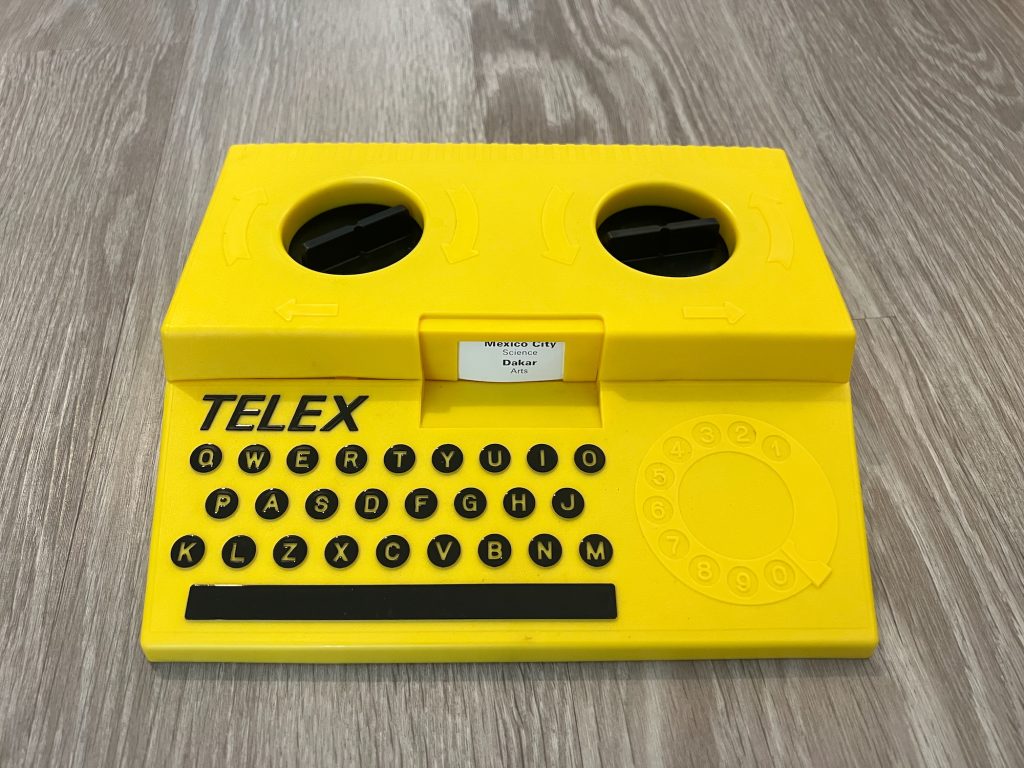
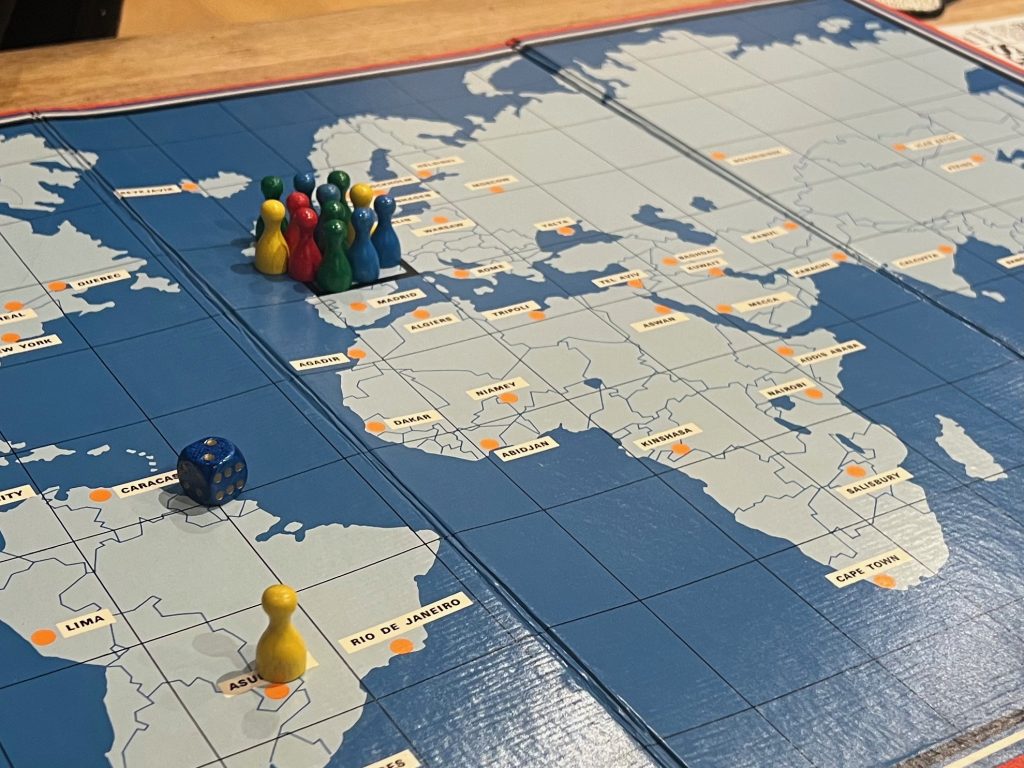
The tape contained places and subjects. The board, meanwhile, was a world map divided into a grid, and when you got the place you had to roll a d64 to try and move there. This was almost always possible with at least one of your pieces.5 You then had to draw a story from the deck of story cards, and hope it matched the subject that the telex had told you to “report on”.
This was where the game broke down completely. Normally I don’t go into game mechanics, because I’m worried it’ll be boring for non-nerds. I think I have to here, though, to explain just how bad this was. Please bear with me; I promise it’s worth it.
Most of the cards were stories. If you drew a card that was a story, but not one matching the telex, you had two choices:
- End your turn. If you did that, you had to leave the card on the table in a sort of “marketplace”. A future player who needed a story of that type could then choose one of the face-up ones instead of drawing at random.
- Draw again.
This doesn’t appear to be intended as a one-time thing; if you draw again, you get the same two choices.
There are the makings of a functional game mechanic here. For this to work, you need there to be some risk to drawing again. For instance, it could be that some of the cards mean that something bad happens—thematically, it could be that your reporter suffered an illness, let’s say, and had to abandon their “assignment” to go back home. And, indeed, that is exactly what some of the cards, called “Write-Off” cards, do.
The problem is that this isn’t sufficiently bad to be a deterrent. To see why, you need to know what happens if you get a matching card. Which is that you put that story on the front page of your newspaper—we’ll come to what that means, don’t worry—then send your reporter back home. So that happens whether you get the good thing or not.
I know what you’re thinking.6 There’s still a disadvantage to drawing too much, which is that you leave a large number of cards available for your opponents, making their lives easier. Even worse, you might draw the Write-Off card, and be forced to leave a load of cards for your opponents without even getting one yourself.
That might indeed salvage this mechanic, were it not for the fact that, when either of the above things happens, you wipe all the cards that you’ve drawn and put them to the bottom of the deck. This means that—unless I’m missing something—the only sensible game play option is to essentially sift through the deck until you get either the card you want, or the bad card. And then put that whole stack of cards on the bottom. This is not fun.7
The stories on the cards, arguably, are fun. They’re all made-up, and a little bit silly, even if some of them have a fixation on the macabre. I suppose I understand that for the “Crime” and “Disaster” categories, but even the others get in on it: one “News-in-Brief” card leads with “Two million teeth have been found in the house of a dentist who died recently”. They also fail to give any sort of flavour of international reporting, not when they involve things like a Mr Albert Thomson who’s come up three times on the Premium Bonds (under “Economics”, for some reason), or a story in “Local News” about little Jimmy Norris finding a tiger on his lawn. Perhaps I’m wrong, and these are some of the most common names in such places as Mexico City and Dakar.8
But then you place them on the newspapers, in little blank slots about the size of the cards. Each player gets one, which is a sheet of—plastic, I think? Or maybe laminated paper; it resembles the dust jacket of a hardback book, but shinier and a little more bendy. These are real British newspapers, which I assume—hope—gave permission for their front pages to be used in the game. They’ve covered the spectrum of newspapers admirably: there are two tabloids and two broadsheets, and in each pair one is left-leaning and one is right-leaning.9 Weirdly, the front pages seem to have been taken from an actual edition of each paper: I’ve checked them all, and they all line up pretty neatly, with only minor differences. I think the discrepancies are partly caused by the designers rearranging bits of the page to make room for the card spaces, and partly by the archive having a different print run of the same paper from the one on which the game copy was based.10 This is a strange tonal shift alongside the fake stories on the cards, especially when some of the stories—about a hostage situation, for instance—are on the darker side.11
Anyway, on their use in the game: these were not quite as big as actual sheets of newsprint, but they were quite unwieldy, so we initially dismissed them as fun but unnecessary theming and put them back in the box. Oh no—some of the telex messages were for one of the players, as identified by the newspaper.
Another thing I should mention is that the strip had various “start” and “end” points on it, and you could wind it either way within those limits (but with the d6 deciding how many steps you wound it). If you had a good enough memory, you could force it to land on a specific place, or specific message for a newspaper. But you couldn’t leave your section of the strip during the game. The newspapers were not, it seems, evenly distributed along the strip. So, in our game, you were at a serious disadvantage if you were playing as The Guardian, because they happened to appear more often in our “neighbourhood” of the tape, and the events were generally bad. Mostly involving sending people back home, which you might notice keeps coming up.
It really does:
I wonder if the game’s designers intended to only allow one re-draw from the pack upon taking a non-matching card. This would ameliorate some of the issues, and perhaps fix them altogether.12 There’s still not much skill in it, but I don’t think it would be fundamentally broken. Indeed, this got me wondering if we had just misread the rules. But I checked, and I don’t think so, because the rules say:
The player may now end his turn or continue to draw.
They say that, if you can’t find anything nice to say, say nothing at all. Unfortunately, I’ve committed myself to writing a blog post every week, and I don’t think I could get away with the John Cage approach of submitting a blank piece of paper.13 Still, let’s try and find something good to wrap this up.
Erm.
Yes.
I guess the little wooden pawns are nice?
Well, see you next week!
- I hope it isn’t a spoiler for my eventual review of that one that this is not particularly representative of gameplay. ↩︎
- Also, a bit weird. The keys were in the QWERTY order, but the breaks between rows were all in the wrong place so it had off vibes. ↩︎
- I don’t know why I felt the need to clarify this. ↩︎
- In dice notation, a standard six-sided die with the numbers 1 to 6 on it. ↩︎
- Which was for the best, because the rules specifically stated that if it was impossible to reach the place you couldn’t move at all. ↩︎
- You’re probably not thinking what I’m about to say, to be honest. It’s a linguistic device, just go with it. ↩︎
- Okay, in the interests of fairness, I should disclose that there is a third type of card in the deck. This is essentially a “superpower” card, which you can keep for one-time use later in the game to make it easier for you to get a story, or else to “nope” out someone else’s turn. You don’t have to take that card—you can keep drawing—so maybe there is some strategy in whether or not you choose to take it? But taking it still wipes all the cards you’ve drawn, so I don’t think it really solves the problem. ↩︎
- Another thing: why are we travelling the world collecting “Local News”? If it means local to our British paper, we’re in the wrong place. And if they mean local to the place we’re going—well, isn’t all news local to somewhere? ↩︎
- The Daily Mirror, the Daily Express, The Guardian and The Daily Telegraph, if you’re interested. And yes, it bothers me that some of those have the word “The” at the start of their mastheads and some don’t. ↩︎
- One thing I don’t fully understand is the picture story on the Express front page, as depicted in the game. The headline is “Sunshine flight for the couple who read all about it in the Daily Express”. Not recognising the people depicted, I assumed that these were the winners of a reader competition. The archive copy, with headline “Hello, young lovers… and it’s calypsos all the way”, reveals that the picture actually shows Princess Anne and her then-husband boarding a plane for their honeymoon. ↩︎
- Then again, the original newspapers weren’t immune to tonal shift: that hostage story was on the front page of The Guardian next to a piece about exporting offal to Spain, which includes the line “it is thought that Italy may son fall, and that even the chauvinistic French may at last succumb to British tripe”. ↩︎
- For example, it’s now clear why taking a second card is a gamble—you might still not get the card you want, and be forced to leave an additional card on the table for another player. ↩︎
- A more apt but less well-known comparison might be Dennis Upper’s 1974 paper in the Journal of Applied Behavior Analysis, called “The unsuccessful self-treatment of a case of ‘writer’s block’”. ↩︎
Leave a Reply