
Yeah, so normally I write these to try and persuade you to actually go to these places, but let’s face it, Milton Keynes has a reputation as a place not just where there’s nothing of interest but to be avoided at all costs. (See also: Bradford, although one day I’ll write a defence of there too.) Faced with this problem, I’ve decided I’m going to have to work a little harder to make you take an interest. And so, taking inspiration from BuzzFeed, I present my first foray into clickbait, with:
10 things you’ll only¹ find in Milton Keynes
Date of trip: Saturday 14th April 2018
Journey time: Approx 1h25 on the dreaded X5
Fare: £10 (student return)
1. V- and H-roads
Being a planned settlement, the planners built MK with a vast grid of dual carriageways partitioning the town into wobbly squares. These are given V and H numbers, reflecting whether they’re horizontal or vertical in the grid. The V-roads are all called something “Street” and the H-roads all something “Way”. I’m sure you find this as fascinating as I do. … No? Okay, best move on.
2. A Grade-II listed shopping centre
The grid squares all have names for the community contained therein, except that two of the central ones are one district, known, imaginatively, as “Central Milton Keynes”, or CMK, or just the city centre.² This is not a city centre in the conventional sense, in that the shops are almost entirely contained in two shopping centres. The older of these, now called “Centre:MK”, has actually quite an innovative design, with huge arcades (and a giant hall at one end), and with service roads all placed above the shops (accessible straight from one of the V-roads) so that delivery vehicles don’t get in the way of shoppers. It was considered such a good piece of architecture, in fact, that it was listed, although the owners weren’t happy about this.
3. Almost-but-not-quite progressive toilets
The accessible toilets in the Centre:MK have signs saying “Not every disability is visible”, which is encouraging. There are also signs that say “These toilets are checked by all gender team members throughout the day”, which acknowledgment of non-binary genders still feels rare outside Oxford. But then they still have men’s and women’s loos, so…



4. A road grid aligned with the sun
The main road through CMK is called Midsummer Boulevard, because on Midsummer’s Day the sun shines directly down it. Allegedly it was noticed that this was almost true during the planning stages, and the engineers were persuaded to shift the grid very slightly to make it exactly so. Unfortunately the effect is now diluted by the fact that they’ve built another (not listed) shopping centre across the street, so you can’t see all the way down it any more.
5. A shopping centre built to avoid a tree
When they built that other shopping centre (Midsummer Place, now called “intu Milton Keynes”), there was a protected oak tree (one of only two Great Oaks in MK), which they couldn’t remove—so they had to build around it, putting it in the middle of a courtyard. Unfortunately, it didn’t like living in a shopping centre: the drainage was poor, and it drowned. The courtyard is still there, now sadly bereft of its oak.
6. The first multiplex cinema in the UK
Next to intu is The Point, a pyramid-shaped building opened in 1985, which contained an Odeon cinema that was the UK’s first multiplex. The building is still there, but the cinema moved out to the suburbs in 2015, and The Point is now scheduled to be demolished. Campaigners tried to get that listed too, but it was described as a “large industrial shed unit” by Historic England—they’re not wrong, to be fair—and listing was refused.
7. A theme park in the city centre
In case I’ve given the impression that MK is a concrete jungle, it’s worth pointing out that the three grid squares to the east of Central Milton Keynes are all parkland: Campbell Park, Newlands and Willen Lake. The middle of these contains “Gulliver’s Land”, a theme park specifically for children, presumably named in reference to Lilliput. (I was going to claim that a children’s theme park was something you’d only find in MK, but I decided to fact check and it turns out the operators run two other “Gulliver’s” parks in Warrington and Derbyshire. That’ll teach me to shoot for accuracy.)



8. A balancing lake
Willen Lake is really cool, with pedalos shaped like dragons as well as the conventional partridges. I looked up why it was there, and it turns out it’s an artificially-built “balancing lake”, designed to control flooding, and apparently built without flooding any settlements. Around the lake are also a high ropes course and several children’s playgrounds.
9. Light Pyramid
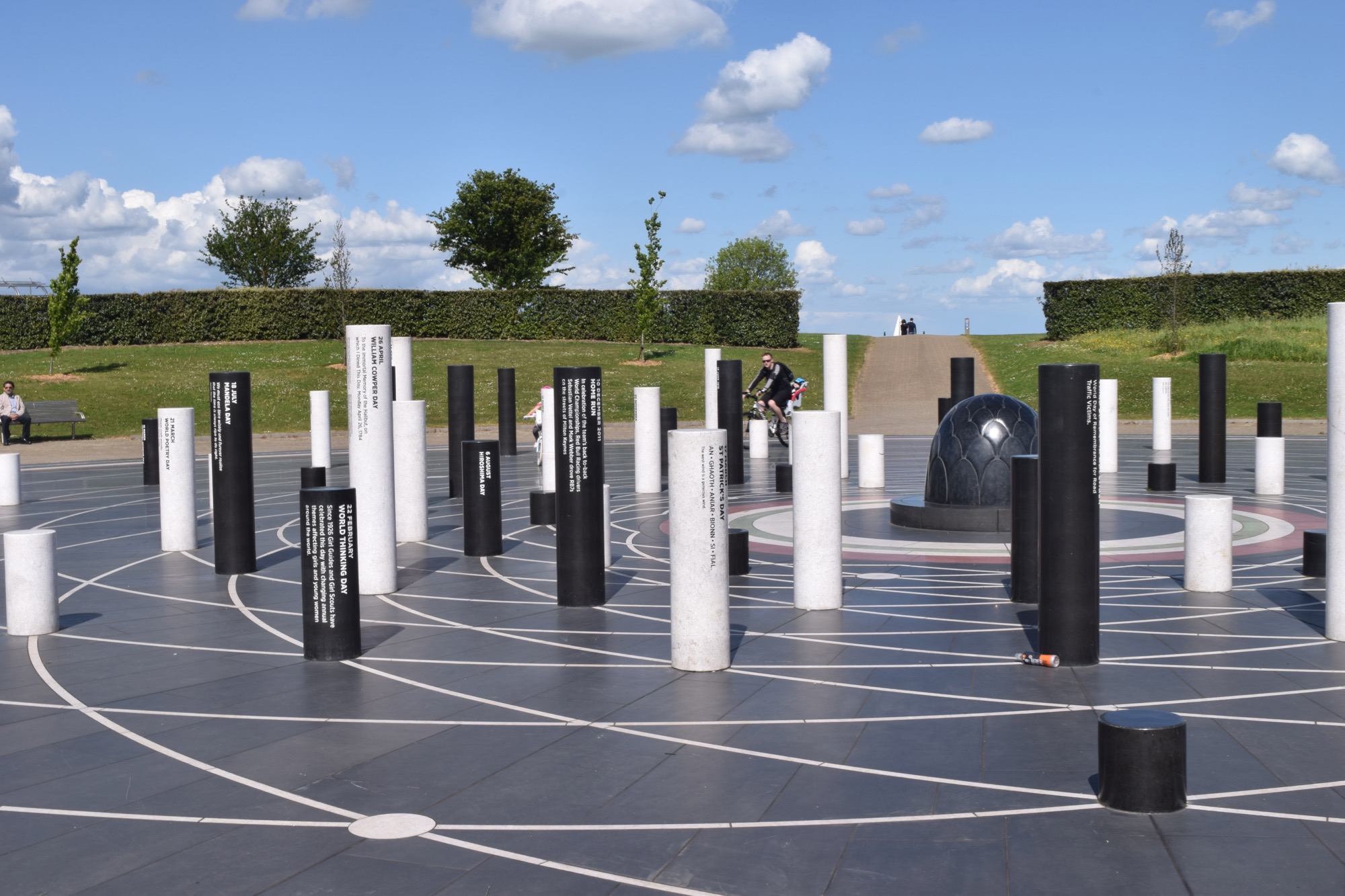
Okay, maybe it’s cheating to say that Milton Keynes is the only place you can find a specific sculpture that’s in Milton Keynes, but this still feels more legit than “What Ridiculously Posh Name Should You Give Your Baby?”. MK was developed from the start with huge amounts of public art, such as the MK Rose (which commemorates key dates in the town’s history) and The Frog Clock in the intu shopping centre. The one in the title of this is a huge pyramid on the top of an artificial hill in Campbell Park. The view’s pretty impressive. And you can run or roll at full pelt down the steep hill… or not, if you’re a sensible adult, which I definitely am.
10. The place where the Enigma code was cracked
Oh yeah, and Bletchley Park is also in MK, giving it a bona fide tourist attraction of national interest. But I still haven’t actually made it there, so far contenting myself with the listed shopping centres and the lake-filled parks. To be honest, if you’re planning to any part of MK, Bletchley is probably the place to go to. But when you’re done there why not hang around?
¹ I haven’t actually checked whether you can find some of these anywhere else, but then it wouldn’t be clickbait if I had.
² Milton Keynes is not actually a city, but the communities in the grid are known as “towns” so calling CMK the “town centre” would be confusing. MK, like Reading, is also bigger than Oxford, so calling it a town feels somewhat wrong.




Leave a Reply to The “story” of Oxford – Escaping Oxford Cancel reply