
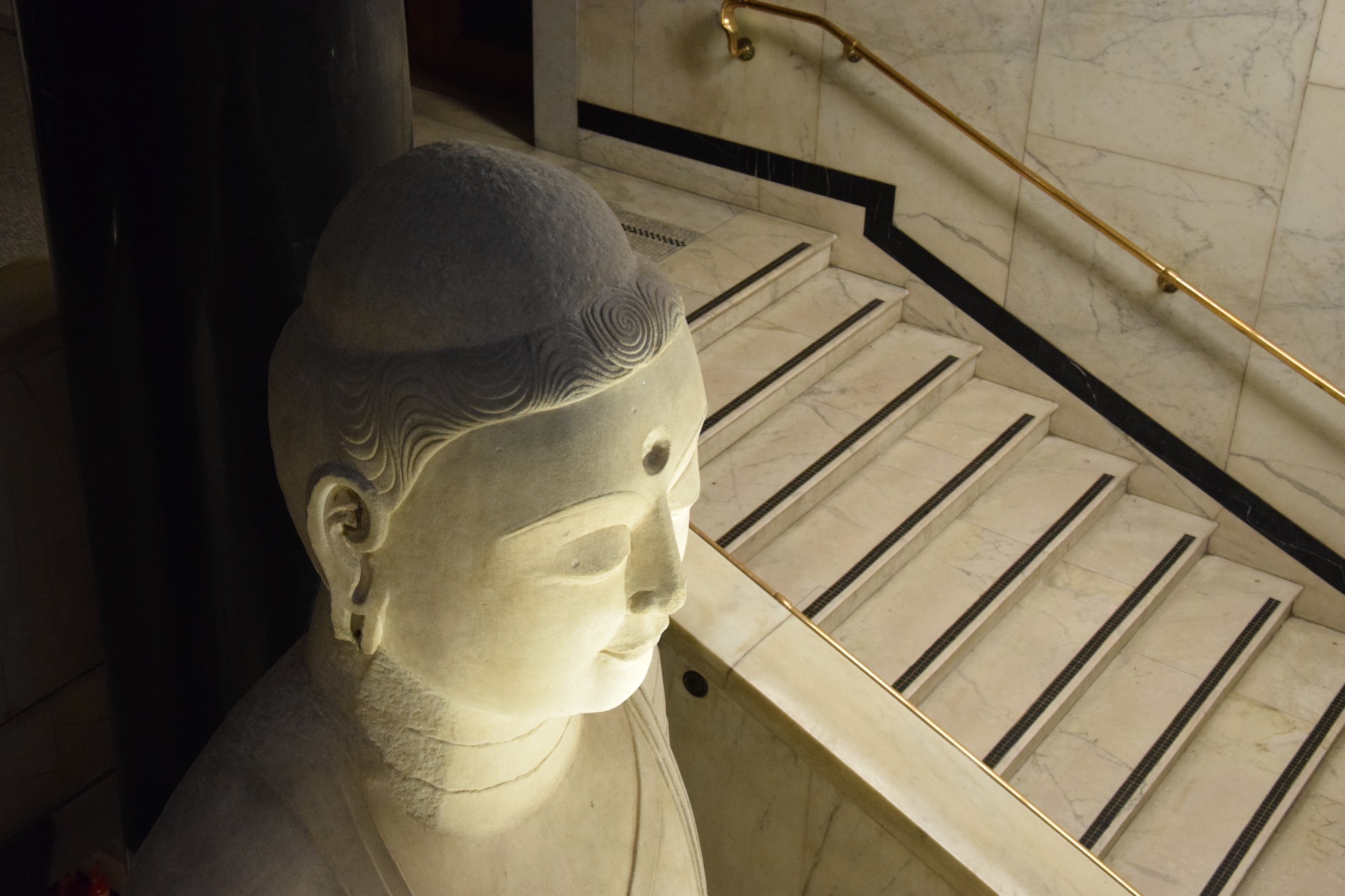
I have a theory. This, you might think, would be good news for my degree, but unfortunately for me (and possibly for you too) it relates rather more to this blog. You see, I’ve been to a lot of museums, some rather niche—although one of last week’s features, the Museum of English Rural Life, went viral the day after I blogged about it, so perhaps not as niche as I thought—and some rather less so. The ones that are less so (the Ashmolean, for instance) are often busy, with tour parties, school groups, and just individuals who somehow end up huddling in groups anyway. But often there’s a room or set of rooms (in the Ashmolean, the rooms on Level 3M) that are just enough tucked into a corner, hidden in the attic or stowed out of sight in the basement that the crowds stay away.
My theory is that the best way to experience a busy major museum is to identify which rooms those are, and seek them out. Sure, they might not be the ones with the world-famous exhibits, but they will let you learn about something unexpected in an atmosphere much more conducive to said learning. So I went to six of the big free museums in London, and tried to see how that theory worked out in practice.
Date of trip: Sunday 8th April 2018
Journey time: approx. 1hr10 (via the Chiltern line)
Fare: £20.55 (Off-Peak, with 16–25 Railcard, including Zones 1–6 Travelcard)
(The fare without the Travelcard costs £17.55, and the Oyster cap is at least £4.50, so this is worth doing—even if you don’t have a Railcard, because everything’s just scaled up by 50%.)
National Gallery
I immediately broke with my theory upon entering the country’s foremost collection of publicly-owned art, by making a beeline instead for the Van Gogh room. Which, of course, is fine—if you try and find the quietest room in all these museums, don’t look at anything else, and leave, that’s a bit of a waste of the time and effort you expended on getting there in the first place. (That is unless, say, you needed a topic for the next post on your blog about places to visit from your university town, called “Leaving Cambridge” or something.) But the crowds eventually took their toll, and I looked at the map for an obscure room.
The National Gallery only really has two floors, one where you enter and one with the galleries, so I initially wasn’t hopeful. But I noticed that there are some galleries on the lower floor, labelled with letters instead of numbers, and decided to give those a try. It worked. Down there is my new favourite room in the gallery, Gallery A, which attempts to demonstrate the breadth of the gallery’s collection by hanging paintings from across the centuries in one room, displayed roughly in chronological order from one side to the other. Given how broad the collection is, this then gives you an overview of the progression of European art from around 1300 to 1900, starting with mostly devotional paintings of scenes from the New Testament and progressing to more secular topics.
I’m not going to say much more, because this would reveal more of my lack of art knowledge than I’m prepared to reveal. But I can say that the room was pretty much deserted, and certainly didn’t deserve to be.


Tate Modern
Ah, well, yes, lack of art knowledge will be revealed quite strongly in this section, I suspect. Partly because I just don’t “get” a lot of the more conceptual stuff in here, I’d have preferred a visit to the Tate Britain up the river, to be honest. But I’ve also been there recently enough, and explored it thoroughly enough, to know that it doesn’t have any quiet bits, so for this blog post would be a wasted visit.
And, well, as it turns out, so was this, mostly. The Tate Modern is in two parts: the old power station building by the river with the Turbine Hall, and the taller, and infinitely more hideous, Blavatnik Building that rises up behind it. (Although the Blavatnik building does have a viewing gallery, which offers excellent views across London, and, somewhat controversially, into the fancy apartment complex next door.) The problem from this post’s perspective is that that makes it all rather too regular, and designed so that visitors will flow through all of the spaces. Sensible for them, a bit useless for me.
The best I can say is that the quieter rooms are in fact in the Blavatnik Building, where most visitors seem to attempt to cram into one of the lifts to mention the aforementioned viewing gallery, and pay less attention to the galleries on the floors in between. My favourite of those was the “Between Object and Architecture” room on Level 2, which contains, as the title suggests, artworks bridging the gap between artwork and built constructions. But I’m still not sure I got it.


British Museum
Next, to the labyrinthine British Museum, where I was sure I’d find somewhere quiet on the nine levels of galleries of stuff we took from the Empire. I’m pretty sure that a good bet would normally be the Japan galleries on Level 6, being the furthest away and only reachable up the staircase at the very back. Except what I would have discovered had I bought a paper map, rather than relying on the permanent ones around the building, is that those are closed until the autumn for a redisplay. Oops.
A few levels below on Level 2, the same tucked-away section of the building contained a gallery on Korea (Room 67), which was indeed relatively quiet (at the moment it has supplementary displays of artefacts from the Seoul Olympics in 1988, marking the PyeongChang Winter Games this year). But it wasn’t quite the hideaway I was looking for. I began to suspect the British Museum is so famous, and thus so well-visited, that it can’t have any quiet corners, especially when it’s actually not as big as you might think (it’s about a third of the size of the Louvre, and in fact smaller than the V&A).
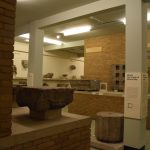
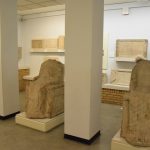
But eventually I found a note on the map that said “Down to Room 77”, and a room that doesn’t even get depicted on the map seemed promising. And it was: Room 77 displays Greek and Roman Architecture, while its neighbour Room 78 contains Classical Inscriptions, and both were empty. (In fact their pages on the museum website suggest they’re not even always open). They’re not exactly the most engagingly-displayed: lots of long panels of text beneath low lights and dated ceiling tiles, even if the panels do tell you a lot about what the Romans put on their tombstones. But it’s worth dropping in if the rooms are open, if only for the chance to stand next to the top of a huge Ionic column, and appreciate its scale with nobody around to disturb you.

To be continued…
Leave a Reply to London Transport Museum and related wanderings – Escaping Oxford Cancel reply