
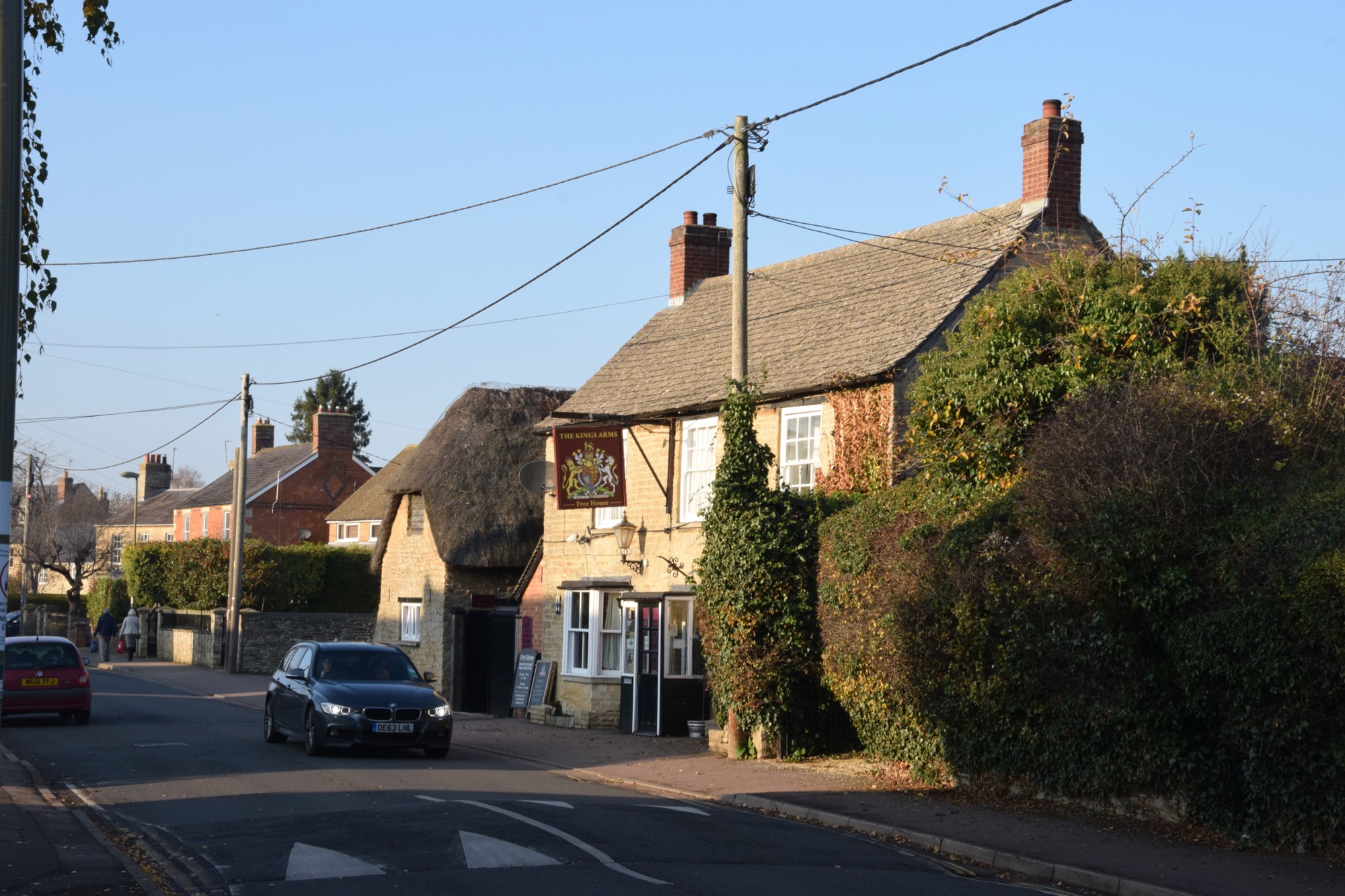
If you know anything about Kidlington, it might not strike you as the sort of place tourists take a trip to. After all, it feels like just another suburb of Oxford—at the end of the number 2 bus, just as Blackbird Leys is on the numbers 1 and 5, Rose Hill on the 3, and Barton and Risinghurst on the 8/9.¹ But you’d be wrong.
Date of trip: Saturday 17th November 2018
Journey time: 20–30 mins, depending on which bus you get from Magdalen Street (the 2A is quicker than the 2; the 2B, 2C and 2D also go there)
Fare: £3.70 (return)
Kidlington actually made the news a couple of years ago, when it turned out that tour buses from China kept turning up in a cul-de-sac in the village (England’s largest, if you believe the hype) and taking photographs of what, to the untrained eye, were ordinary semi-detached houses. But to those in the know, these were actually… still ordinary semi-detached houses.
You see, after the language barrier was overcome (when residents gave one tour party a Chinese-language questionnaire, provided by the BBC, to fill out), it turned out that they were visiting because, in the crowded cities from which many of the tourists hailed, this type of housing is rare—and so the village was being marketed as a chance to see how the English live. As someone who would be fascinated by seeing dense clusters of tower blocks in Shanghai or Beijing, in a way the local residents would probably find a little strange, I completely relate.



If you’re wondering why Kidlington was chosen as representative of England—well, it helps that it’s on the way between two better-known tourist destinations: namely, Oxford and Bicester Village. So maybe there is nothing special about Kidlington after all. Well, the only way to find out is to go, right?²
The buses take you, via interminable/fascinating housing estates, to the town centre. (Not that it’s a town, apparently, but I’m not sure why. The dividing line between a village and a town is traditionally that the latter has a market—and when we arrived in “town” there was a market on. So I’m lost.) And, er, yeah, it’s not particularly remarkable. There’s a large Co-op, a small Tesco, and, of course, a Costa. There’s a butcher’s shop that does hot baguettes. There’s a shopping centre with the sorts of independent shops you’d find really useful for avoiding the chains if you lived there, but not the sort of thing you’d travel to.
My surprisingly-willing travel companion, in fact, said it had the feel of a northern town. And he was right—it had an uncanny resemblance to my own home town of Shipley, right down to the presence of one of the only branches of Greggs anywhere near Oxford. (God, I miss their sausage rolls when I’m down south.) In fact, just put in a 1960s clock tower and I could have been home.
Done (fairly quickly) with the town village, we wandered out to the east, hoping to find something. Anything. Eventually the houses got older, and thatched-roofier, and we saw a signpost for the church, which was probably, we thought, a good sign of something of historical interest. It was indeed, as the church dated from c.1220. I’m not going to quote you the entirety of the little yellow guide pamphlet to St Mary’s Church, but it’s worth picking up if you visit. A few fun facts:
- The choir (front bit) of the church is slightly off-centre from the nave (back bit). This represents the tilted head of Jesus on the cross.
- A “piscina” is a basin where the communion vessels (cups) can be washed. Unfortunately the pamphlet doesn’t actually tell you this—it just uses the word and hopes you know what it means.
- The wooden rail in front of some of the pews in the choir contains two puns on the word “Kidlington”. I always appreciate a pun, so this is now one of my top ten favourite churches.³
And then we got the bus back, which took us via a charming little corner of the village featuring more thatched roofs.
So worth a trip? Well… For anyone who doesn’t live in Oxford, no. There’s not actually very much to see there, and I feel like the supposed hordes of tourists would be better just looking at the semis that I presume there are in Bicester. Even if you live in Oxford, there are probably better places nearby to visit—for instance, there’s probably more to see at Iffley than at Kidlington (and the church is more historic). That said, if you live to the north of Oxford, and are from the north of England, I have one word for you.
Greggs.





¹ Not to be confused with the 1/9, which climbed a dotted line to my place.
² Yes, I have heard of Google Street View. Shush.
³ A 2019 calendar featuring all of the top ten, plus bonus photos of the Museum of English Rural Life and the Horlicks factory in Slough to round off the year, is available now from the Escaping Oxford online store, priced at £23.19 plus P&P. A perfect Christmas present for all the family!
Leave a Reply to Oxford: around the ring road – Escaping Oxford Cancel reply