

The big, scary day is approaching, and you’re scared. There have been a lot of stories in the newspapers, about food running out in supermarkets, medicines being unavailable, and the NHS collapsing under the strain. Some people have even expressed fears about an accidental war being triggered by the chaos, but you’re trying not to think about that. To try and reassure you, the Government has issued communications saying everything will be okay, and that Britain will be prepared at the moment of reckoning. You’d like to trust them, but you’re not sure.
When is the big, scary day? If you’re thinking 31st October 2019, at 11pm, that would be a fair guess. But no: I’m talking about a date and time almost twenty years before: 1st January 2000, at the stroke of midnight, as the spectre of the Millennium Bug approaches.
If you’ve not heard of the Millennium Bug, a quick explanation. Computers used to sometimes store years as two-digit numbers to save space. To convert into a real year, they’d either add 1900 or just put the digits “19” before the number. For machines made in the seventies which were expected to be obsolete before the century was out, this wasn’t considered a problem. But some of those machines were still in use, and maybe controlling vital systems. The trouble is, if they only stored the last two digits of the year, then ’99 would roll around into ’00 – fine, except the computer thinks that’s 1900, and that it’s gone a century back in time. So a program set to start on 1st January 1999 and run for a year, say, would get to a year later and think it had been running for -99 years. At which point it would probably freak out, and crash.
What made me think about this? The answer is this 24-page booklet, found lurking around my old family home:
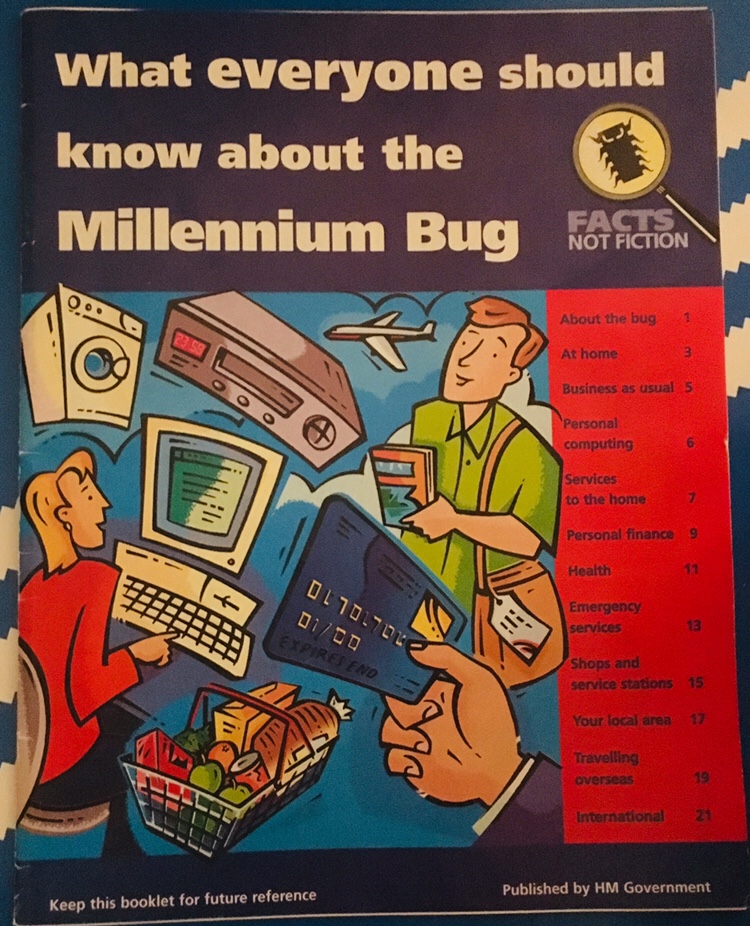
It starts with a slightly more involved explanation of the bug than the one I just gave (“It’s not a virus and you certainly can’t catch it”). In fact, it even debunks the poetic licence I used a few paragraphs ago.
FICTION: “The Millennium Bug will strike as the clocks chime midnight on New Year’s Eve.”
FACT: The Millennium Bug could have an effect any time a computer or an electronic system uses a date after 31st December 1999.
After the intro, it’s a strange mix of things. Most of it is just enumerating various aspects of life, and explaining that, no, they probably won’t be affected by the Millennium Bug. Your car will still run, it says. Your overdraft will remain intact, it apologises.¹ Your travel plans might be slightly affected, but you’ll be okay if you pack “a good book”, it counsels.²
Other bits of advice are for dealing with the long bank holiday: Friday 31st December 1999 was declared a Bank Holiday in addition to the regularly scheduled holiday on Monday 3rd January 2000 (because Bank Holidays can’t be on weekends). But this means the suggestions are nothing to do with the Millennium Bug at all. In fact, some of the advice isn’t even related to the Millennium:
FICTION: “You should always dial 999 when you want to contact the police.”
FACT: […] Only call 999 when there is a direct threat to property or life
I mostly love this booklet, though, because it’s so very of its time. If you use DOS, it says, you should type “DATE [space] 01-01-2000 [Enter] at the C:> [space] prompt” to fix the problem, and you should make sure you copy your files to floppy disk if you use your PC for spreadsheets. You can order more copies of the booklet by cutting out and sending the provided form to the Freepost address. And, of course, you can find out more by visiting ITV Teletext page 348.
But what about that Brexit parallel I drew at the beginning? Well, I don’t know. The optimistic part of me says that we can draw hope from this. After all, here was a time when the government reassurances were right – if you’re too young to remember the start of the new millennium (and I pretty much am to remember it in any detail), you don’t hear about the time everyone ran out of food and antibiotics because it didn’t happen, and nor did the predictions that planes would fall out of the sky because their systems wouldn’t be able to cope with the change. (There were fears of a second potential wave of problems at the end of February, because 2000 was a leap year whereas 1900 wasn’t, but again they proved mostly baseless.) Much like today’s government, in fact, the government of the day put repeated reassurances into their booklet that business would be prepared.
BEATING THE BUG
Employees of a large British company would have been locked out of the office after the New Year holiday. Their key cards, used to gain entry, couldn’t be programmed to work after 31st December 1999. Fortunately this was discovered during a routine Millennium Bug check and the system was replaced.
So, we’re going to be fine come Hallowe’en this year, right? Well, the pessimist in me says that’s overly optimistic.³ And I think the key sentence is this one:
The National Health Service (NHS) has been tackling the Millennium Bug since 1996.
I mean, firstly, bless them for explaining what “NHS” means. Seventeen years later, it would help people to understand what was written on the side of a big red bus.
Joking aside, they’d been preparing for three years for this. People haven’t been preparing for three years for a no-deal Brexit, because for the first two years after the referendum we were going to leave with a good deal. Assuming we do leave at the end of the current Article 50 extension period, is the period since Johnson took over as PM, even with “supercharged” preparations, enough time? One wonders if not. And, what’s more, No-Deal Brexit is a political decision, not a technological problem. A risk of food shortages caused by an active policy choice is not the same as a risk of food shortages caused by not abandoning all use of computers.
But enough doom-and-gloom, since it’s a matter of months before I’ll be able to look back on this idle speculation and know what happened. Instead, I’ll return to something I mentioned in the first paragraph, perhaps the biggest giveaway that I wasn’t talking about Brexit: were people really worried about the prospect of war caused by a computer bug? Apparently, yes:
FICTION: “The Millennium Bug could cause nuclear missiles to be accidentally fired.”
Well, yikes. The “FACT”, of course, points out that “The MoD is confident that there is no risk of a nuclear weapons incident”, which is somehow less reassuring than I think they intended. But at least nobody’s predicting possible nuclear warfare as a result of a No-Deal, as far as I’m aware. If they are, though, please don’t leave a comment to tell me. I’d rather not know.
Yes, this has been a long hiatus, and it’s still going. I haven’t even managed to keep up filler posts, and it’s likely to remain this way for a while, given that I have another, much longer-form, writing project that’s keeping me busy at the moment, and about which I will – on here, at least – maintain an enigmatic silence. I will make this promise: that before any point at which I permanently abandon this blog, I will make such abandonment clear, and try to post a final round-up of places you can visit that I haven’t managed to cover, so I can leave this blog as a (hopefully) useful reference. In the meantime, I’ll try to be slightly more frequent in posting whatever random thoughts come into my head.
¹ Yes, it says that. This is an official HM Government publication.
² It says that too. Sometimes this feels less like advice from the Government and more like advice from your mum.
³ Shocking, I know.
Leave a Reply to Act III – Escaping Oxford Cancel reply