
Bridge is a game that vaguely fascinates me. I would have first encountered it in one of two places, the first possibility being on the puzzle page of newspapers—right after the chess column. The second possibility was Teletext, where it also had its own page in the same section as the popular quiz Bamboozle!—again, right after the chess column. Either way, and for both chess and bridge, I was simultaneously intrigued and unable to see the appeal: why would you want to read about a game someone else has played?
But at least I knew how to play chess, even if I was very bad at it,1 so I sort of knew what was going on. For bridge, I had nothing. I could tell it was a card game, from the little suit symbols in the diagram at the top, but I had no idea why there were compass points, or bidding, or what any of the analysis meant. It seemed impenetrable—there was a baseline level of knowledge assumed that nobody had ever offered me.
If only I’d had today’s game.
Autobridge
I’m not sure the box for this “game” does it justice. On the side it says “YOU PLAY ALONE”, which seems more like a joyless directive than a selling point. It also very proudly proclaims that there are “NO CARDS USED”—maybe I’m wrong, but this doesn’t seem much like a thing you’d look for in a product relating to a card game, either. But the contraption on the box looks very technologically advanced for something that, bearing the graphic design in mind, seems to be from the 1960s. Unfortunately, based on a copyright date inside, it is from no earlier than 1985, when actual home computers very much existed and (presumably) could play rudimentary bridge with you, but we’ll give it a pass on that.
Autobridge identifies itself to the prospective purchaser as a “game”, but the back of the box makes it much clearer what’s going on:
Autobridge® teaches you how to play and how to play well. It approves the correct bids and correct cards, and rectifies the wrong moves, requiring the player to think again.
Really, this is a teaching aid, more than it is a game in itself. It consists of a 128-page instruction book, a plastic “machine”, and a series of “printed hands” on slips of paper.2 The machine opens up to take one of the hands, and when closed again parts of the hand show through little windows on the front, with each window having a slider to change exactly what is revealed. Each slider can be position to show either the rank and suit of a card, or a number from 1 to 13; as initially set up, your cards (as the “South” player) are visible, but for the players at the other compass points you can only see the numbers. There are also some other larger windows, which are completely closed at the start, and one telling you the situation of the wider game at the start of the hand which doesn’t have a slider.
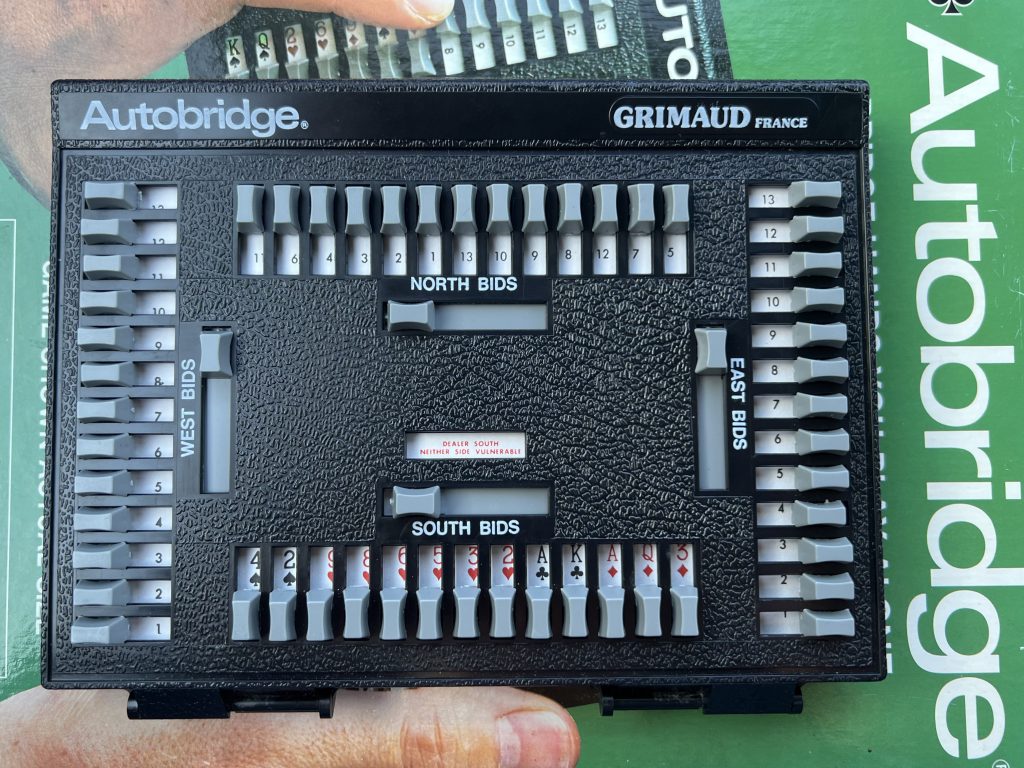
You “play” by progressively revealing information that corresponds to what you as the player would know in the game. So you start by gradually moving the sliders across the larger windows, to reflect the bidding. (In bridge, it turns out, you start by bidding on how my tricks you think you and your partner, sitting across the table, can win—but more on how I know that later.) When it’s time to slide your slider, you guess what your bid should be, and then reveal the next bid to see if you were right. As you might imagine for a printed sheet of paper, you can’t play out what happens with your incorrect bid: the correct one stands, and play goes on.
Let’s say (as for the first hand) your side wins the bidding and it’s you to lead. You start by uncovering the card numbered 1 for “West”. Then you reveal your partner’s entire hand, because in a real game of bridge they would become the “dummy”: they would reveal their hand to all players and take no further part in the game, and you would play their hand as well as your own. You can now proceed to play the actual game.
You might have guessed how this works, but if not: on your first turn (or the dummy turn), you pick the card you want to play, revealing the number. If it’s a 1: congratulations, you picked right! Play continues. If not, bad luck: hide your shame by once more revealing the card, and make your second attempt.
When the hand is over, you determine who won. That player gets to go first in the next hand, meaning that you either (for your opponents) reveal the card next to the 2 or (for your side) guess which card is next to a 2. And so on, all the way through the 13 cards for each player. Then you can look in the accompanying booklet for a commentary on the hand you’ve just played.
I’ll be honest, this was less “auto-” than I had been expecting.3 For example, when I tried playing through hand 1, I realised on reading the commentary that I’d forgotten about the “trick winner goes next” rule—specifically, that if I had won with the dummy hand, I would need to lead with the dummy hand rather than my own. A mistake like this will right itself: given any four cards, the same one wins the trick irrespective of the order in which they were played. But it does confuse the element of learning strategy, because given a different order of play those may not have been the right cards to play.
If I want to pull this apart, I can do. For instance, although you hide your partner’s cards during the bidding, you can still see the numbers, meaning that you have to make sure you don’t pay too much attention to them if you don’t want to spoil the dummy hand. There would be a similar problem when your opponents win the bidding: in that case, you’re not supposed to know the contents of your partner’s hand, but, as the cards are arranged in suit order, you would have a clue as to which suit was coming next by the order of the numbers.4 But this doesn’t seem to be an actual problem, because as far as I can tell every card is set up so that your side wins the bidding.5 Does this matter? And is there really, as the game implies, only one right card to play at each juncture, or could I have made an equally good play? I’m not sure. To know that I’d need to know how to play bridge, and if I knew how to play bridge we wouldn’t be here.
The first time I played with this I followed the little quick-start slip, and played with the slip that had been in the machine when it found its way to me. I found it fairly dull. But, to write this, I decided to read the introduction to the 128-page book before starting, and to start with hand 1. And I almost—almost, mind—started to take an interest in learning to play this game. The rules explanation goes up to page 54 of the 128 pages, which, even in a little A6-format booklet, is pretty comprehensive. And it’s got a lively, and fairly quirky, writing style:
While the cards are being dealt, the other players refrain from touching them, as a matter of politeness. Each game has its own little code of courtesy, and most bridge players are very polite creatures!
And, who knows? Maybe the previous owner of this went through the whole course, playing all 48 provided hands. Maybe they went on to buy the Advanced edition of Autobridge, as advertised towards the end of the booklet, and bridge became a lifelong hobby, such that they felt compelled to pass on the joy of the game by giving away the training aid that had first introduced them to it.
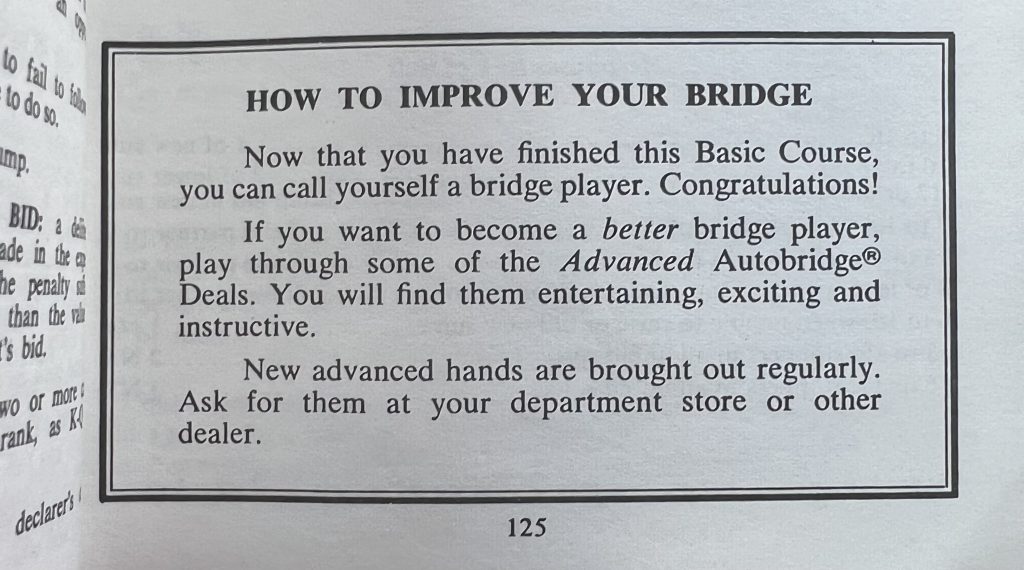
Well, we can’t be sure about most of that, but I can say they didn’t go through the whole course. I noticed in the course of writing this up for the blog that the 48 hands came in a tear-off pad, like a page-a-day calendar. And so I can say with certainty that hands 9 and onwards have never been played, because they remain attached together.
Perhaps I’ll stick to hearts.
- I still am. ↩︎
- They have to be careful not to refer to these as “cards”, since “NO CARDS [are] USED”. To be fair, this is accurate, as they are quite flimsy sheets, that are challenging to fit into the machine so that they line up properly. ↩︎
- I know, they probably didn’t mean it as “automatic”, but as “self”. Remember, YOU PLAY ALONE. ↩︎
- A fairly trivial fix to this would be to put your partner’s card in numerical order in this case—it would give away that you don’t win the bidding, but that seems like less of a spoiler. ↩︎
- Specifically, you lead, not your partner—the lead is always with the team that wins the bidding, but not necessarily the player. But that makes sense, because if your partner was leading then you would take no further part in the hand, which is pretty useless as a teaching aid. ↩︎
Leave a Reply