Yeah, so the next few weeks’ posts are not viable day trips from Oxford, sorry. But, as you might hope from someone who writes a blog about getting out of Oxford, I’m spending a considerable amount of the summer getting out of Oxford, except for longer. So if I didn’t write about places like this I’d run out of posts to write, and wouldn’t that be a shame? In any case, I hope you don’t mind this excursion from the Home Counties to my home county.
Date of trip: Friday 6th July 2018
Journey time (from Leeds): approx. 35 minutes to Halifax, 50 minutes to Hebden Bridge
Fare (from Leeds): £6.55 (Anytime Day Return, with 16–25 Railcard)
I wanted to keep the format the same, so I’ve picked Leeds as a nominal starting point for the journeys described, because it’s essentially the transport hub of West Yorkshire; it’s also the largest city, so on the off chance you should find yourself in a position to visit any of these places, you’re more like to be there than anywhere else.
Today’s post is about three places I visited while showing a friend of mine—indeed, the friend who suggested I write this blog in the first place—around West Yorkshire. I don’t know if you have any preconceptions of West Yorkshire, but if you do they’re probably of the “dark satanic mills” variety. And that’s not entirely wrong (cough Bradford cough). But I was hoping to demonstrate that there’s a fair bit of green and pleasant land too.
Hebden Bridge
And let’s start here. Hebden Bridge is a town in Calderdale, which is easily the most rural of West Yorkshire’s five districts. This is largely because the Calder’s dale is very steep, and so heavy urbanisation didn’t quite spread here. But more of that later. Hebden’s main claim to fame is as an LGBTQ-friendly town, as it has been for decades. (Indeed, if you ask anyone from the county they’ll probably say it’s specifically known for its large lesbian population in particular, although nobody seems to be able to explain why.)
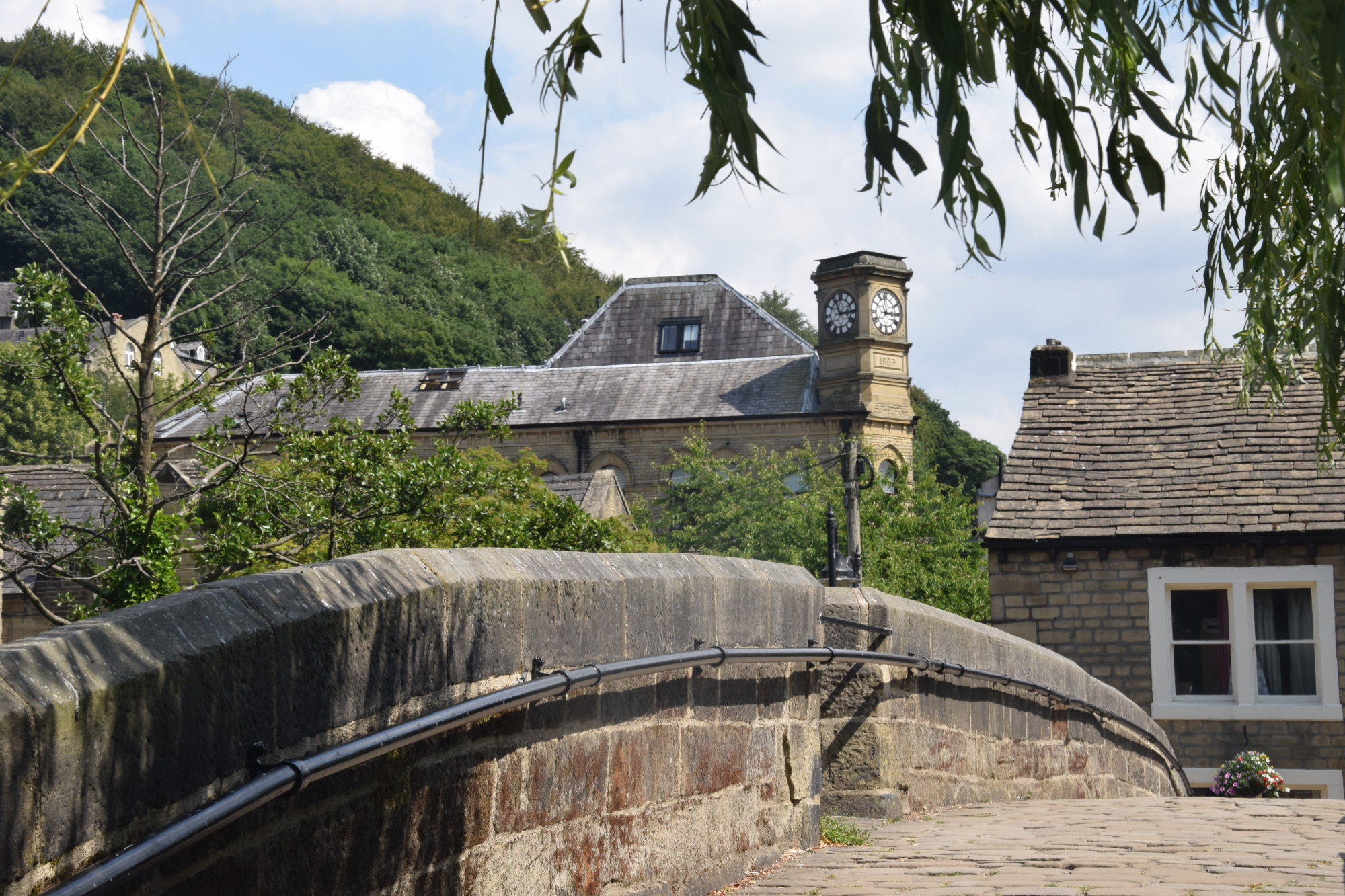
It’s also very pretty—starting with the station, which they’ve left looking decidedly old-fashioned. The old Hebden Bridge over Hebden Water (we’re not very imaginative up north) remains, closed to traffic because it’s tiny and very steep. That leads onto a cobbled street with tea rooms, a traditional sweet shop, gift shops… you get the idea. But, although there are a lot of towns with gift shops (I’m looking at you, Oxford) there aren’t many towns where one of the gift shops contains an actual working water wheel.
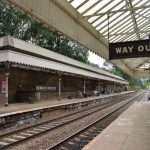
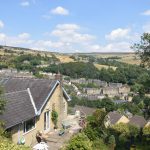
That being said, we didn’t spend long in Hebden, because my friend wanted to visit a village. And Hebden, while a very pretty place, and quite small, is still decidedly a town. Which led us to…
Heptonstall
(CN: suicide for this section)
And this was actually new to me too, despite the fact that it’s right next to Hebden Bridge on a map, and I’ve been there more times than I can count. There’s a reason for this: while Heptonstall and Hebden are right next to each other on a map,¹ it’s not that easy to get between them. And that would be because of that very steep valley that I mentioned.
So it’s up a hill. Quite a hill. Admittedly we walked the wrong way and ended up picking our way over a not-really-a-footpath, but it still took us about half an hour of continuous walking uphill to get there. My friend was not expecting this and was not wearing sensible shoes (the trip was a last-minute decision on my part, so this was entirely my fault). But the views on the walk are phenomenal, as Hebden Bridge opens out below, making it obvious how much its houses cling to the hillsides.
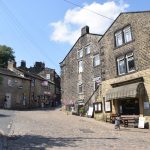
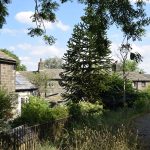
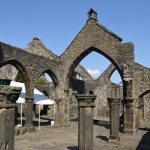
And then at the top is Heptonstall, which is a largely unspoiled village, partly because it’s so far up that ruddy hill. A cobbled street winds past the (friendly) Post Office, the café and the two pubs, while down a side street is the church. In fact, churches, in the plural. Part of the tower of the old one collapsed, and so they built a new one, leaving the old as a picturesque and vaguely haunting ruin. The replacement is pretty, but, to be honest, mainly just a typical church.
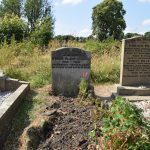
It does, though, have a famous figure buried in its graveyard, that being the American poet Sylvia Plath. Or, as she is named on her tombstone, “Sylvia Plath Hughes”, having been married to Ted Hughes, who hailed from nearby Mytholmroyd. This inscription is a bone of contention. Plath took her own life in 1963, while separated from but still married to Hughes. While I’m not going to get into details about Plath’s relationship with Hughes because it’s all a bit murky, it is worth saying that it’s all a bit murky partly because Hughes destroyed Plath’s last journal, which was in itself not a great move. The word “Hughes” gets vandalised frequently, apparently.
The main reason I took my friend here, though, wasn’t for its literary connections, or its ruined church, but because she wanted to see a northern English village, and I hoped this would be a good choice. In its isolated spot above the valley, it didn’t disappoint.
Halifax
Of the three places in this post,² this is the one you’re most likely to have heard of, if only because they give you extra. Halifax is the main town of the Calderdale district, and was an early centre for the wool trade. Essentially, if I remember Key Stage 3 History properly, it ceased to be in the Nineteenth Century, because it was in that steep-sided valley that I keep going on about. While nearby Bradford could flourish³ as a city built on wool, Halifax was destined to remain its smaller, but somewhat prettier, cousin.
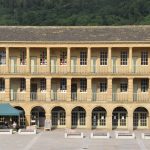
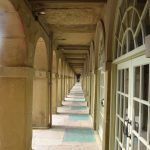
It does have a large mill, Dean Clough, now repurposed as business space,⁴ which is nestled in the valley of the Hebble Brook. But the most impressive remnant of Halifax’s industrial past, as well as a symbol of its industrial decline, is the Piece Hall. This dates from the Eighteenth Century, when “pieces” of cloth would be sold by traders both in a large market square, and in offices on three storeys surrounding it. The three storeys each have a different architectural style, making the square all the more impressive.
The reason it’s symbolic of the town’s decline is that large manufacturers of the Victorian era tended to skip the middlemen who worked in places like the Piece Hall and sell directly to customers, which made the building obsolete less than a century after its construction. It went through a range of uses, eventually becoming essentially a shopping centre, which it remains today. It was recently reopened, and the new visitor centre gives a pretty good summary of the building’s history, and also has costumes you can dress up in (again, no, you can’t see the pictures). The square is also used for public events (the Antiques Roadshow was preparing to film when we visited).

We did all this in one day, incidentally. (And also visited Bradford, where someone swore at me.) This did involve a certain amount of rushing around, so that is perhaps not to be recommended. Calderdale, on the other hand, certainly is.
¹ In fact, Heptonstall was the original settlement which spread down into the valley as Hebden Bridge (thank you Wikipedia).
² The fact that they all begin with “H” is coincidence.
³ And for all I denigrate it now, it really did flourish, making mill bosses very wealthy (often through the exploitation of cheap labour). In The Waste Land T.S. Eliot used the phrase “a silk hat on a Bradford millionaire”, a literary reference I’m including because I know it will make my mum happy that I did so.
⁴ One of the partners in this was Jonathan Silver, of whom more in a few weeks’ time.


Leave a Reply to Alex Cancel reply