
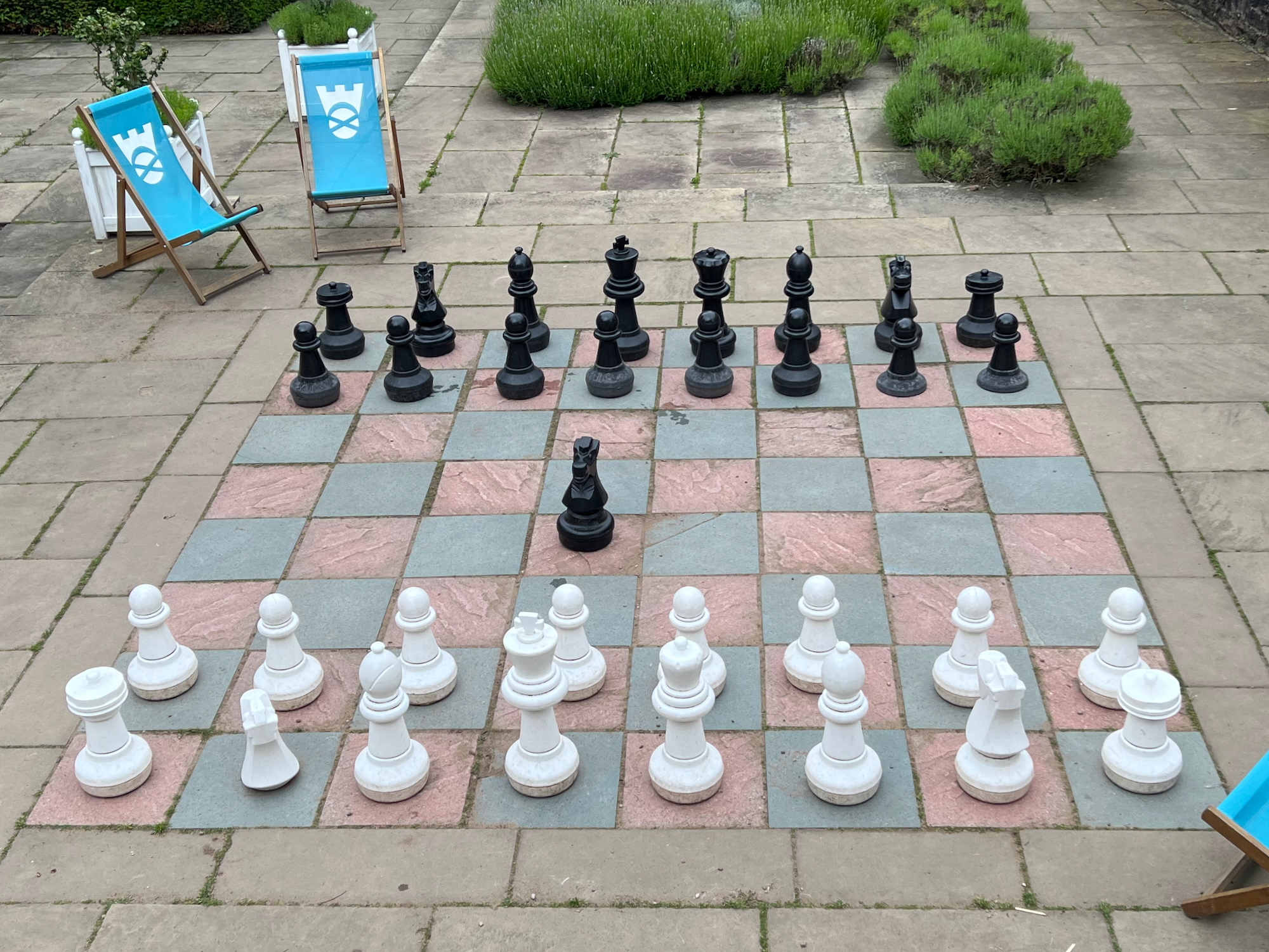
When I’ve written about board games before, a frequently recurring theme is that a game is pitched as being “chess, but simpler”. Octogo, you may recall, billed itself this way, as did Multiplay. As, indeed, did some other games I’ve come across in the process of writing this blog. As for others, I’ve already mentioned Chess 2000 in a footnote to the Octogo post, and when I was in the National Library the other week I came across Tri-Chess, the three-player chess variant that at most two people asked for.
To my knowledge, this strategy has never worked, in that chess is yet to be supplanted. Indeed, its closest rival is probably Go, which can’t be said to have surpassed chess simply because it’s older, so if anything chess has surpassed it.1 But if one game has at least achieved success with this marketing strategy, even if it failed to top the other party in its one-sided arch-rivalry, it would have to be the one we’re talking about this week.
Othello
Othello is my first request in the series, based on a message I got from a friend of the blog.2 “It calls to me with much blogging possibilities”, they said. And I agree, although I hadn’t thought of it as a potential topic—largely because I’ve known about it for some time. Indeed, it was one of the board games we put out for guests to play at our wedding; whether or not anyone did is unclear, but I do suspect that that’s when we lost one of the pieces.
This game very much positioned itself in opposition to the “classics” of the board game genre: it was apparently advertised in 1978 as “the game that combines the simplicity of checkers with the challenge of chess and the excitement of backgammon”.3 The comparison with the first two of those is a fairly obvious one to make: like those games, it’s played on an eight-by-eight board, by two players represented by dark- and light-coloured pieces. I could do a deep dive into its history, but someone’s already done a deep dive into its history, so I won’t do that. I will, though, tell you about a few things I turned up.
The extent of my research into this is a few quick searches on Newspapers.com. Based on that, the earliest source on Othello I can find in the British press is in a diary column in the Sunday Telegraph by Kenneth Rose, published in 1976. The game is described with the following sentence:
A simplified version of Go, Japan’s popular form of chess, Othello was invented five years ago by Takeshi Yonekawa, who named it after his anglophile father’s favourite Shakespeare play.
I don’t know where to start with this, so I’ll take Maria von Trapp’s advice and start at the very beginning.
- Othello isn’t a simplified form of Go, although at least one of the inventor’s obituaries, in the The New York Times, notes the similarity between some of the pieces.
- Go is absolutely nothing like chess, except that they’re both ancient two-player abstract strategy games that are very popular.
- If any game is “Japan’s popular form of chess” it’s Shogi.
- The inventor’s name was Goro Hasegawa, not “Takeshi Yonekawa”.4
- His father was apparently an “English literature aficionado”, to quote the same NYT obituary, which I guess classes as a type of anglophile. But it seems that the name comes from an analogy between the black and white pieces in the game and the racial tensions in the Shakespeare play of the same name.5
One thing that does seem to be the subject of debate is whether Hasegawa was influenced by a similar game, known as “reversi” and invented in England in the late nineteenth century. The rules are simple enough that it’s entirely possible that two people could come up with them independently—and, indeed, it seems that two different Englishmen both claimed to have invented the game in the 1880s. I found a report in The Daily Telegraph from 1888 about the relevant dispute, where one sued the other to prevent. The article, a curious mix of opinion and factual reporting that modern broadsheets tend to avoid—at least overtly—has an extremely detailed description of the rules of a card game called “reversi” that seems to have been tangentially relevant to the case. Sadly, though dispatches with the rules of the board game with the phrase “described as being analogous to draughts”. Plus ça change…
And talking of change, here’s a sentence from later in the same article.
We hear nowadays less and less of hunting the pig, climbing the greasy pole, running in sacks, dipping for apple in treacle, wheelbarrow races, gingling and whistling matches, and grinning through horse-collars at fairs, simply because fairs themselves, when they are of a festive ad not of an agricultural character, are falling year after year into greater and greater discredit.
I feel that that sentence has a mix of wistful nostalgia, along with an acknowledgement that perhaps change isn’t necessarily for the worse, that pretty much hits what I aim for with half the content on this blog. As for reversi, the court gave judgement in favour of the party that sued, but on appeal it was ruled that both could continue to market their own versions of the game.
Before this, the earliest reference I turned up for reversi, in the Carmarthen Journal in 1886, doesn’t say which person’s claim it’s backing, but it does describe it as “A Clever and Interesting Game for the Chess-Board” that is “To be had of all Toy Dealers and Fancy Stationers”.6 And by 1894, The Lichfield Mercury had it advertised alongside “Royal Reversi”, which seems to have been a multiplayer variant.
So how do you play? Othello’s slogan, at least on the box I have, is “A minute to learn, a lifetime to master!” So can I explain it in a minute? Start the clock…
The pieces are double-sided discs, white on one side and black on the other, which are placed on an eight-by-eight grid. You start by placing four pieces in the middle four squares of the grid, two with each side facing up, with pieces matching on the diagonal. Starting from there, each person plays a piece on each turn, always their side up. To be a legal play, the piece played (call it A) must be adjacent (horizontally, vertically, or diagonally) to a piece with the opposite colour face up (B); moreover, if you draw a line starting at A and passing through B, it must hit a piece of the same colour as A before the line hits an empty space or the edge of the board (C). All pieces in the line between A and C will be of the same colour as B (there might only be one), but they are then all flipped to match A and C. It may be that, when playing A, there are multiple valid choices of B and C; if so, you flip the pieces corresponding to all of them. If you can’t play, you miss your go. The winner is the player with the most pieces of their colour showing at the end of the game, which occurs when the board is filled or when neither player has a legal move.
Did that help? I’m not sure it did. Wikipedia has rules with diagrams, if you’re interested. The point is that, unlike some other entries in the “better than chess” genre, the rules of this one make sense, and do lead to a fast-paced and strategic game. That said, it can still be “described as analogous to draughts” in at least one way: like that game, but unlike chess and Go, Othello appears to be “solved”, and a perfect game of either would end in a draw.7
Back in 1894, you could get the game with enamelled, bone, or “mother o’ pearl” counters. It’s a shame to report, then, that in the edition I have they are all plastic.8 So is the board, which is made of an unnecessary amount so it can hold a built-in rack for each player’s pieces. The actual playing surface is green felt like you’d have on a table at a casino, with ribs forming the grid so that the pieces nestle into each space; this is a nice touch, but the dips aren’t quite deep enough, so the pieces do easily get knocked out again.
And is it easy to learn? Well, I played it with my mother-in-law, who is not (I hope it is fair to say, since I understand she reads this) the world’s biggest fan of board games. But she got it, maybe not in a minute exactly but fairly quickly. Indeed, she went on to win—with a little help from my husband, who proved where his loyalties lie.
Well, maybe. Perhaps it isn’t, after all, quite so black and white.
- And I’m not even sure about that. Chess is much more popular than Go in the UK, but on a global scale it may be that Go has more players. It’s hard to get good comparative statistics. ↩︎
- They’re also, to be clear, a friend of me. ↩︎
- This is according to an old TV ad I found on YouTube, which I warn you contains a person dressed up as a genie in a way that I’m not convinced is culturally sensitive. ↩︎
- Wikipedia gives a different “legal name” for him as well, but that isn’t even remotely similar to “Takeshi Yonekawa” either. ↩︎
- I’m not convinced that this is culturally sensitive either. ↩︎
- I choose to believe that a “fancy stationer” relates to a regular stationer in the same way that a fancy pigeon relates to a regular pigeon. ↩︎
- For those unfamiliar with academic publishing, note that this is what is known as a “preprint”, and has not been subject to peer review. As an aside, I wish I had both the ability and the confidence required to describe anything I’d done as “a monumental achievement for humanity”. ↩︎
- Then again, in 1894 you could also get them with ivory counters, so maybe plastic isn’t the worst possible material. ↩︎
Leave a Reply