
This week’s post is an anecdote.
Well, it is right now. I’ve just looked up the origin of the word “anecdote”, and it derives from an Ancient Greek word meaning “unpublished”. To put it here, I have to press a little button on WordPress that says “publish”—so, by the time you read it, it won’t be an anecdote any more. At least, etymologically speaking. The modern definition of “anecdote” is “a story you could imagine someone reading out from Dictionary Corner on Countdown”,1 and I feel like this fits the bill.
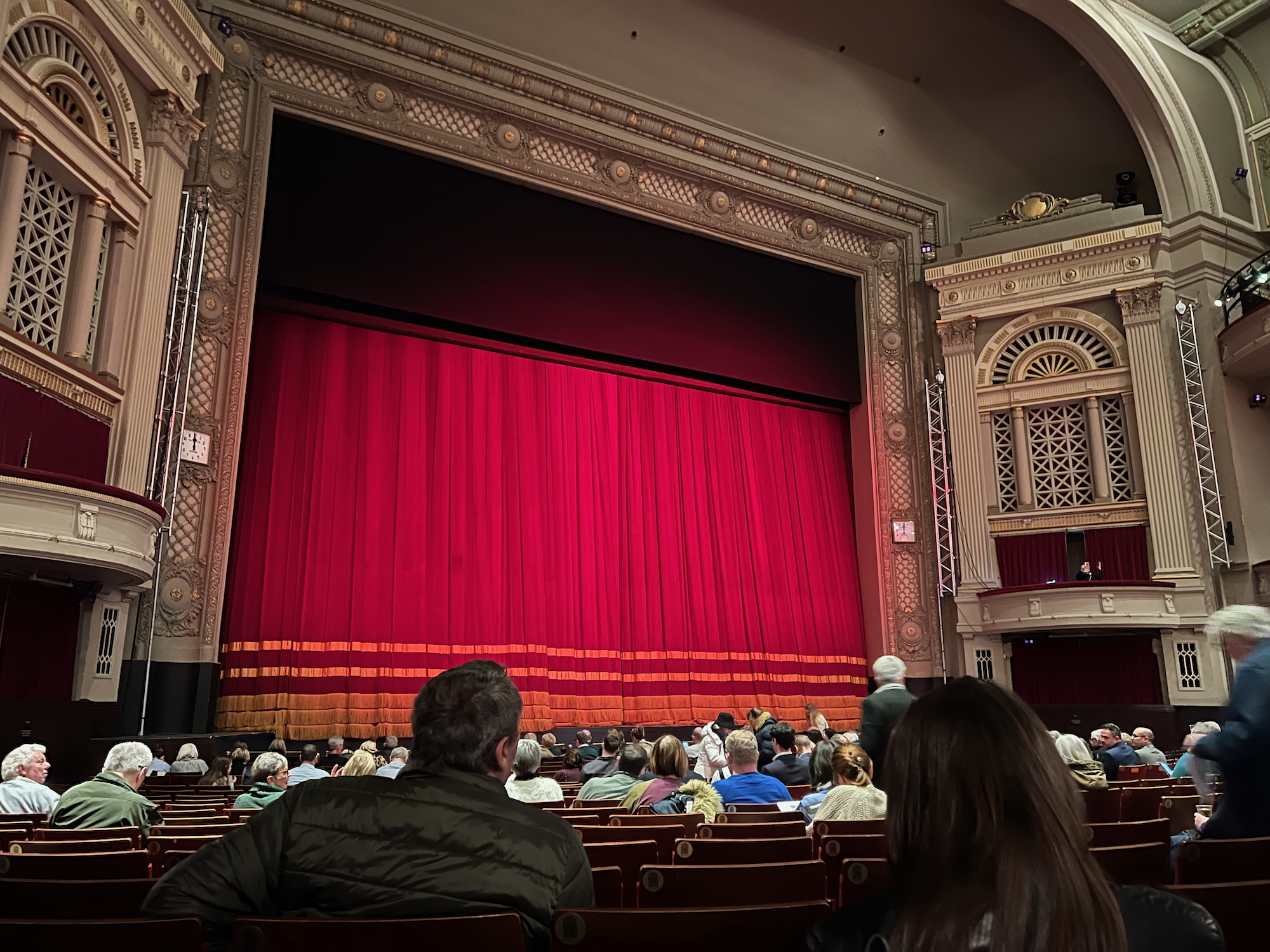
The place is the theatre, and the time is the interval.2 The theatre in question is the Apollo Victoria—an art deco theatre in the West End, opened as a super-cinema in 1930. Apparently (according to the programme I bought) its green theming is original; it proved curiously apt for Wicked, the show it’s hosted for the last couple of decades. Like a lot of venues from that era that were built as picture houses, it’s massive, so it has to have the necessary facilities to cope. And yes, I’m using the word “facilities” in its euphemistic sense.
We were in the stalls—by which I mean the lowest level of the theatre, not anything else.3 The loos are strategically located at either side of the auditorium—a ladies’ toilet to house left, and a separate gents’ and ladies’ to house right. Unfortunately, the men’s toilet was, on this occasion, out of order. Fortunately, the presence of a spare set meant that the women’s toilet on that side could be relabelled as a men’s,4 and so it was to there that I rushed as Elphaba closed “Defying Gravity” with a dramatic “Woah-oh-oh-oh”.
Naturally, they hadn’t blanked out the big sign on that side of the room, which suggested both sets of toilets of the gender binary were available. Instead, they’d just positioned someone in front of the doors, who was bouncing people away who looked like they were going to the wrong side, like a problematic pinball paddle. This, then, meant there was a continual stream of people walking in the opposite direction to me, and it therefore took a while for me to make my way to the bathroom. So long, in fact, that, as I got there, I saw the door of the last vacant cubicle slam shut.
I sometimes think of myself as being on the unfortunate side of changes: I was in the last year at school to do Year 9 SATs, which was also the first year to pay £9,000 university tuition fees. I suppose, on a grand scale, being the first person not to be able to go for a wee during the interval of a West End show isn’t really the same, but I was nevertheless a little miffed as I waited for the first door to re-open.
Meanwhile, a queue started to form, as you might expect. I say “queue”—in fact, it didn’t take long for someone to walk past me, presumably looking for the urinals. I decided to save him the time. “They’re all occupied,” I told him, stopping him in his tracks about halfway down the row.
“Sorry,” he said. “I didn’t realise.”
I realised at this point that it looked like I thought he was stupid—or that I thought that he thought that I was stupid. So I tried to smooth things over by explaining. “It’s normally a ladies’,” I said. I’m not sure that that really did fully explain the situation, but social convention says that you don’t talk to other people in the queue for the gents’—and also that in London you don’t make small talk with anyone at all—so I didn’t expand.
The queue continued growing. Eventually, two boys barrelled in, and they too rushed past all the waiting adults. Their parent, watching from behind them, shouted that the boys should check whether the people waiting were a queue. In response, the queue murmured its confirmation that it was, indeed, a queue.5
One of the boys, though, was undeterred. He walked up to the closest door, and pushed on it. It opened. There was nobody inside. He looked at us, inquisitively.
“I think you should go in that,” I said. It felt like he deserved to queue-jump after exposing the silliness of the grown adults around him. The crowd indicated their agreement, and he went in.
“You mean, you didn’t check?” someone joked. I laughed along with the crowd. We had been foolish, and I had especially, but now all the cubicles really were occupied. So it was just a matter of waiting a little longer, my mood now somewhat lighter than it had been.
After a few seconds, it occurred to me that perhaps I should just have one more look, if only to reassure those behind me after my previous lapse in judgement. I mean, as that incident had proven, an unlocked cubicle looked much like a locked one. So I walked down the aisle, gently pushing on the doors on either side, gaining in confidence as each successive one stayed firmly shut.
Push. Nothing.
Push. Nothing.
Push. Noth—oh.
The door gave way beneath my hand.
“D’you know, there is one,” I said, as a chorus of boos and light-hearted expletives reached my ears. “I’m terribly sorry!” I called over the noise as I hurried into the free cubicle, and shut the door behind me.
- It’s not, but I hear rumour Susie Dent has been lobbying for that change for years. ↩︎
- I actually wrote the first version of this anecdote in a series of WhatsApp messages immediately after the events described, before turning my phone off again. Yes, off, not just on silent. I’ve been doing this for years, and I feel vindicated after someone got kicked out of the snooker final at the Crucible a week ago because alarms still go off on “silent” mode. ↩︎
- Don’t worry, it’s not that sort of anecdote. ↩︎
- There was still no option, as far as I saw, for non-binary people. Presumably that’s because, as is well known, queer people and theatre simply don’t mix. ↩︎
- Thus preventing any unnecessary existential angst it might otherwise have experienced had it believed itself not to be a queue at all. ↩︎
Leave a Reply