
Okay, first thing’s first—a regular reader (apparently I have those? Who knew) would like me to issue a correction. Two weeks ago I wrote about Calderdale, and in my section on Halifax I neglected, despite my intention to the contrary, to mention Eureka, the National Children’s Museum. I did in fact show my travelling companion this, but we did not go in, on account of the fact that neither of us was a child. This did mean that I didn’t get to nostalgically relive shopping in the teeny-tiny M&S with fake money from the Halifax cash point, but I might have looked a bit out of place.
Date of trip: Friday 5th to Sunday 7th July 2018
Journey time (from Leeds): approx. 25 minutes to Keighley, 20 minutes to Bingley, 15 minutes to Saltaire
Fare (from Leeds): £5.60 (Anytime Day Return, with 16–25 Railcard)
Anyway, this week I’m concluding my series about Yorkshire by talking about a different valley, that of the Aire. Three places to talk about this week, so I’d better get on with it.
Keighley
Although I don’t really have much to say about this one, to be honest. The main reason I’m including it is that writing in poetry form last week means I couldn’t really write much about the steam railway which goes to Haworth. The Keighley and Worth Valley Railway is one of only a few preserved railways to operate a complete branch line, aided by the fact that it was planned to be reopened as a heritage line not long after it was closed. In fact, it celebrated its fiftieth anniversary since reopening this year. There are a few museums along the line, so even though it’s only a few miles long it’s worth a visit if you’re a steamy person.¹
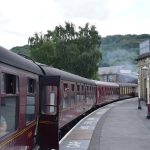
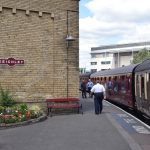

Beyond that, Keighley’s just an ordinary large town, really. The only other thing to say is that it’s pronounced “Keith-lee”—as in “I think that was Mr Lemon walking down the street over there; I’m not sure, but he seemed very Keighley.” Ahem. Let’s move on.
Bingley
If you didn’t pay much attention to the financial news in 2008, chances are you’ve never heard of Bingley; if you did, chances are you’ve only heard of it in the context of a failed bank. The Bradford & Bingley does, in fact, still exist, as part of a government-owned residual organisation which manages its old mortgage book; that company is still based in the old headquarters of the B&B, in Bingley’s northern suburb of Crossflatts. The old old headquarters of the B&B was in Bingley itself, and was a 1960s architectural marvel/monstrosity that they demolished three years ago to build a Sainsbury’s.
But I didn’t take my friend to Bingley to show her the site of an old bank’s HQ.² The touristy thing in Bingley is on its canal.
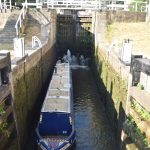
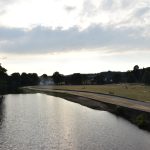
The Leeds and Liverpool Canal runs alongside the Aire from Leeds as far as the village of Gargrave, where it turns to cross the Pennines. At Bingley it has to go uphill, which of course means a lock. Except at Bingley it has to go very uphill. Which means lots of locks.
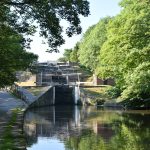
If you put lots of locks in a row, that’s called a flight of locks. But if you need to go uphill quickly, you can make the top gate of one lock the same as the bottom gate of the next, chaining them together. That’s called a staircase lock, and there aren’t that many of them in the country with more than two “steps”. Bingley has two such sets.
Lower down, nearer the town, are the Three Rise Locks. And to be honest I feel a bit sorry for them, because they get overshadowed somewhat by their higher-up neighbour, the Five Rise Locks. Both sets are impressive, though, and also a bit of a pain to navigate, which means they still have a full-time lock-keeper to help boaters along their way. If you’re lucky, you’ll turn up at the locks as a boat is going through, and get to see the somewhat-convoluted process for yourself. And if you’re really lucky, you’ll turn up when there’s a friendly lock-keeper, who’ll let you have a go at operating the lock gates. I was quite excited, as my friend can confirm. (No, you still can’t see the pictures.)
Saltaire
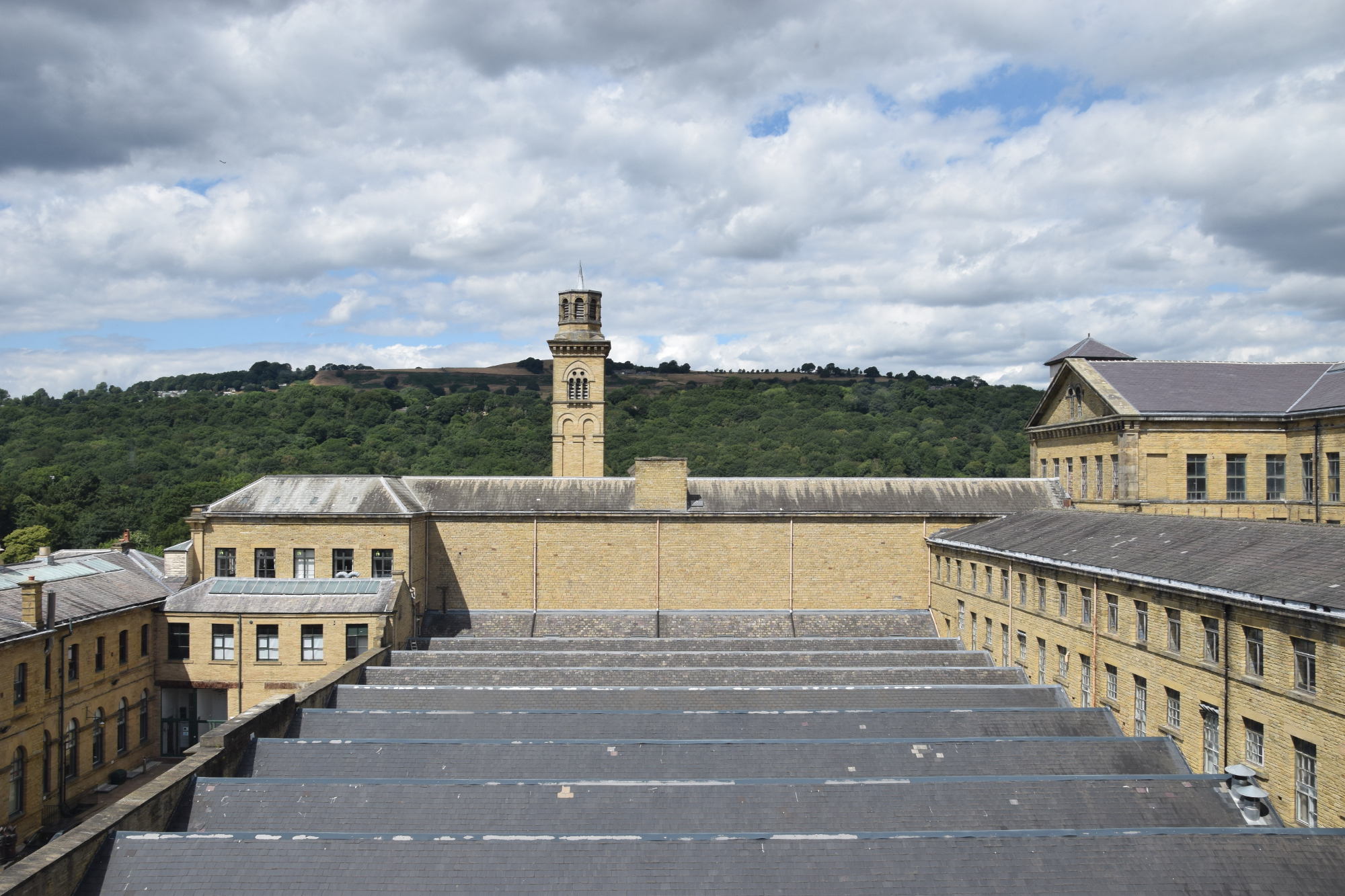
I could write pages on Saltaire. In fact, this isn’t even the first time Saltaire has featured on this blog, because on my one week off from writing this since I started, my filler was a collection of photos I’d taken in the village. (I haven’t repeated those photos here—and they’re actually better pictures than these—so click on the link to see them.)
As I said on that post, Saltaire is a World Heritage Site, which makes it as important as the Great Pyramid, Machu Picchu and the Taj Mahal. Alright, maybe not. But it’s important, because it’s one of the most complete examples of a model village—by which I don’t mean a miniature version of a village, like that at Bourton-on-the-Water in the Cotswolds. Here “model” is in the sense of “model student”: model villages were considered by their constructors, to quote Wikipedia, “an ideal to which other developments could aspire”.
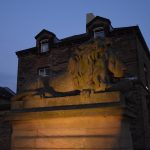
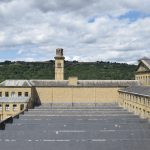
Saltaire was built around Salt’s Mill, a mill built by Sir Titus Salt. The village was owned by the mill, and was built to house his workers. Salt provided amenities for his workers, such as a meeting space and library, a school, two churches, a Sunday school, a wash house (in the days without internal plumbing), a hospital, almshouses for the elderly, and a park. In return, there were fairly strict rules that the villagers had to follow: most notably, a prohibition on the consumption of alcohol. The only pub in Saltaire remains one is the one that was converted from a former boathouse.³
In case this sounds a bit paternalistic: well, it was, and deliberately so.⁴ But you should compare Salt’s approach to that of the other Bradford mill owners of the time, many of whom took significantly less interest in their employees’ welfare. Many Bradford workers lived in back-to-back houses, very few of which remain (some are preserved at the Bradford Industrial Museum). These were terraced houses with only one external wall, because rows on adjacent streets were placed right up against each other. This was somewhat unsanitary, and the reason very few remain is that most were demolished in the 20th Century as part of slum clearance. Saltaire was a massive improvement on this: apart from anything else, every house had a back yard.
I can’t give a full history of Saltaire here, much as I’d like to, but in short: the mill closed in the 1980s, and a couple of years after it closed, it was reopened by local businessman Jonathan Silver⁵ as—well, I don’t know how to describe it, to be honest. I’ve mentioned that this is my neck of the woods, and so Salt’s Mill has always been like this as long as I can remember, and it’s only recently that I’ve realised it’s a bit of a strange thing. It’s part art gallery, part history museum, part set of restaurants, part shopping centre, part business park. If you have a Sky Digibox, there’s a reasonable chance it was made in Salt’s Mill.
A word on the art gallery aspect: most of the works on display are by David Hockney, who was born in Bradford (he now lives in the East Riding of Yorkshire). Hockney has always been one to explore new media: a piece I remember when I was a child was an abstract depiction of a tennis match, cut into pieces and faxed from California to Saltaire in separate sheets which were then re-assembled and displayed. Now on display are his many pictures done on an iPad drawing app.
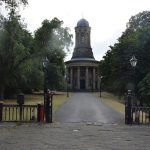
It’s worth mentioning the United Reformed Church, which is the only Grade I listed building in Saltaire (although all the surviving original buildings throughout the village are listed). The whole village is in an Italianate style, and that’s most obvious in the church, which wouldn’t look hugely out of place in Venice. It’s rather fancy inside, and has a little extension protruding from the side which is the Salt family mausoleum.
The village is worth a wander too: around the grid of streets, which are mostly named after members of Salt’s family (“William Henry Street”, “Caroline Street”, “Fanny Street”, etc.). And that’s without mentioning the Village Society, and the independent shops, and the annual Festival, and the funicular tramway, and the Wurlitzer cinema organ recently installed in the Victoria Hall. Like I said, I could write pages, and I’m going to stop now before you get bored silly. But it’s no wonder house prices in Saltaire are through the roof for what are really quite tiny houses, despite their improvement on the old back-to-backs.
One last thing to say, though; all the places I’ve just mentioned are in Bradford district. I criticise Bradford a lot, but actually we don’t do badly for local heritage. Perhaps one day you’ll pay it a visit.
¹ This is a reference to one of the first times I said something stupid at a particular university society that I attend. It wasn’t remotely the last.
² If you know me, you’ll know this is a clarification I have to make. Also I say “site” because they didn’t ever build the Sainsbury’s.
³ There is also a wine bar, called “Don’t Tell Titus”.
⁴ One of the major biographies of Sir Titus Salt is called The Great Paternalist; as far as I know, the author intended no negative connotations in the use of the word.
⁵ I mentioned Silver in the context of Dean Clough mills when I wrote about Halifax. Sadly he died in 1997, but I’m told he was a really nice person: he worked in the mill after opening it, and apparently on at least one occasion he helped to lift me into the premises in my pram.
Leave a Reply to Bradford – Escaping Oxford Cancel reply