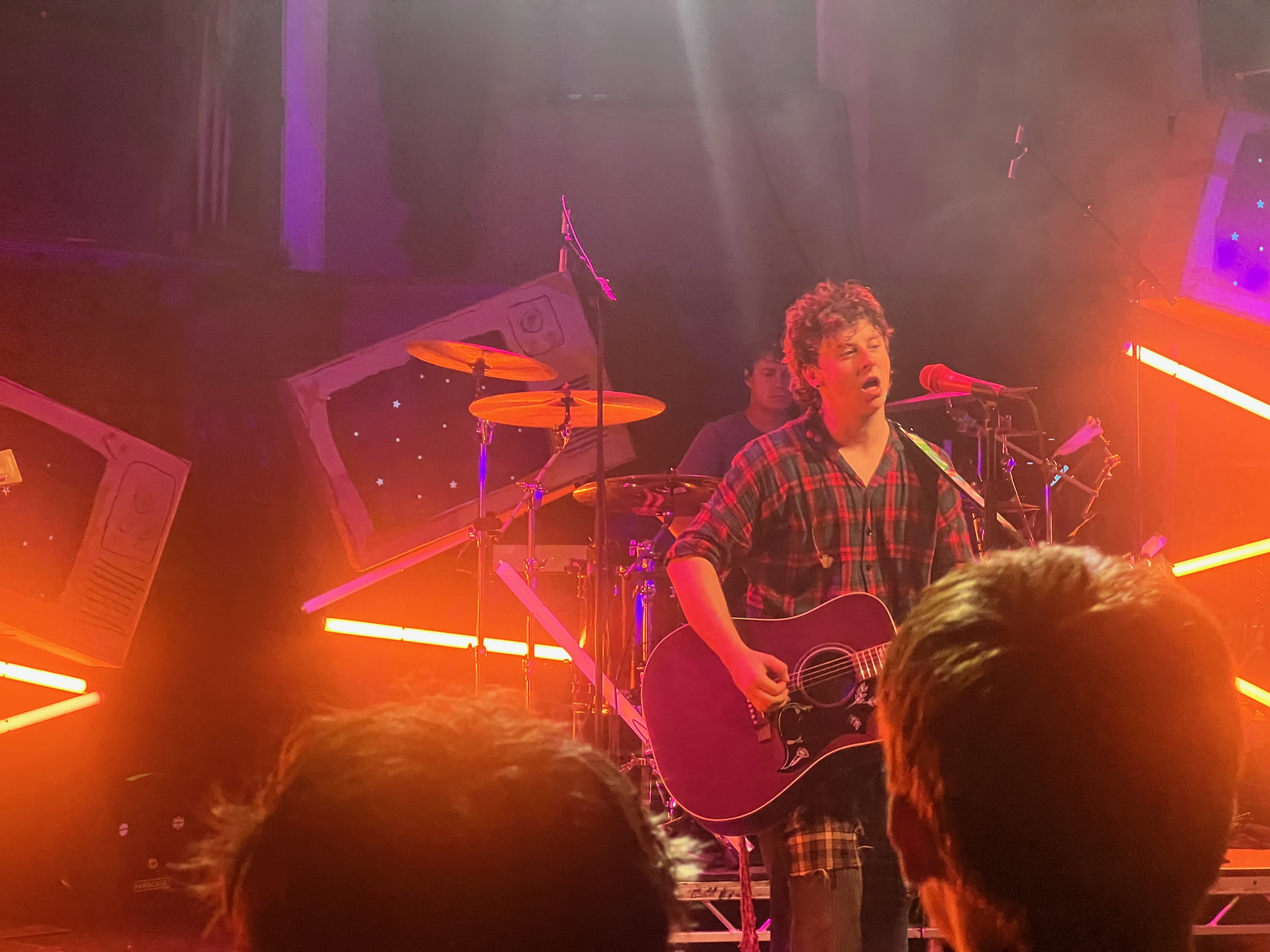
On Sunday I was at a gig with my husband, our second in the space of a few days. That one, in Glasgow’s West End, was for a folk artist called Yaelokre, while three days earlier we’d been in the East End instead seeing pop-punk singer-songwriter Noahfinnce. You probably haven’t heard of these artists—or, if you have, it’s probably from me telling you about them. They’re both great, and both successful, but neither of them has reached household name status. Actually, almost nobody I’ve seen live has; the closest is probably Walk the Moon, but if you have heard of them I bet you can’t name two of their songs.1
While having dinner before Sunday’s show, I got to wondering who, out of last weekend’s artists, was the more mainstream. I thought one way to tell might be to look at their respective chart performance, but it’s a bit of a mixed picture. Neither has made the official singles or albums chart. Noah’s debut album Growing Up on the Internet got to number 93 in the midweek album chart, but had dropped out by the end of the week; it also appeared on various other charts ranking albums, like the albums sales chart and the “Record Store Chart”. The only album credited to Yaelokre (and to Keath Ósk, their real-life name2) only came out a couple of weeks ago, and so hasn’t really had chance to appear on anything but the folk albums chart; unlike Noah, though, they have made it onto some of the sub-charts for singles (“Hartebeest” got to number 30 in the singles sales chart).3
When I’ve looked before, I’ve noticed that artists I like tend to do better on the albums chart than on the singles chart. To take another example, Conan Gray—not a household name either, in my experience, but he does play arenas—has had three of his four albums make the UK top ten, with his latest, Wishbone, debuting at number 2 last year.4 Meanwhile, only two of his songs have made the singles chart: “Heather” peaked at number 17 in 2020, and “Vodka Cranberry” managed the giddy heights of number 93 last year.
But I don’t know how much to read into this, because one thing I’ve discovered is that the albums chart, these days, is rather odd.
A fair amount has been written about anomalies in the singles chart—remember that time in 2017 when four-fifths of the top 20 was Ed Sheeran? His album ÷ had just been released, and it had been streamed a lot. And its deluxe edition had 16 tracks. (This can’t happen any more, because artists are restricted to at most three singles in the top 100.) Before then, remember when The X Factor dominated the Christmas Number 1 spot so much that a 17-year-old song became one of the best-selling singles of the decade, in protest? What a time.
I haven’t seen much about the albums chart, probably because nobody cares about the albums chart; BBC Radio 1 doesn’t, to my knowledge, have a show playing through the top albums, because that would take far too long.5 My own interest was piqued by the fact that, when I looked at last week’s albums chart, the number one album was The Black Parade by My Chemical Romance, a record that came out twenty years ago. This is, incidentally, its best chart performance ever: on its debut it was kept off the top spot by a Robbie Williams album.
It turns out that this is more understandable than I first thought: the album came out near enough exactly 20 years ago, and it’s the reissue of it that has caused it to top the charts.6 I presume, then, that it’s a similar reason why Back to Black by Amy Winehouse—another album from October 2006—was at number 4, though that has reached higher positions in the past. (It was, for instance, number 1 for three weeks shortly after Winehouse died.) But I don’t think that explains all the old albums in the chart: Oasis’s seminal album (What’s the Story) Morning Glory? was at number 18, but hasn’t just had a significant anniversary, unless there’s something special about the number 31 I’m unaware of.
That, by the way, has been on the charts for a frankly obscene number of weeks: 773, to be precise. Not as many as Fleetwood Mac’s Rumours, though, which as of last week had clocked up well over a thousand. Presumably all the Fleetwood Mac fans are going early for its 50th anniversary in February—truly, they don’t stop thinking about tomorrow.
The other thing you see a lot of is greatest hits albums. Last week, this started at number 5, where The Essential Michael Jackson could be found, but carried on down the chart: six of the top twenty albums were compilations,7 as were 42% of the top 100.8 Eminem had two greatest hits albums in the chart, which to me seems to be stretching what you can legitimately count as “greatest”—you need to have a word with yourself, Mr Shady (if that is your real name).9
All this can’t actually reflect trends in the music industry, surely? And surely the charts haven’t always been this way?
The problem here is that I’m at risk of sounding like Monty Python’s Four Yorkshiremen, when I am but one. If I’m going to claim that “back in my day” it was better, I would need to look at last week’s chart alongside the one from, say, 25 years ago, and do some sort of data analysis to compare them. But the Official Charts company provides data “only to entertainment industry professionals”, which I am not.10 So the only way to get the data would be to manually collect it, and who could be bothered to do that?
You know, sometimes I think I overuse this literary device.
To be continued…
- You might be able to do one, because “Shut Up and Dance” was a moderate hit in the UK. It’s even been used on Strictly as the soundtrack to a paso doble. (Ask me how I know.) ↩︎
- Specifically, “Yaelokre” is the name of a music project by Keath Ósk, but it is treated like a stage name. “Owl City” as Adam Young’s music project would be another example of the same thing. ↩︎
- All figures correct as on 4pm on Friday 6th November 2026, which is about ninety minutes before a new chart is released. That means that, by the time you read this, this blog post will be out of date. Oh, well. ↩︎
- I now have a purely irrational hatred for Tom Grennan’s Everywhere I Went, Led Me to Where I Didn’t Want to Be, which kept it off the top spot. ↩︎
- Then again, I’m not sure I’ve voluntarily listened to more than about an hour of Radio 1 in my life, so for all I know that’s all they play. ↩︎
- The same thing happened in the US, prompting an article in the New York Times whose headline at implies I wasn’t the only one to be somewhat baffled. ↩︎
- Not counting The Holy Bible – Live by Manic Street Preachers, a live recording of a previous album. ↩︎
- I could have just said “42 of the top 100”, but this way it sounds much more scientific. ↩︎
- To be fair to him, “Won’t the real Marshall Bruce Mathers III please stand up?” doesn’t have the same ring to it. ↩︎
- I assume this blog doesn’t count. ↩︎
Leave a Reply