
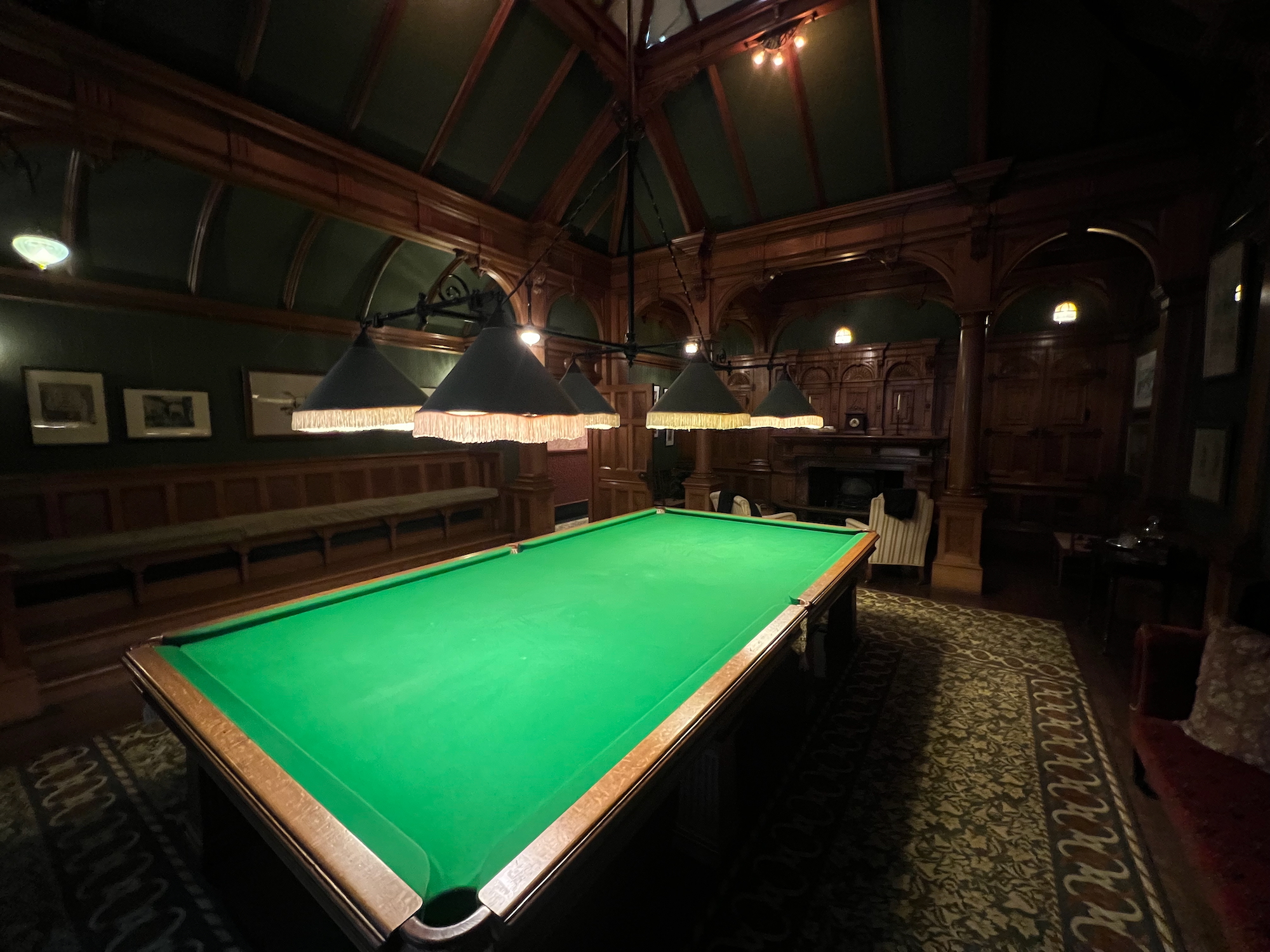
Who was the first sportsperson you were aware of?
If you’re about my age, it might have been Paula Radcliffe, or Tim Henman. If you’re from my neck of the woods, it might have been someone who played for City or the Bulls. If, like me, you don’t actually care much about sport in general, it might have been Posh Spice’s husband, or that footballer who won Strictly last year.
But I don’t think it was any of those people for me. I’m pretty sure it was John Virgo.
If you’ve not heard of him, John Virgo was a snooker player, and latterly a snooker commentator,1 who died on Wednesday at the age of 79. His last commentary gig was three weeks ago today, at the Masters (one of the “Triple Crown” of snooker events), ending with his confirmatory announcement that Kyren Wilson would be lifting the trophy, so it came as a bit of a shock when I heard.
I was an unusual child,2 and one way in which this manifested was in the TV shows I watched as a kid. Sure, I watched Teletubbies, Tots TV, Playdays and all the rest of what CBBC3 showed in the mid-to-late nineties. But the other genre of programme I loved was the game show.
Three of these stand out in my memory as early childhood favourites. Supermarket Sweep makes sense as a show a child would enjoy: catchy theme tune,4 giant inflatable foodstuffs, and a bit where full-grown adults run around a supermarket in a way that you always wished you could when you had to go with your mum to Asda. Wipeout, which I only saw in its Bob Monkhouse era, makes less sense to me as a kid-friendly show, since it’s pretty much entirely a straight quiz. I assume what attracted me to it was the endgame, where the contestant had a “Monkhouse minute” to run back and forth between a grid of screens and a big plunger button until the six correct answers were lit up.
But one game show stood above them all, and that was Big Break—which, in the pub-games-as-game-shows stakes, was to snooker what Bullseye was to darts. Again, it makes sense that I’d enjoy this one—like Sweep, it had a catchy theme tune, lots of colours (for obvious reasons),5 and people running around a set. The people in this case were professional snooker players I’d never heard of (because I was a kid), paired with members of the public I’d never heard of (because I was a weird kid, but not that weird). What the snooker players frantically did at the table had an effect on the questions the civilians had to answer, or on the prizes they’d win. Hosting proceedings were Jim Davidson (before most of the dates included in his Wikipedia article under the heading “Controversies”) and John Virgo. Virgo had had a good-but-not-stellar playing career, only winning one of what we now call the Triple Crown, but he’d become known for his exhibition match routine, which included trick shots and impressions of other snooker players.
I didn’t know any of this at the time, of course—only that he was that nice man on the telly on that show I liked. Well, I knew about his trick shots, but only because that was the chance for the losing contestant to try and repeat one that Virgo had just demonstrated before they left the show. As I recall, he usually succeeded, unlike the contestants.
After Big Break ended in 2002, so did my engagement with snooker. My grandad would watch it from time to time, and I’d watch too, so I knew most of the rules if not the tactics. I had no access to a full-size snooker table, so I couldn’t try my hand at it. That said, I did have access to pool tables from time to time in childhood and (particularly) early adulthood, so it quickly became obvious I had no natural talent at cue sports whatsoever.
But then, in 2023, my husband and I got COVID—I think that was the first time we’d actually caught it. We were still trying to follow the pandemic-era guidance, so we stayed in and watched a lot of television. This was in late April, so the BBC schedule was dominated by the snooker, from the World Championship at the Crucible in Sheffield. It was a particularly exciting one: the semi-final between Luca Brecel and Si Jiahui in particular, where both players bucked the then-prevailing trend of safety-dominated play. Luca Brecel would go on to win, beating the then world number 2 Mark Selby in the final, and becoming the first world champion from a country where English isn’t the majority language.
I don’t think I’d have understood any of that, or found it nearly as exciting, without the commentary. And this is where Mr Virgo returns to the story. In the time since Big Break, he’d become—as I was vaguely aware—one of the leading BBC commentators, usually being paired with a more-recently retired (or even active) player. And when I say he was one of the leading commentators, I mean that he was iconic.
That’s a word that’s used a lot these days, but I think it applies here. In part that’s because of his catchphrases: “There’s always a gap”, for instance, which would usually provoke a chuckle of recognition from the crowd listening along to the commentary with portable radios.6 More famous, perhaps, was: “Where’s the cue ball going?” (or “red ball”, “yellow ball”, etc.), said any time a ball looked vaguely like it might go into a pocket where it shouldn’t,7 always, always, with exactly the same urgency, excitement, and rising inflection. If you don’t believe me, there are compilation videos on YouTube.
But any fool can have a catchphrase or two. John Virgo’s commentary was truly iconic because he clearly knew the game like the tip of his cue. He explained the rules in a way that was inclusive for new viewers, without coming across as tired of having to do it for the umpteenth time in his long career. He could explain why a player was making a particular shot—and if he couldn’t explain it, he would tell you exactly why he thought it was a bad idea. (He was usually right.) And he did it all without coming across as a show-off—just someone who clearly loved the game deeply and wanted to share that with the viewer. The BBC still has other gifted commentators, but there’s nobody quite like JV was.
We managed (somehow) to get tickets for the first session of the World Championship last year, where Zhao Xintong took seven of the eight frames against Mark Williams.8 The commentators were Dennis Taylor and Stephen Hendry, an excellent pairing and a pair from the gifted set I mentioned. I was very excited to be able to watch snooker live, for the first time, with such legends to guide me along. But, despite that, I did feel a small, guilty twinge of regret that we hadn’t got a session for which Virgo was in the commentary box. Another time, I thought.
Ah, well.
I’m not normally one to mourn the death of people in the public eye. For some reason, though, this one got me. Maybe because he’d been well enough to work only recently. Maybe because 79, while not young, isn’t that old these days either. Or maybe, somewhat egotistically on my part, it’s because another little part of my childhood died with him. Whatever the reason, though, I’ll miss hearing him at the Crucible when April rolls around again—it won’t be the same without him.
Or, put another way: there’ll always be a gap, JV.
- And it was ordained that, upon reading this, a chorus of the multitudes would ring out across the land, saying, “Yeah, but snooker’s not a sport tho”. But the author of the post of the blog, who had foreseen this pitiful cry, did respond unto them, “Ah, but it is broadcast by BBC Sport. Also, shuttest thou up.” ↩︎
- I know, right, who’d have thought? ↩︎
- Yes, CBBC. CBeebies didn’t launch as a separate pre-school brand until 2002. ↩︎
- Bizarrely, this was released as a single at the height of the show’s popularity, with words added to the existing tune in the manner of “Anyone Can Fall in Love”. ↩︎
- I enjoy, incidentally, that snooker provides a definitive answer to the question of whether or not black counts as a “colour”. Yes, it does—but red doesn’t. ↩︎
- For those unfamiliar, a key tactic in the game is to “lay a snooker”, which is where the straight-line path between the cue ball and the ball the player needs to hit is blocked. Often the way to achieve this is with a combination of other balls as the block, which works as long as the cue ball can’t get through any gap between them. And, well… ↩︎
- Again, to explain: the active player must pot a red ball, then one of the others, in alternating sequence. The player must also nominate one of the colours on the non-red turns. It’s a foul if any ball that is not of the appropriate hue goes into a pocket. The cue ball going into the pocket is always a foul. ↩︎
- Zhao went on to become the first world champion from China, a country with a huge and growing snooker fanbase. ↩︎
Leave a Reply