
A few weeks ago I promised a review of the third board game from Tabletop Scotland. I then kept you waiting for two weeks while I wrote about other things—sorry about that. And sorry about this, because I’m going to keep you waiting a bit longer.
Instead, this week I’m going to tell you about another second-hand game I got recently. I was hoping to tell you about both in one post, but, well, things may have octo-got a little out of hand…
Octogo
When I was in Yorkshire at Christmas, I was helping to clear some stuff from my mum’s house, leading to my dropping a large number of bags at a charity shop. I then spotted an intriguing-looking game on the shelf, and felt it was only fair, having increased their stock of stuff they have to try and shift, that I should do my part by taking something off their shelves.
Octogo is a game that was introduced in the mid-1980s, and plays as a two-player skill game that’s a little like draughts,1 but with more depth; or, alternatively, a little like chess but with fewer rules. This second comparison was, indeed, printed on the box by the publisher (“At last! A game which compares more favourably with Chess than any other, yet is infinitely more simple to learn”). That publisher was called, er, Octogo Games, and they were based in the town of Calne in Wiltshire. There’s not much online about them, but I’ve had a week off work this week, and I have spent it (let’s go with) “productively”.
Genuinely, I went down a massive rabbit hole for this post, and for me that is saying something. I don’t think a lot of this has been documented anywhere—to my knowledge, the next four paragraphs are the first attempt at a potted history of Octogo Games, despite the fact that they seem to have had a much greater presence on the board games scene of the time than their size would imply. So I’ve included references, in case anyone does want to follow this up.
The two founders of the company were the designer of Octogo, who came up with the idea when idly doodling, and a businessman who persuaded the former that he should make Octogo happen (North 1987). I guess they did, founding the company in 1984 (Garnett 1990) with a stated mission to counter a perceived trend for over-complicated and overpriced games from the big players (North 1987). Octogo seems to have commercially launched in 1987, and to have been a quick success: it won a Game of the Year award that year, and according to a newspaper report sales for its first week were above those for Monopoly, Trivial Pursuit, and Ludo (Lidiker 1987).
They went on to have a lot of other games—examples include Counterstrike and The Game (Garnett 1990),2 which is a name that was probably eye-catchingly ballsy when it was launched but didn’t foresee the difficulties random bloggers would have forty-years later when trying to search for it online. The Game, incidentally, is “More exciting than backgammon” (Octogo 1987)—yes, there’s a theme here, but you can’t blame Octogo for that, as it seems to have been very much the norm in the late eighties to launch your new board game as “It’s like [insert public-domain board game], but better”.3
They went big: they formed a trade association of other manufacturers called the European Games Agency (Brien 1988), which got pickup in The Observer (sadly, without mentioning any of Octogo’s own games in the report; Clifton 1988), and supplied to the US (Salmon 1988), Saudi Arabia and Iceland, the distributor in the last of which seems to have requested a repeat shipment within a week of receipt (Burton 1988).4 They moved into IP, producing games based on the children’s TV series Tugs and the comic strip character Hägar the Horrible (Grocer 1990), and bought up the stock of another game from a bankrupt publisher to keep promoting it (Games International 1989).5 In late 1989 the company appears at around the same time on what seems like every local newspaper in England, with the same puzzle in each, offering a chance to win a selection of their products (e.g. Telegraph and Argus 1989).6
They appeared at the British International Toy and Hobby Fair in 1990 at Earls Court, London. This got a write-up in a video games magazine—despite Octogo’s not being a video games manufacturer—which described their stand as “By far the best, most eye-catching stand of the show […] This was due to the presence of two robots, a silver ‘male’ and gold ‘female’, both reminiscent of a cross between C-3PO and Battlestar Galactica’s Cylons”. I wish I could report that this meant Octogo was at the forefront of artificial intelligence, but unfortunately, and yet delightfully, they were merely costumed “body-poppers” who were “conversing in a bizarre bleeping language” (Lapworth 1990). I think this may have been to promote an electronic puzzle toy they were promoting called Troi? They were selling such a huge range, though, that I can’t be sure—a total of sixteen products are mentioned in the Buyers’ Guide from the fair (British Toy and Hobby Manufacturers Association 1990), and for some of them there’s little information I can find beyond their names.
Sadly, it seems to have been downhill from here for Octogo Games. In November 1990, the Financial Times printed a profile on the company which described how it was yet to make a profit, but hoped to in the following year (Garnett 1990). Whether 1991 was a good year for Octogo I can’t say, because most of the references I’ve found for that year relate to their sponsorship of a local darts league in Calne (Devizes Gazette and Herald 1991). 1992, on the other hand, doesn’t seem to have been great—the company was put into liquidation on a motion of its creditors in January 1993 (Wiltshire Times 1993). The last reference I can find in the press to it is a different company giving away one of its games, The Green Game,7 some years after the company folded (Staines Informer 1996).
Nearly 33 years after the liquidator was appointed, Octogo (the game, not the company) stood out to me in that charity shop because of its packaging. The front cover, for a start, which implies this is a space-themed game; it isn’t, it’s an abstract strategy game, but again I don’t think this was uncommon for the time period.8
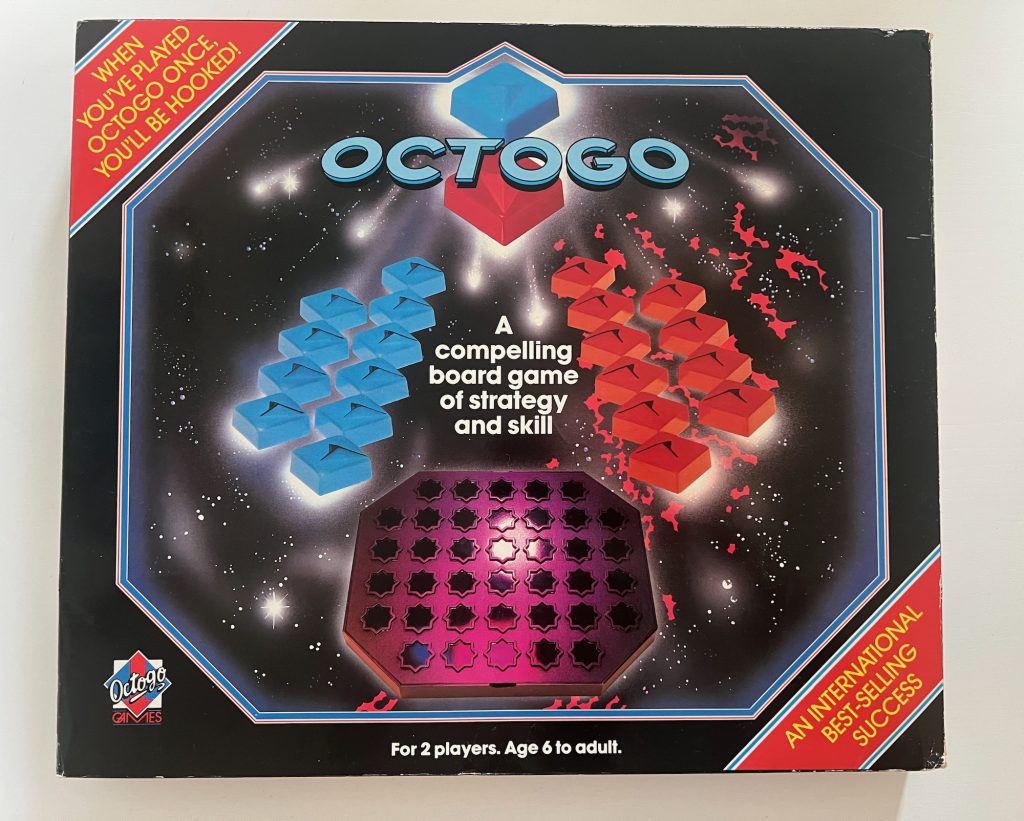
And then there’s the blurb text, which is extremely optimistic. Is it “a truly amazing breakthrough in the field of strategy and board games”? No, but that’s not a comment on this game specifically—like all games, it was invented, not unearthed as a fundamental truth of the universe. And while it’s easy to say from a 2026 standpoint that it was not “the board game of today that is destined to become a classic of tomorrow”, I can’t help but wonder if that would have raised eyebrows even then. Then again, some parts are uncannily accurate. Google tells me that one line of the French blurb text back-translates as “play once and you will be afflicted with Octogomania”—I can’t think of a more accurate description of my actions that lead to this week’s post.
I also fear the box undermines its message that this is not an overcomplicated game—the bit that attempts to prove it with a three-step photo story only gets you as far as setting the game up. Which is a shame, because there’s a beautiful simplicity to it:
- Each player’s piece is a square with an arrow in it, which can be placed in each of the spaces in the board with the arrow pointing in one of eight possible directions. (It can “octo-go”, you see.)
- In a single move, you can move a piece one space in the direction shown on its arrow, or rotate it 45 degrees. On your turn you either make one move, or two in succession with the same piece.
- If at any point a piece passes over one of your opponent’s pieces, you capture it, but you can’t move over capture your own pieces.
- The last player with pieces wins.
There’s a special rule for what you do if you get down to one piece each, but otherwise I’ve explained the whole game.
So how does it play? Well, I’ve had three plays through now, and as a result I am inordinately fond of this game. I can see how the strategy comes in: in particular, the set of possible moves is just wide enough to allow you to capture pieces by “forking”, much as in chess. The arrows are also a clever touch. From what I could tell, the endgame strategy essentially involves forcing your opponent’s last piece into a corner, quite literally, so that it has to waste time turning around to get out again; eventually that takes just long enough that there’s no escape. I note that there seems to have been some effort to optimise the board for this style of play—the grid is a rectangle with the corner spaces removed, so that instead of having four spaces with only three directions of escape, there are eight spaces with only four.9
Maybe Octogo was never going to replace chess and draughts. Maybe it wasn’t the future of board games. But posterity doesn’t always reward the most deserving ideas. Octogo isn’t available new any more, but Monopoly exists in innumerable variations. And if you gave me a choice of one of those two to play, I know which I’d pick.
Although, since my second-hand copy of The Game arrived yesterday, I’d like to propose a third option.
Thanks to the Calne Heritage Centre and the National Library of Scotland for assistance with this post.
- “Checkers”, for my American readers. I know you’re there (because, before I switched the hosting for this website, the WordPress.com stats package said so) but I fear you’re all bots; all you seem to do is repeatedly download the two PDFs I’ve uploaded to this site without registering any article views. Ah, well, I look forward to reading the ghost story I wrote when I was 15 reported as fact in an “AI summary” in a few months’ time. ↩︎
- Which you just lost, by the way. ↩︎
- As an example: Octogo Games exhibited at a trade fair in 1990, of which more in a couple of paragraphs’ time. Other games advertised in the catalogue are 21 by Noraut, a game based on blackjack, and Chess 2000 by Catalfa House (“Chess will never appear black and white again”; British Toy and Hobby Manufacturers Association 1990). ↩︎
- One of the founders is quoted as saying “I can only attribute this to the long, dark, winter nights they have” (Burton 1988), which rather charmingly bypasses the possibility that it might have something to do with the quality of the game itself. ↩︎
- This game was called, um, Orgy (Games International 1989), and was themed around ancient Roman drinking parties. I wish it weren’t too much of a tangent to go into the story of that game, because it’s quite a ride—pun not intended. ↩︎
- Except in Huddersfield, where the Daily Examiner printed the advertising content but forgot to actually print the puzzle. “Oops!” they said the next week (Huddersfield Daily Examiner 1989). ↩︎
- Which, sadly, appears to be an eco-themed game rather than a colour theming of The Game. ↩︎
- The example that comes to mind is the gentle alphabet-themed game show Blockbusters, which had an extremely hi-tech vibe for a show whose game board was made up of an array of precisely aligned slide projectors. ↩︎
- Although maybe I’m overanalysing this: it also happens to mean that the board is octagonal. ↩︎
References
Brien, Jeremy (1988), ‘Move in battle of the board games’, Evening Post, 19th September, 13.
British Toy and Hobby Manufacturers Assocation (1990), The Official 1990 Buyers Guide: British International Toy and Hobby Fair (London: British Toy and Hobby Manufacturers Association).
Burton, Roger (1988), ‘Iceland warms to West board game’, Evening Post, 27th December, 8.
Clifton, Claire (1988), ‘Home a sweeter home’, The Observer, 27th November, 49.
Devizes Gazette and Herald (1991), ‘Avebury pick up their title’, 6th June, 16.
Garnett, Nick (1990), ‘Minding Your Own Business: Puzzling out a game’, Financial Times, 10th November, VI.
Games International (1989), ‘Orgies live on’, 7 (July), 30.
The Grocer (1990), ‘Hagar the Horrible’s Glog Game and Troi, an electronic puzzle, are the…’, 6th January, 52.
Huddersfield Daily Examiner (1989), ‘Sorry about the missing bit!’, 21st October, 22.
Lapworth, Warren (1990), ‘Little toys for big boys’, The Games Machine, 29 (April), 14–15.
Lidiker, Pat (1987), ‘Doodle earns a million’, Leicester Mercury, 8th December, 27.
North, John (1987), ‘Chairman of board plays for real’, The Northern Echo (Teesside ed.), 8th December, 8.
Octogo Games Ltd (1987), The Game (packaging) (Calne: Octogo Games Ltd).
Salmon, Adrian (1988), ‘The world’s at their feet and it’s all in the game’, Devizes Gazette and Herald, 11th February, 11.
The Staines Infomer (1996), ‘Win… a super “green” board game’, 1st March, 14.
Telegraph and Argus (1989), ‘Chance to win some real fun and games’, 14th October, 19.
The Wiltshire Times (1993, Warminster ed.), ‘Octogo Games Limited’ (classified advert), 29th January, 26.
Leave a Reply