
I’m sorry. I’m sorry this is yet another bloody post about central London, when I was supposed to be writing about all sorts of places you could visit from Oxford. I’m sorry that, as you can tell from the title of this post, this is going to contain a fair amount of Tube geekery. I’m sorry, dear readers, to have failed you. And especially to realise I’ve done so on my twenty-first post, arguably something of a jubilee. Anyway, I’m going around in circles. So from next week this blog is going into self-imposed Northern exile: I’ll be telling you about Victorian cities and ancient villages in districts much further north, and getting out of my shameful metropolitan elite bubble. But for now, let’s have some stuff about the Tube.
Date of trip: Wednesday 20th June 2018
Journey time: approx 1h10 (by train to Marylebone)
Fare: £20.55 (Off-Peak, with 16–25 Railcard, including Zones 1–6 Travelcard)
The London Transport Museum is in Covent Garden, and isn’t actually just about the Tube. In fact, you see a second mode of transport straight away, when you ride back to the year 1800 in their time-travelling lift. Sadly, the lifts on the Tube are resolutely stuck in their own times.
And, more seriously, you see other forms of transport because in 1800 the Tube didn’t exist. Indeed, in 1800, steam railways didn’t even exist, and the first railway service in London, a couple of years later, was pulled by horses. So the top floor tells you all about horse-drawn carriages, and horse-drawn trams, and to be honest there were a lot more horses than I’d expect if this weren’t the third time I’d visited.
The next floor down tells you about the Metropolitan Railway, and at this point I could just give you a potted history of the Tube for the rest of the post, but I’m not going to. I am instead going to tell you that, in honour (I think) of the hundredth anniversary of women’s suffrage, this floor currently has two temporary displays about women’s contribution to transport in London, which is still seen overwhelmingly as a subject of interest to men,¹ and still somewhat as a man’s profession.
![A roundel with a purple circle and a blue bar, reading “ELIZABETH LINE”. It is suspended from a wall. Behind it is the title of an exhibition “SECRET LIFE OF A [obscured]GAPROJECT with some images dotted onto a white wall.](https://escapingoxford.blog/wp-content/uploads/2018/07/dsc_0512-150x150.jpg)
The main temporary exhibition is called “Poster Girls”, and features posters from women artists throughout the history of London Transport. As something of a Tube fan, I’m aware of some of the most famous and most-reprinted posters throughout the organisation’s history, and the revealing thing here was that I’d seen, I’m pretty sure, none of the ones in this exhibition before. Not because they were any less good. Just because the famous designers all, somehow, ended up being men.
More directly revealing from a gender-equality point of view was the second display, of recruitment posters over time. Women first worked in transport jobs when there were labour shortages during the First and Second World Wars, but for years after that, even when hired permanently, women had poorer pay and fewer job benefits, and were still excluded from some roles. (Of course, some back-room roles were only for women, because it just wouldn’t do to have a man serving tea.)
Later, people realised that this was, to put it bluntly, stupid, and it wasn’t long after LT introduced gender equality that discrimination in employment on gender grounds was outlawed. But this was still in the late sixties, which to modern eyes (well, to me) still seems shocking. Posters from this period are shown too, including one aimed specifically at increasing equality within the labour force with the slogan “Who needs women drivers”, with, in smaller type, “and pays them really good money?”.
Downstairs is the more modern stuff, and the buses, and quite a lot of stuff to geek out about if you geek out about the Tube. (Incidentally, if you geek out about the Tube, I recommend visiting with someone else who enjoys geeking out about the Tube, but not if they’re also someone who enjoys taking pictures of you geeking out about the Tube. No, you can’t see the photos.) There’s also a display on Crossrail, which I will refuse to call “the Elizabeth Line” as long as people know what I’m talking about when I don’t.
This trip was followed by a pilgrimage to Aldwych, the disused station just off the Strand whose street-level remains are clearly visible, and which is used for filming underground. (Unlike most disused Tube stations the line is also closed, so it’s convenient for that. Aldwych tends to represent an “old” Tube station, whereas they use the nearby disused Jubilee platforms at Charing Cross for a “modern” one.)
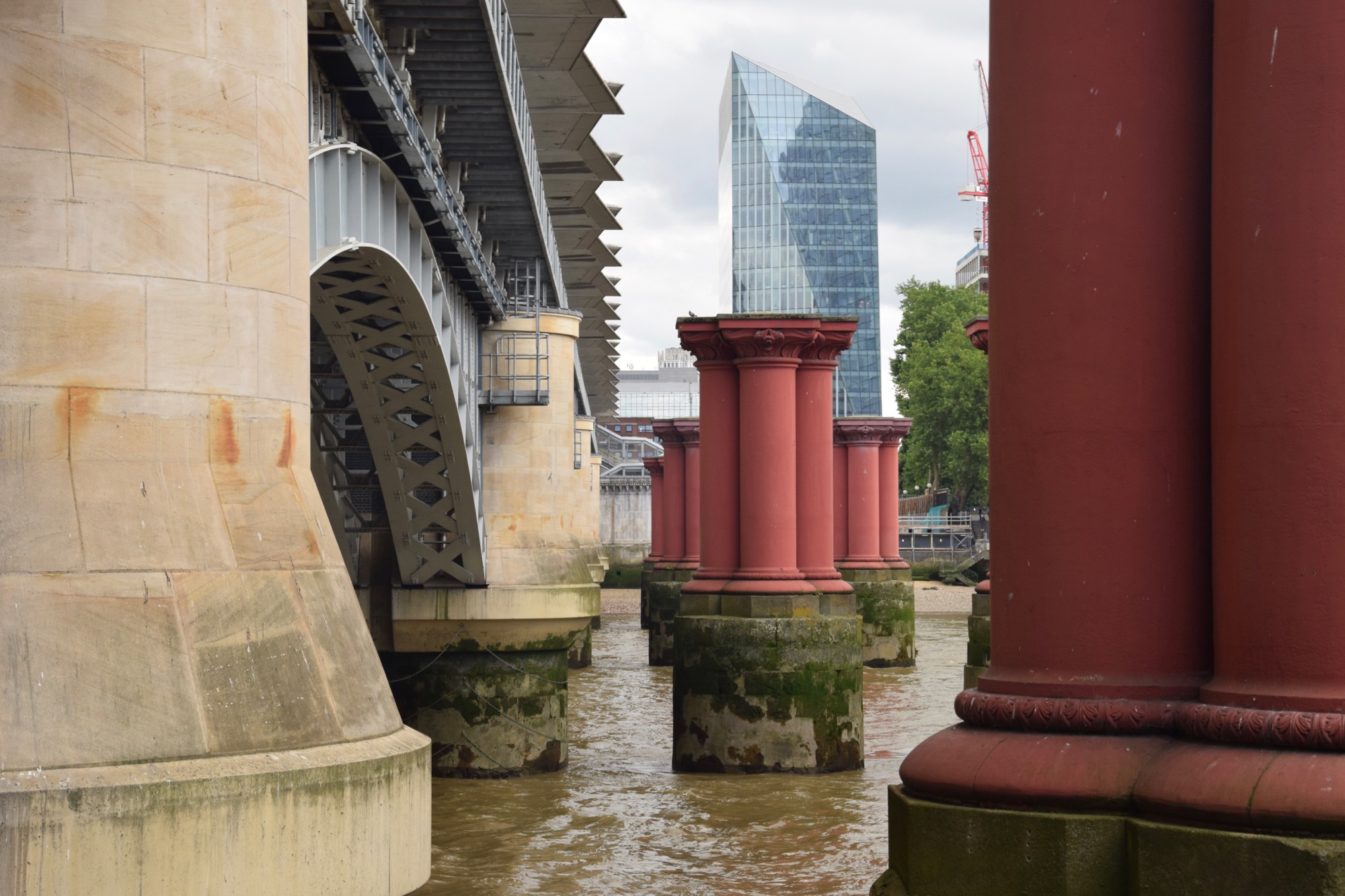
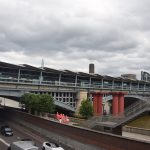
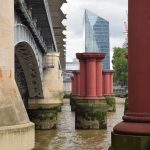
We then walked along the Thames for two more bits of transport geekery. Firstly, we went under Blackfriars Railway Bridge, which is now home to Blackfriars station itself. The station was extended onto the bridge, which was cleverly widened by using the adjacent piers of a disused railway bridge, disguised to look like those of the one still in use. If this doesn’t make sense, look at the pictures. (Assuming I’ve remembered to include a picture of this, when I added the pictures.) But yeah, a station on a bridge is pretty cool, no?²
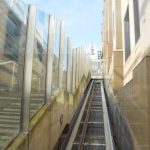
London also has a funicular railway near here: a railway where the carriage runs on sloping rails, and is pulled by a rope at the other end of which is a counterweight.³ Its purpose is to provide an alternative to the steps that lead from the Victoria Embankment to the bridge deck of the Millennium Bridge, most famous for being the wobbly one that they had to close for two years days after it opened so people stopped feeling sick.
Well done if you made it this far through a transport-heavy post. Hopefully it was vaguely interesting to you even if you don’t geek out about the Tube. If it wasn’t, then the good news is that I’ve wiped out most of the “interesting” transport things I can write about in central London in this one post, so at least you won’t have to suffer through this again.

¹ Quote from a magazine on display in the museum: “And just to remind you—make sure you take home a copy [of London Transport Magazine] to your own boy: he is sure to enjoy it. There is something, too, for everyone in the family, including a page for the womenfolk.”
² I mean, Leeds had has a station on a bridge since 1869, but as I said in my introduction, apparently I’m now a member of the chattering south-east classes who thinks there’s just a huge wasteland north of Watford Gap.
³ Strictly speaking, it’s only a funicular if there are two cars which are each other’s counterweights, so if one goes up the other goes down; if it’s a car with a counterweight, it’s an inclined lift. But one of the most famous funiculars in the world is the Funiculaire de Montmartre, and they decoupled the cars in the nineties. So if Paris can call its inclined lift a funicular, so can London.
Leave a Reply