
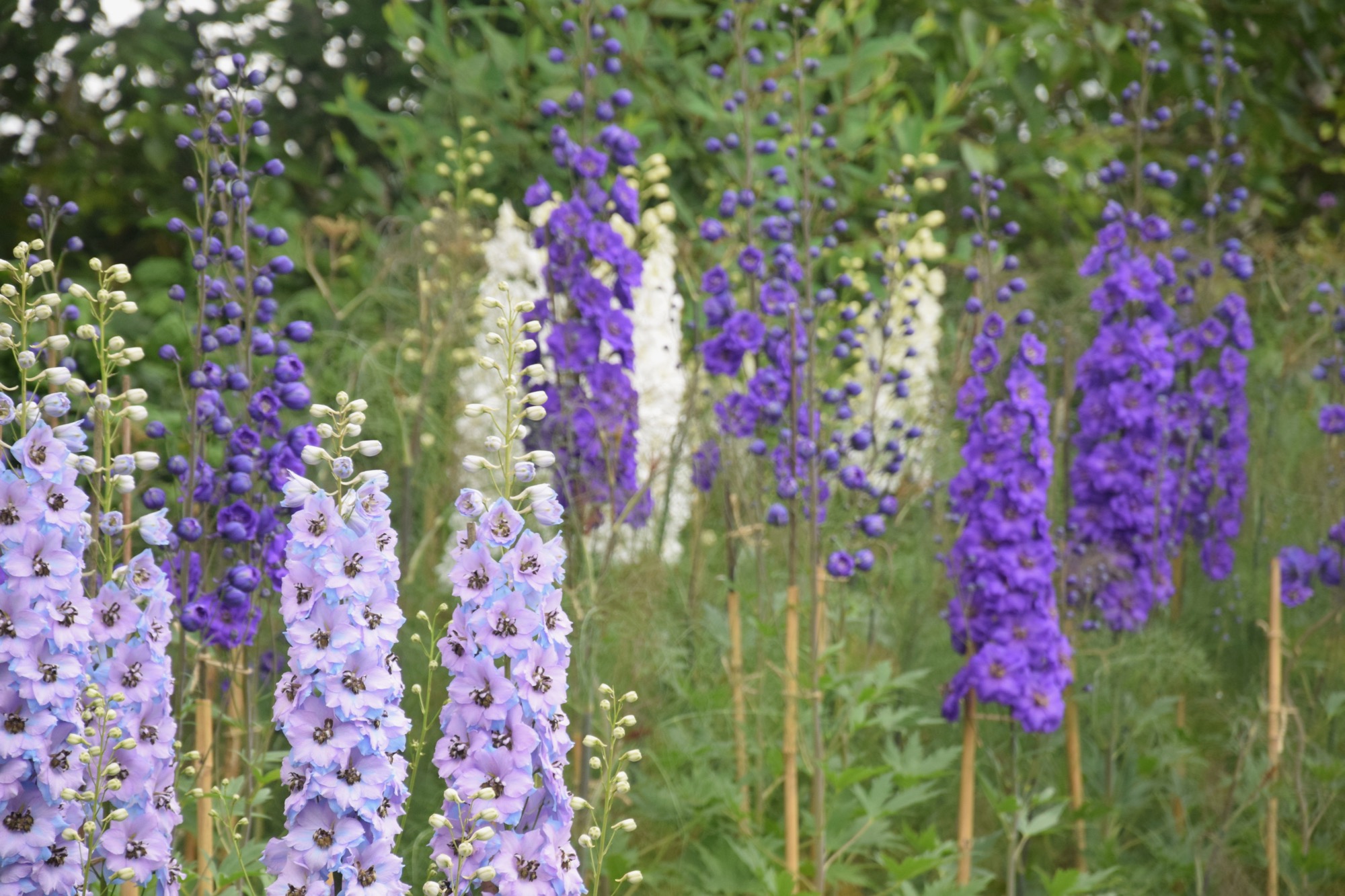
On Tuesday I went to see Hamilton, which I’d highly recommend (if you haven’t listened to it, shame on you). I am not a theatre blogger, so I’m not going to tell you about that, and it’s not exactly the venue for an impromptu day trip given that tickets are hard to come by. So instead, this week and next, I’m going to tell you about what happened earlier in the day.
Date of trip: Tuesday 12th June 2018
Journey time: approx 1h10 (by train to Marylebone)
Fare: £17.55 (Off-Peak, with 16–25 Railcard; you can walk to the park from Marylebone)
Devoting a whole blog post to a park and that other park that’s basically the same park might seem like an exercise in padding. That would not be entirely inaccurate. After all, I went on for a paragraph just last week about how you shouldn’t just go to a park and assume it will be interesting. But I think we can probably make an exception when the park is a Royal Park.
Regent’s Park—the Regent’s Park, if we’re being formal about it—is one of eight Royal Parks in London, these making up most of the famous ones. They’re still the property of the Crown, and the public still don’t have any actual legal right to use them—you’re allowed to wander around because the Queen is nice like that. They were formerly hunting grounds, but don’t expect deer any more.
Instead, expect large numbers of mislabelable waterfowl on the boating lake, including the Australia and Tunisian varieties of pigeon, plenty of Flying Scotsman cormorants, and of course, as befits a royal park, silent nightjars, which are still all owned by the Queen. Unfortunately, the presence of large numbers of birds leads to the presence of large amounts of bird mess, so it’s not always the most, er, pleasant walk. However, while pigeons are normally scary and prone to attack people walking past, the ones here seem tame, perhaps because of the large number of visitors.


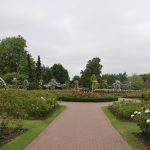
But enough fowl play, what of the rest of the park? The park contains two loop roads: the Outer Circle paralleling the boundary of the park, and the Inner Circle forming a perfect circle in the centre. Within the latter are the ornamental gardens, including a fountain of Triton slightly more impressive and less burbly than the one in Oxford. It also contains Queen Mary’s rose garden, which, in spring, smells as beautiful as it looks. I don’t know much about flowers (as evidenced that time I wrote about a botanical garden), but pretty!
Outside the Inner Circle, but inside the Outer Circle, the park is mostly, well, parkland, though it does contain the campus of Regent’s University London (not to be confused with Oxford’s own Regent’s Park College, but that does get its name from the fact that it was situated in a house on the edge of the Royal Park before it moved to Oxford). It also contains ZSL London Zoo, but that costs £££ to get in, so we didn’t go. But we could hear the children’s show in the crow enclosure from the path alongside (“On the count of three: what’s crows’ favourite food… One, two three:” “Fish!”) and I’m pretty sure that’s an equivalent experience. The crows are probably more exciting in the imagination anyway.
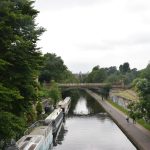
And finally for Regent’s Park is the Regent’s Canal which runs along the north, which connects the Grand Union Canal (the main canal connecting Birmingham and London) to the lower reaches of the Thames at Limehouse. It’s very pretty, and you can walk along it to Camden, of which more next week.
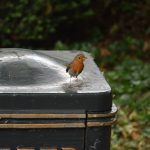
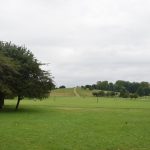
So, alright, Regent’s Park is, arguably, just a park, unless you’re going to the zoo. But it’s a very pretty park, and very big, and in the middle of a huge urban sprawl it’s always nice to get out into green space. It’s also really fun if you have a camera, because it’s ludicrously photogenic: not just the rose gardens and the birds, but also the little bridges over streams with islands,¹ the isolated patches surrounded by trees,² the open lawns.³ Even the dustbins are photogenic if you stick a sparrow on top. (Also the toilets are the cleanest I’ve ever seen in a park.)






Right, so that’s Regent’s Park. But across the road is Primrose Hill, and that’s quite spectacular. (Primrose Hill is also the name of an area of London, and that’s not spectacular, though it is pretty nice. I’ll be writing about that next week, though. Writing about things I’m going to write about, incidentally, is an excellent way of providing extra padding. As is making meta-comments about the process of blog-writing. But anyway.) For a start, it’s spectacular because it’s a hill—not a large one, not if you come from Yorkshire—or even if you walk up to Headington—but a hill nonetheless. You don’t get many of them in London.
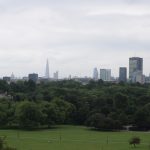
And the fact that there aren’t many of them means that when you do get one, you can see a bloody long way. This especially holds here because it’s the start-point of one of London’s protected views. There are a number of corridors across London along which the development of high-rise buildings is restricted, so that certain landmarks can still be seen, and two of these corridors start at Primrose Hill, to ensure that you can still see the comparatively low-rise Palace of Westminster and St Paul’s Cathedral—the latter restriction being particularly important with all the skyscrapers in the City of London.
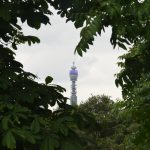
Of course, the skyscrapers of the City and nearby are also a sight to see in themselves, named, in the typical London style, after objects that they vaguely resemble (the Gherkin being the original, followed by the Shard, the Cheesegrater, the Walkie-Talkie…). And then Canary Wharf beyond, and the BT Tower, and (closer by) St Pancras station, and the assorted rooftops of north London. It’s honestly quite breathtaking—maybe not quite as dramatic as The View from the Shard, but also 100% less expensive too. And there’s even a metal sign showing you what you can see, newly installed for when the Shard became a thing you could indeed see.
And there you have it—how to write a thousand words on a park and that other park that’s basically the same park. You should visit.

¹ I haven’t actually provided any pictures of these, sorry.
² Ditto.
³ In hindsight I should probably have selected my pictures before writing the paragraph about how photogenic the park is, but oh well.
Leave a Reply