
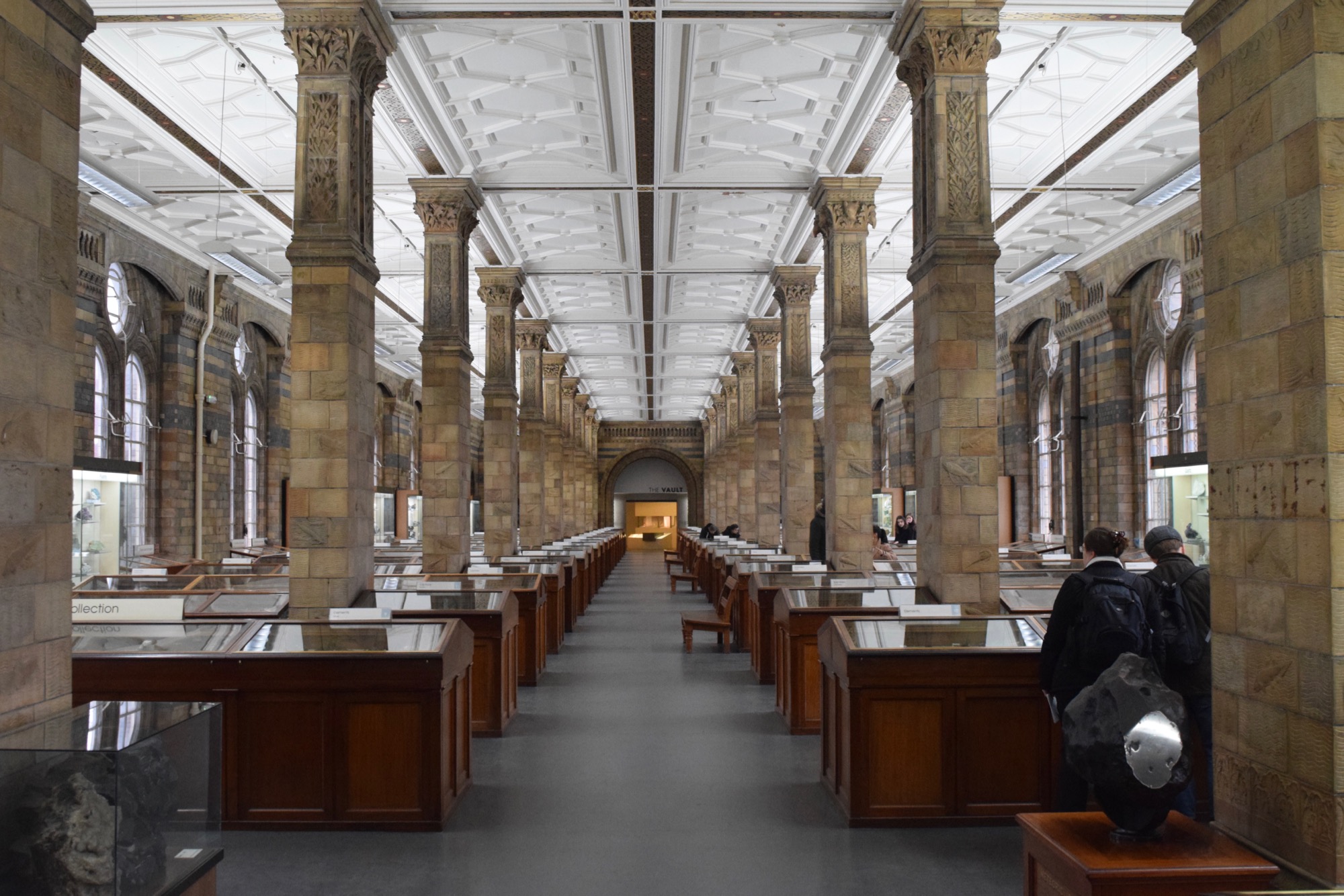
Last week I told you about three museums I visited dotted around London, and where to go to get away from the hordes of tourists (let’s pretend for the moment that I wasn’t also one of them). This week I’ll tell you about three more: specifically, the three museums in that part of South Kensington known as “Albertopolis” (at least, according to Wikipedia).
Date of trip: Wednesday 11th April 2018
Journey time: approx. 1hr10 (via the Chiltern line)
Fare: £20.55 (Off-Peak, with 16–25 Railcard, including Zones 1–6 Travelcard)
Victoria and Albert Museum
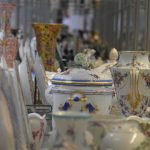
Despite the fact that I love visiting the V&A, and have been several times now, I’m never actually sure what it’s supposed to be a museum of. Mostly it’s various forms of art and design, but it also contains collections of classical sculpture that you’d think would be in the British Museum. The museum is organised by the objects’ function, rather than where they’re from; strongly recommended is the jewellery room, which displays spotlit sparkly things against a black background, so the effect is pretty stunning (but I didn’t go there this time).
I decided to try the very top floor, on the assumption that that would be the quietest part of the museum. That holds two collections: the furniture gallery, and the porcelain galleries. My preference was for the former: there are various displays explaining intricate techniques for making the objects that you really can’t believe anyone can be bothered to do by hand. The porcelain galleries, meanwhile, are impressive, but somewhat overwhelming, with long floor-to-near-ceiling glass cases filled with chinaware in the middle of the rooms, and down the sides. It’s still worth a look, though, if for no other reason than the view down into the entrance hall from the central room (unless you’re scared of heights, of course). There’s a special exhibition room too, which was… well, to be honest, kind of grim, being made up as it was of pottery models of dead animals, but, hey, if that’s your thing…
Having said all this about the quiet rooms, I should point out that when making my way down the stairs and out of the museum to move on to the next, I realised that the various other galleries I walked through (architecture, glassware, fashion, etc.) were not much busier, and this was in the school holidays. So, to be honest, if you’re planning a visit to the V&A, I’d say just go to whichever bit takes your fancy.
Science Museum
This was my favourite museum as a kid; I remember well, on a trip to London when I was about six, being excited by the working model of a flushable toilet. And I think that’s the problem I found visiting it as an adult: it very much feels like it’s now entirely aimed at engaging children with science. This, of course, is fantastic—it is probably for the best that the dusty cases of glass Klein bottles have been put in storage and been replaced with more accessible exhibits. On the other hand, it does make it less appealing as a place to visit if you are not a child, and don’t have children that you’re trying to keep occupied. (I’m also unconvinced that charging families £8–£10 per person to visit the new interactive gallery is particularly in line with making science accessible.)
There are still things to see if you steer away from the specifically children’s galleries towards the ones aimed at a general audience: in particular, Information Age, the gallery about six communication networks that transformed the world, is excellent (not that I went there this time either). But even these galleries have the potential to be utterly packed, and indeed this was the only one of the six museums in these two posts where I failed to find anywhere even remotely quiet—even the Clockmakers’ Museum was thronged with families (is your child texting about horology?).
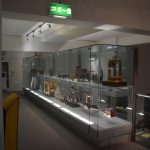
The best I could do was the Model Gallery above the Making the Modern World room, which displays models of all different kinds: by architects, for training, as toys, and so on. It still wasn’t hugely quiet, but it was still at least calm enough that you could have a good look at the displays.
Natural History Museum
Alright, here goes: I’m going to type the sentence that will make me lose half my readership, and possibly half my friends as well. I know it’s an unpopular opinion, but I just can’t keep it to myself any longer. If you don’t want to think less of me, stop reading now.
I don’t much like the Natural History Museum.
I’m sorry. I don’t have any nostalgia for the place because I never went as a small child, and I never had the dinosaur phase, so all I associate it with is that time I went when I was fourteen and it was too busy to see anything, and they charged us a fortune for a slightly congealed mac and cheese in the café.
But despite this, my dedication to you, my readers, is such that I was prepared to brave the crowds and visit anyway. However, when I turned up, there was a huge and stationary queue to enter, and I’m afraid my dedication to you, my readers, is not quite such that I was prepared to join that, especially when I’d probably be spending less time in the museum than in the queue. And, as it happens, I know where the one quiet bit of the NHM is—it was partly the inspiration for these two posts—so I’m just going to cheat and tell you about the time I went before.
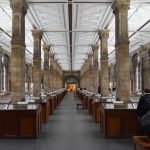
Near the centre of the museum there’s a staircase tucked away a little bit, and that takes you up to the Minerals Gallery. This was the only bit when I went where there was actually space to breathe and enjoy the exhibits, although that may have been because you couldn’t even go up there to look into the Hintze Hall, which was closed during the interregnum between Dippy and Hope. On the next floor up is the sequoia, which is huge.
But, as you can probably tell from the above, I can’t work up any enthusiasm for the NHM, even the bits that aren’t hellishly crowded. Again, I’m sorry; complaints may be sent to the usual address.

So, having visited six museums, how does my theory stack up? Pretty well, I think, with a particular success being Room A at the National Gallery. Even in the Science Museum, which was busy everywhere, it showed me a section I wouldn’t have thought to go and look for otherwise. It was probably least successful in the Tate Modern, and indeed will work less well in modern museums that are uniformly laid out, and hence with uniformly spread-out crowds.
I’m not saying you should try this trick in every museum you visit. But if the crowds are getting to you, try getting away from them, even if the room you’re going to might not have been your first choice. You might be pleasantly surprised.


Leave a Reply