
Hmm, so I’m in two minds about this post. I’m trying here to encourage people to leave Oxford, but it’s already true that if we Oxonians leave Oxford for somewhere other than our hometowns, we probably go to London. But I think this post is still in the spirit of this blog, because the two museums here are both places you might not think to visit, and I think you really should.
Date of trip: Friday 23rd March 2018
Journey time: 1hr30–2hrs, depending on traffic
Fare: £14 (X90 young person return), plus Oyster fares (£4.50 cap with a Railcard for Zones 1–2 Tube travel)
Travel tip: I don’t know how many people know this, but you can add a Railcard to your Oyster card, and you get the corresponding discount on the Oyster cap. This is slightly annoying to do now that the Tube doesn’t have ticket offices, but you can do it by registering your Oyster card online, and then presenting your Oyster and your Railcard to any member of staff in a ticket hall. You can’t do this if you’re paying for Tube travel by contactless.
Design Museum
They have a room with displays of a Tube train, Tube maps, road signs, logos and fonts all together. That’s all I need to say.



Alright, yes, I realise that that’s not a reason that will necessarily be hugely convincing to anyone else. But I went on this trip with three other people and they seemed to enjoy themselves too, so either they were humouring me or this is a good place to visit.
The museum’s main gallery, on the top floor, is called “Designer, Maker, User”, and is free to look around. This is the gallery with the aforementioned display, but it’s quite the eclectic mixture; it displays all aspects of design together, from fashion and graphics to consumer electronics and vehicles. This is therefore partly a study of design but serves equally well as nostalgia (or as “Wow, they actually used those?”, depending on the relative age of object and visitor).
Unfortunately, it doesn’t have the biggest permanent collection; there are two temporary exhibition spaces, but when I visited one contained an expensive exhibition about Ferrari, and one was about the graphics of politics and did look interesting but wasn’t open yet (and also will be moderately expensive when it does). But you shouldn’t miss the small displays on the balcony floor; these seemed to be changing, but were all interesting insights into specific aspects of design: school students’ entries to a product design competition; articles representing good design in the opinion of a famous designer; architectural photos of the museum itself during its conversion; and a display about the typographical evolution of The Guardian.
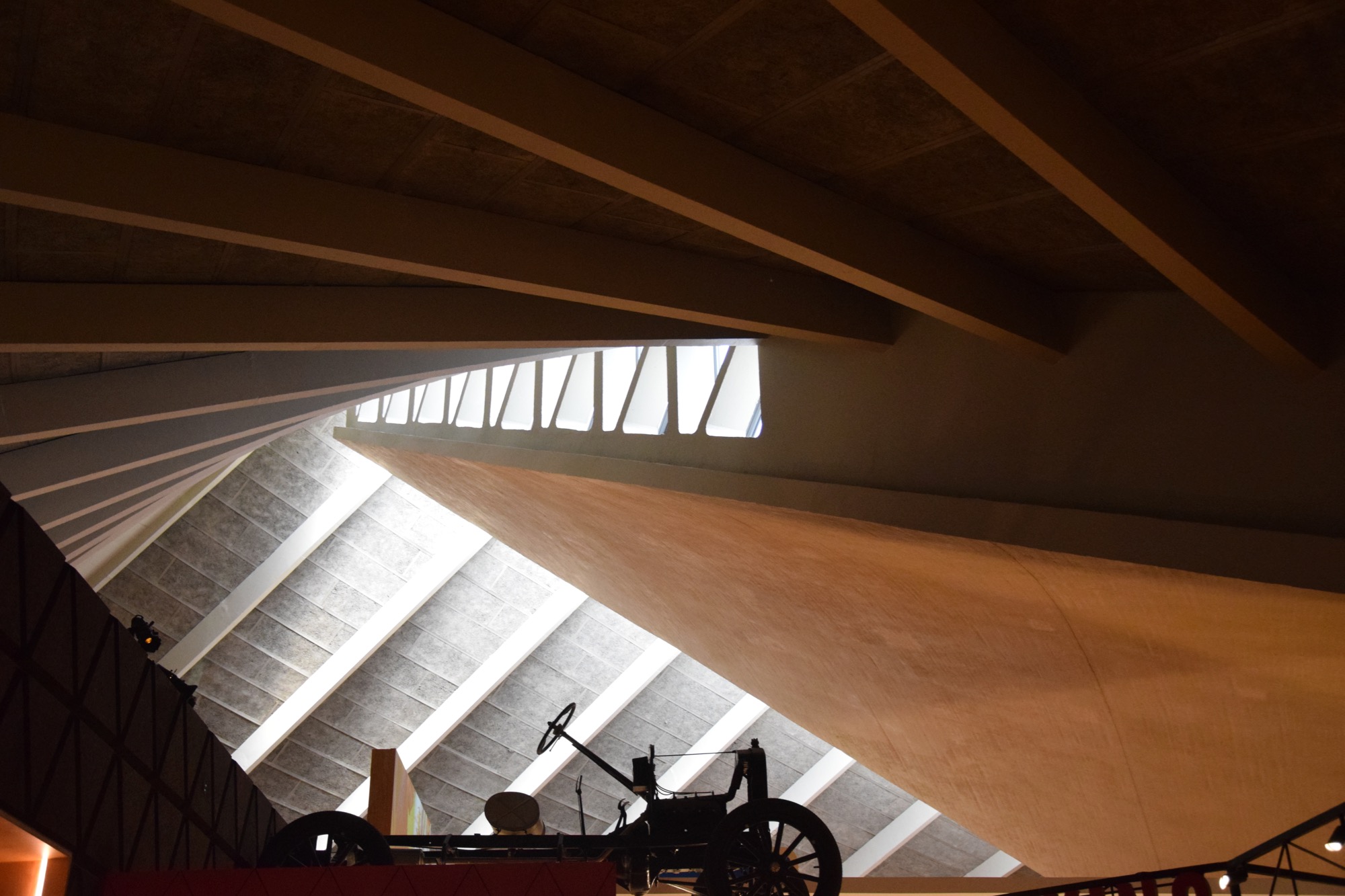
I mentioned that the museum was converted: it’s actually the former Commonwealth Institute, opened in 1962, closed in 2003, and reopened as the Design Museum in 2016. It has a hyperbolic paraboloid roof (the shape of a Pringle), which is visible from the rest of the museum and creates interesting angles. In fact, it was one of the few places I’ve been where being one of the people wandering around taking pretentious photographs did not put me in the minority.
(Nearest Tube: High Street Kensington.)
Sir John Soane’s Museum
Whereas here I would have been in the minority, because you weren’t allowed to take photos (apologies; the rest of the shots on this post will be from other parts of the day). But this is probably the strangest national museum there is (it is in the same category as the British Museum, the V&A, and the National Science and Media Museum, and consequently has free entry—but you don’t get the full experience unless you buy the £3 guidebook, because there are no signs). The museum was the private residence of architect and collector Sir John Soane, who donated his house to the nation on condition that it be kept as it was when he died (hence the lack of signs).
The museum is the sort of house only an architect could have: two-storey spaces open at random, walls with paintings fold out to reveal more paintings, there’s a gratuitous sarcophagus, and so on. Basically, imagine that weird convoluted house you built in The Sims, but in real life. And to be honest it’s hard to imagine its ever feeling like a home, but I love the idea of modifying your house to have whatever strange features you fancied.
What’s particularly enjoyable about it is that, unlike most historic houses, you’re left to roam its interior at leisure, with no pre-determined route to follow, so you can feel a little like it really is your house to roam around. And I assume that’s partly the reason for the “no phones, no cameras” rule; moreover, while I could have got some amazing shots in there, if I’d been allowed to do that then so would have everyone else, and that would have ruined the atmosphere completely.
(Nearest Tube: Holborn.)





The two museums are perfectly doable as a day trip; neither will take a full day, and they’re relatively close (because everything is relatively close with the Tube to connect it). You can, of course, make even more of a day of it by just walking around either part of London. Kensington High Street is your fairly typical affluent London shopping street (think Summertown), but the museum is set in Holland Park—which, to be fair, we didn’t wander around, but it looked nice—and High Street Kensington station itself is near to Kensington Gardens, the western bit of Hyde Park containing the palace. The Soane, meanwhile, is next to Lincoln’s Inn Fields, and you can walk through the nearby Inns of Court (the professional organisations, somewhat like Oxbridge Colleges, that barristers belong to).
Or you can do what we did and take a pointlessly convoluted trip on the Tube. But I already bored my friends with the actual trip, so I’ll spare you the details.
Leave a Reply