
I am so excited to write this one. So so so excited. Literally, this is a whole post about a Tube station. I’ll try and make it interesting for the rest of you too.
Date of trip: Wednesday 30th January 2019
Journey time: approx. 1hr10 (via the Chiltern line)
Fare: depends on the time of your tour; I spent about £23, plus Oyster fares, in order to get there in time (and for once bought Advance tickets)
But before I go on, this is post number 52, which means, as all you calendar nerds out there will notice, means that this marks a whole year of Sundays on which I’ve posted.¹ Which, before I started, I wouldn’t have imagined in a month of Sundays. So let me just take a chance to thank you, whether you’ve been reading for the whole year or this is your first post. You’re awesome. (Incidentally, from the stats on the page, I’m pretty sure I have a couple of regular readers who’ve found this blog via other means than my posts on Facebook. If that’s you, why not fill in the contact form and say hello?)
The London Transport Museum runs a series of “Hidden London” tours. These are opportunities to look around various parts of the TfL estate that aren’t normally open to the public—and, somehow, I’ve never managed to go on one. I still wouldn’t have, had a very kind friend² not received a ticket to one from their equally kind mother, who offered to give up her place so I could go.
This tour was of Charing Cross station. Now, at this point you might be confused, because Charing Cross station is indeed open to the public. It’s on the Tube Map and everything. If you’ll look, you’ll notice that it serves the Northern and Bakerloo lines; indeed, if you wanted to interchange between those two lines, it looks like a better choice than the other two possibilities, because the lines overlap rather neatly there rather than being bridged by a pair of thin black lines.
The thing is, this is yet another example of the Tube Map’s ability to mislead. In fact, if you try and interchange there, you’ll end up walking down corridor after corridor, up and down escalators, and end up wishing you’d just walked from wherever you started from: at least you’d have been in the fresh air, instead of dank tunnels.³
There’s a reason for this: what’s now Charing Cross station was once two stations, called Trafalgar Square and Strand. They were joined together in the seventies, when the Jubilee line was built; the new Charing Cross formed the southern terminus of the new route, the new platforms joining the former two stations together. But then, twenty years later, the Jubilee was extended, and the extension had to be built from further back along the route to avoid a tight curve. Thus an orphan branch was created, closed just twenty years after it had opened.

It’s now nearly another twenty years down the line;⁴ the platforms have been shut almost as long as they were open. Our guides took us down shut-off escalators to an empty concourse, where we had a short presentation on the history of the site before we were led out onto the platforms. The whole atmosphere was eerie: a platform with no trains, a hallway with no passengers; announcements from the working station echoing around the blank walls.⁵
The platforms are in pretty good nick, though, maintained almost to running standard. There are two reasons for this. One is that the line is still live, because this branch has its uses for the Tube. Various innovations were tested there; the platform hump that provides a point of step-free access to the train, for instance, or the glow-in-the-dark lights marking the exit in an emergency (never rolled out, because they faded too quickly). Meanwhile, the concourse between the platforms is used for busker auditions, presumably to mimic the acoustics of the places the buskers play.
The other use for these allegedly disused platforms is that, when a film or television programme wants to represented the Underground, they can’t normally shut down an entire station to accommodate the actors and cameras. So there are two main sites used to represent the network, both on disused branches in central London. If you want an old-looking station, Aldwych is your best bet. If you want a modern one… well, you can guess where they use.
The guides played us a montage of clips featuring Charing Cross; perhaps the most famous in recent times was Skyfall, which used the site for months on end to produce just a few minutes of film. For this, Charing Cross stood in as both Embankment and Temple, and fake signs were put up to represent the two stations—one of which, unusually, the film-makers left behind.⁶ Meanwhile, for a different (unidentified) film, various fake posters were up, including one for a film starring “Hugh Jass”.
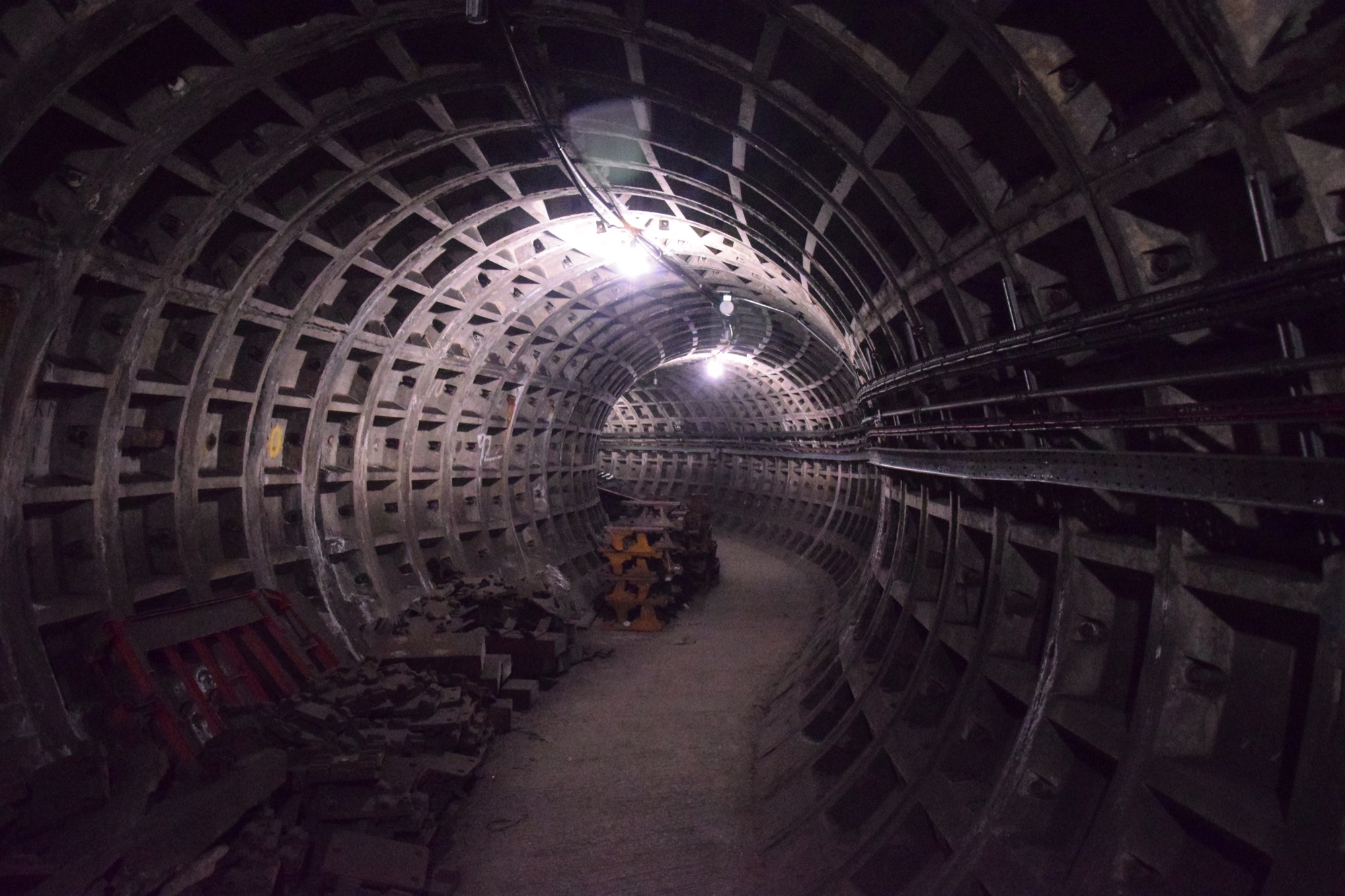
We left the closed-off bits of the station soon after and headed into the public spaces. But there was still more to show us, in darkened, undecorated tunnels. One of these was the ventilation shaft for the Northern line; we had the (frankly, scary) view through a grille in the floor down to the station, before walking to the other end and seeing the huge shaft that lets in air (and apparently reaches almost to the height of Nelson’s toes in the square across the road, though is well-hidden from the street. We were also taken into a construction tunnel, which was very #aesthetic (see photos).
Our guides were fun and friendly, and gave us lots of information with plenty of opportunities for picture-taking.⁷ I suspect, however, that this tour would mostly be of interest to railway buffs, and perhaps of limited appeal if you’re not. The other tours, such as the one of Clapham North bomb shelter, are perhaps more suited to a general audience. I’ll let you know when I’ve been—after this, I certainly intend to.

¹ Alright, I missed one, but I posted the next day instead.
² The one who led me to some of the most interesting places I’ve visited for this blog, that I’d never have thought of otherwise. I maintain that this perhaps should be his blog and not mine.
³ Which are not like dank memes.
⁴ Pun not intended (indeed, only noticed during proof-reading).
⁵ There was a fun moment when we all joined the recorded voice in a chorus of “See it, say it, sorted”.
⁶ It doesn’t say the fake name of the station, but you can still tell it’s a prop; it directs you to the Circle and District lines, which never served this station. Though they did, until the seventies, serve a different station, also called Charing Cross, which is now Embankment. It’s all a bit of a confused mess.
⁷ A note for TfL’s lawyers: we were told that we could not use the photos commercially. Though this site contains adverts, I (at time of writing) make no money from it, and the adverts are required purely because I don’t pay WordPress (at the moment) for my account. If you do want the pictures taking down, please let me know.⁸
⁸ A note for everyone else: this might seem paranoid, but TfL threatened to take someone who made a parody anagram Tube map to court unless they took it down from their site, so I’m not taking any chances.
Leave a Reply