
Have you any friends who go, or went, to the University of Warwick? If so, then there’s a pretty good chance you know a current or former resident of Leamington, because the University of Warwick isn’t actually in Warwick, and, sadly, nobody wants to live in Coventry. Turns out it’s quite a nice place to live, as a friend and I found out when we went to visit one of those Warwick students.
Date of trip: Sunday 17th February 2019
Journey time: approx. 35mins
Fare: £13.20 (Off-Peak, with 16–25 Railcard; you can get it slightly cheaper with a split at Banbury if you can be bothered)
Leamington, or Leamington Spa, or Royal Leamington Spa, or just Leam—or, according to Wikipedia, “Silicon Spa”, but I don’t believe anyone not in marketing has ever called it that—is a spa town in Warwickshire, made “Royal” when the new Queen Victoria visited the town in 1838.¹ (The town’s main bridge, Victoria Bridge, was named after her two years later, as a 21st birthday present. Just what she’d always wanted, I’m sure.) The town grew quickly in that century, owing to the presence of spa waters which people believed had healing properties—to the extent that, for much of the Twentieth Century, the NHS still ran the spa baths. These are now the Royal Pump Rooms, and, while some of the bath complex is preserved, the building is now mostly an art gallery and museum (free to enter), library, tourist information centre, and assembly rooms. (And café, closed for refurbishment.) So, not much there, you know? Also, apparently you can still sample the water from a fountain outside, but I’ve never tried this, and, having tasted spa water from Harrogate and Bath before, am not sure I’d want to.


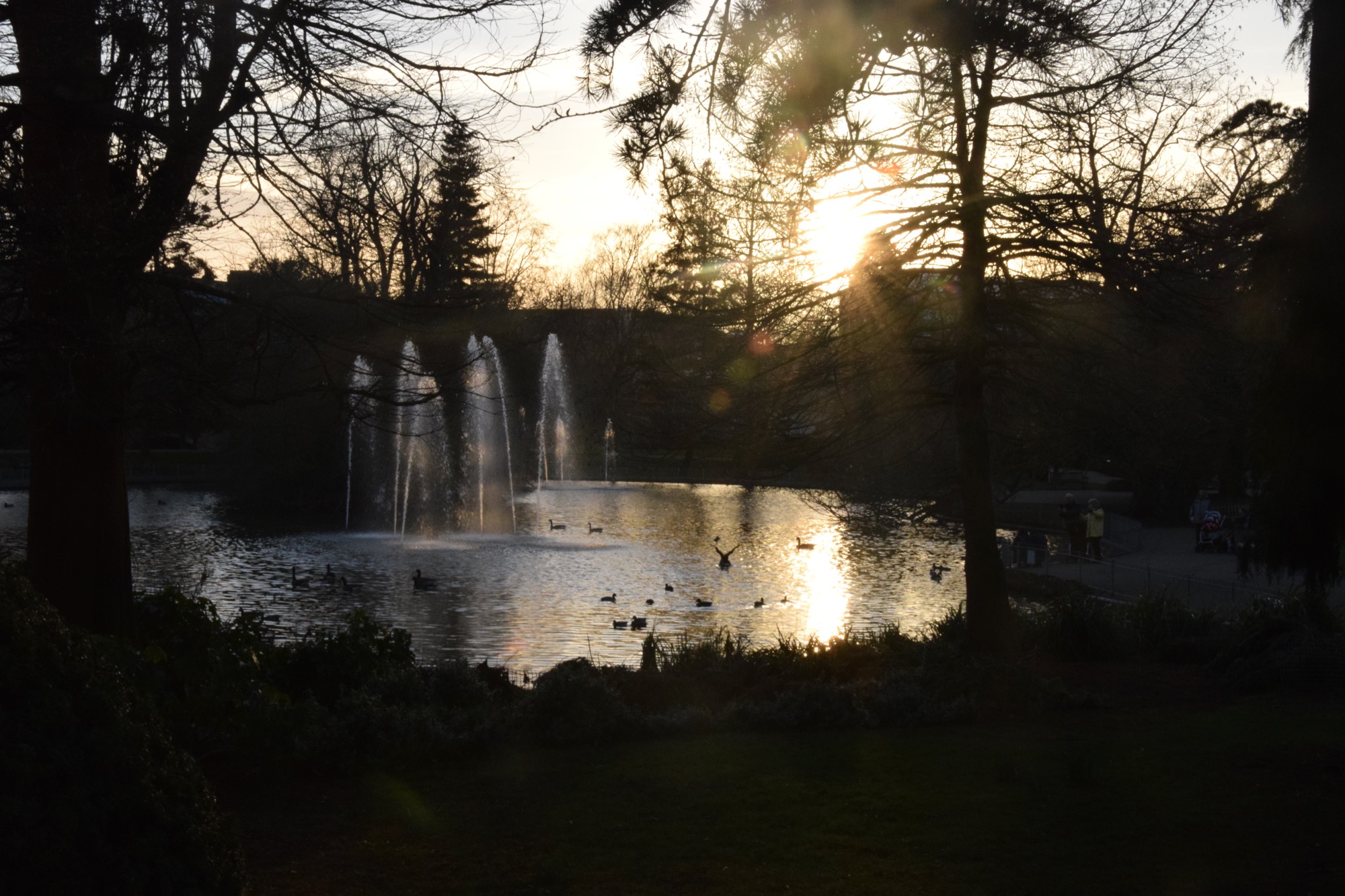
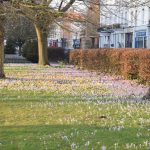
We didn’t go to the Pump Rooms on this visit. (I’ve been before, though, and they’re interesting.) We did, however, go to the park across the road, Jephson Gardens. Dr Henry Jephson, their namesake, helped to promote the spa’s medicinal properties—fairly dubious grounds for a doctor to be commemorated, but still. The park, full of gushing fountains, still lakes, and lush grasses, is bisected by a footpath, which has to remain open even when the park closes; quaint little footbridges join the two sides of the park together, with the path passing underneath.
On the western side is the glasshouse. Compared to the ones at Kew, it’s not particularly impressive, but it probably beats out the ones in Oxford. As well as a variety of exotic plants, it has a stream running through it (you’re asked not to drop coins in because they upset the fish, a warning heartily ignored by legions of past visitors). There is also a display beehive, which you are invited to open, to see… a picture of bees in a hive, presumably something to do with the fact that it’s winter. With this, and the café, and the fact that the restaurant next to the glasshouse had also closed for refurbishment, I got the sense that we’d come at the wrong time of year.
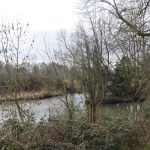
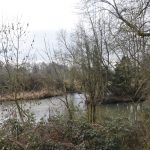
But no matter, the sensory garden was still open, albeit a bit more broken than the last time I visited. And there’s a riverside walk to go on at the far end of the gardens, too. It was mildly muddy, but a pleasant stroll. Although it did peter out at the end, into the grounds of a leisure centre, which was mildly disappointing.
I fear I’m not doing a good job of selling Leamington to you. And, in truth, the town centre has an air of faded glory, with the grand foyers of the grand hotels now serving as oversized entrances to restaurants and shops, the budget chains that have taken over the rooms upstairs having a smaller door up the road. The smart white façades of the Regency buildings on the Parade, while still impressive in their uniformity, are fairly uniformly peeling too.² But there’s a lot more there than I expected before I visited.
Incidentally, did you know squirrels make nests? We discovered this when we saw a squirrel carrying a stick about twice as long as the squirrel was tall, and spent several minutes mocking the silly squirrel for its useless, impractical acquisition, until we realised that it wasn’t useless after all (but was still impractical, in our defence).
Back to Leamington, then, with one last fact (if you can call it a fact): there are a lot of bowling greens there. (Indeed, when I went on a previous occasion, the banners of various county bowls associations were suspended above the Parade.) Bowls England is headquartered there, you see, and so the annual national bowls tournament is held there, as will be the tournament for the 2022 Commonwealth Games (in nearby Birmingham). I can’t find out why this should be, but, as a northerner, I do know they play the wrong type of bowls.
So, to bring this to a conclusion: should you Leamington? Well, maybe. It’s a pleasant place, not far away, and with lots of general outdoorsy things to do, which makes it a decent destination for summer—but I suspect you’re more likely to have a reason to go if you have a friend at the University of Warwick. If you do, why not go visit them one Saturday afternoon? I’m sure they’ll jump at the chance, given that you’ll have given them a reason to get out of Coventry.

¹ Fun fact: there are three places in the country with a “Royal” prefix, and all of them have two other words in their name (Tunbridge Wells and Wootton Bassett are the other two).
² I apparently forgot to take a picture of the Parade. Google obliged—and, of course, when I typed “parade leamington flickr” into Google Images, the best image to appear was by Diamond Geezer, who has almost certainly already written about anywhere I write about. His write-up is probably much better than mine, but if I read it to find out how much better I’ll lose the confidence to post this, so you’ll have to find out for yourself. 😛
Leave a Reply