

It’s finally time for me to tell you about the third game I bought at Tabletop Scotland. Well, almost. You see, the defining feature of that game is that it isn’t one—a game, I mean. And so, to get appropriate context, we first need to talk about something that is a game.
When there are so many, though, how does one choose? Which example of the genre is most representative? Indeed, what is the game?
Fortunately, Octogo Games has me covered.
The Game
I mentioned this one in my post on Octogo a few weeks ago. As you may recall, I enjoyed that game a lot, even if my friends didn’t.1 And so I thought it was worth seeing if any of their other revolutionary games was worth a try.
The Game—or, to give it its full title from the box, Octogo Presents The Game—is certainly revolutionary. I mean that literally—the board is circular, and all moves are (to borrow language from Pratchett) hubward, rimward and turnwise, as indicated by the arrows on the board.2 The spaces are numbered 1 to 6, each number appearing multiple times. You get six pieces at first, which are placed on the numbered squares according to the throw of the two dice. On subsequent turns, you roll both dice, and can then move up to two pieces, as long as they start on correspondingly numbered spaces.
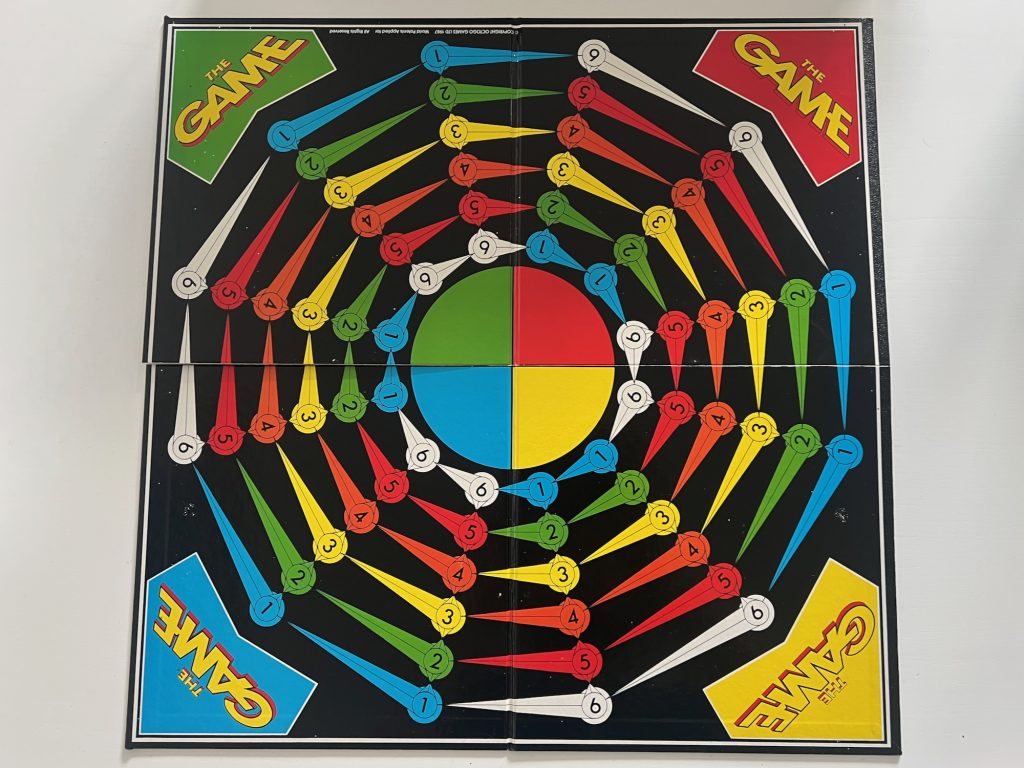
Pieces don’t have to move in a straight line, but do have to move exactly as many spaces as the number on the square they started off on (so a piece that started a turn on a 4 could move one space towards the centre of the board, two clockwise, and one space back out). If the final position of the piece is on an opponent’s space, it captures it. Last player standing—of the two-to-four at the start of the game—wins.
The rules are certainly simple, something it has in common with Octogo—I’ve explained pretty much all of them, with one major exception that I’ll come back to in a bit. Unfortunately, they’re perhaps a little too simple, as written—the rules are written on a sheet of paper that’s a little bigger than A4, which has to fit five copies for the different languages.3 That means that certain edge cases are missed. Can you “waste” a piece’s moves by moving back and forth along a spoke of the board? Not clear, although this doesn’t much matter in practice.4 Are you allowed to land on your own pieces? Probably not, in the spirit of other games, but the rules don’t actually tell you.5 What about, if you roll a 6 and a 5, but only have a piece on a 5—can you move it once so it lands on a 6, and then use the 6 you rolled to move it again? That one really isn’t clear—we assumed not, but it would substantially change the strategy if so.
Speaking of which, the main strategy seemed to be counting which spaces were safe and which weren’t—but I don’t want to dwell on this, because it’s possible there is deeper strategy than we realised from a single play. It’s also not very relevant, because no amount of strategy could resolve this game’s fatal flaw: it starts moderately fast, but before long slows down to a mind-numbing crawl.
With your initial six pieces, unless you actively try to ensure you have at least one on each number at all times, there is some chance that you will only be able to make one move on each turn, and if you’re really unlucky you might make none at all. But once you’ve started capturing pieces, that gets steadily worse. When we were down to two pieces each,6 whole runs of turns passed with neither player being able to do anything because the dice weren’t being helpful.
There is one mechanic that counters this, which is the rule I skipped over—on a double, you can (instead of making any moves) restore a captured piece to the board, as long as it goes on the number that you rolled. It can even capture an opponent’s piece if there’s one in the right place—which seems unfair, but does have the advantage that it keeps the total number of pieces in play the same, so that the game keeps progressing towards its conclusion. Sometimes, though, that isn’t possible, and then it just makes the game go on even longer. In the end, our session turned into a co-op game: both parties declined to use the option to restore, and used their turns to manipulate pieces into a setting where a capture by either side was possible.
I asked one of my opponents whether they felt that The Game had indeed lived up to its promise on the box of being “more exciting than backgammon”. Their response was: “You know what it’s not more exciting than? Octogo.”
True, but they had a tough act to follow.
The Ungame
Alright, this is the big one. I’ve seen a YouTube thumbnail describe The Ungame as “boardgaming’s most hated game”, which isn’t entirely accurate.7 For a start, while its BoardGameGeek rank is low—30,183 out of 30,238 at the time of writing—it’s still a whole 50 places above Monopoly.8 It’s also, as we’ve discussed, very open that it isn’t really a game; in fact, BGG has a note about how, by the site’s current standards, it wouldn’t be eligible to appear.
The Ungame is basically a structured group discussion exercise, centred around a pack of question cards that ask questions to help you get to know better your fellow players. That’s about as much as I can say about it in general, because there are lots of different editions with only that one thing in common. The specific edition I bought from Tabletop Scotland features a board with a looping path around a landscape with different terrain types. Some of the squares on the track tell you to consider leaving the path and going to one of those areas, then (according to the rules) explaining to the other players the reasons for your decision. For instance, the square might say “If you have felt Alone lately, go to Dejection Desert”.
![A close-up of a space on a board for a board game, which reads "If you have felt Alone lately, go to Dejection Desert". The words "Alone" and "Dejection Desert" are in bold. The path is beige, curving around between two spaces with "ungame" printed on them. The left-hand space and another space are decorated like decking, with text on the second that says "If you want to Get Away, b[oard] the Sailb[oat]". Above the curve of the main track is an illustration of what looks like a sandpit with a plastic tunnel, seen top-down, with an arrowhead marked "RE-ENTER" pointing back onto the path. Below the path is a sea-blue colour.](https://escapingoxford.blog/wp-content/uploads/2026/03/IMG_9006-768x1024.jpeg)
I feel I need to clarify at this point that this is a “game” genuinely aimed at helping communication, and not some sort of parody. The story is easy to find online;9 in summary, The Ungame’s inventor was unable to speak for medical reasons, found the experience made her a better listener, and thus came up with the idea. That influence is clearly present in the rules: when a player lands on an “Ungame” space and answers a question, other players may (indeed, are encouraged to) make notes, but may not reply until they land on a “question/comment” space.
I’m therefore not going to review this as a game, because that wouldn’t be in the spirit in which The Ungame was made. Instead, I’m going to review it as a communication exercise. And, seen through that lens, I still don’t think it works.
There are two issues I have, and one is with the questions. My edition came with two packs of cards: pack 1, which is more light-hearted, and pack 2, which is designed for getting to know your fellow players at a deeper level. Pack 1 is fine: questions like “What would you like to receive for your next birthday?” are hard to argue with. Pack 2, though, is where it gets dicier.
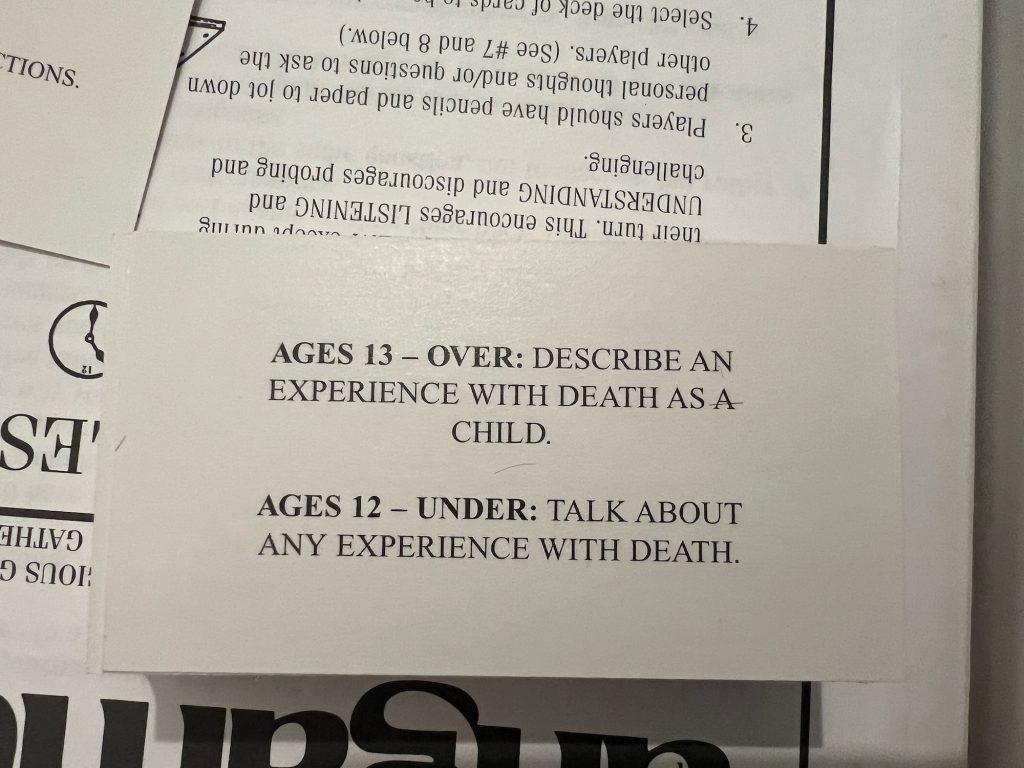
I can imagine some of the questions might be uncomfortable to answer, but do contribute towards The Ungame’s stated purpose of allowing players to get things off their chests—that includes things like “If you have ever felt ‘broken-hearted’, talk about it.” But some are just plain uncomfortable. “Share any experience you have had with a disabled person”, for example.10 The cards at least acknowledge that not all of their questions are suitable for the lower end of the stated age range, which is 5 and over. So the card that asks you to “Describe an experience with death as a child” carries an alternative for pre-teens.
Unfortunately, that alternative is just: “Talk about any experience with death.”
I hope that they’ve amended these questions in more-recent editions of The Ungame, so maybe this isn’t a problem any more. My more fundamental issue, though, is that I’m not sure that the format actually encourages you to get to know your fellow players, or indeed allows them to feel listened to. Even in a conversation where you want to be heard, it helps when people let you know that they are paying attention—maybe by stating back what you’ve just said in their own words, or asking follow-on questions that encourage you to say more.
The Ungame doesn’t let your friends or family do that. They can take notes to ask questions later, but, well—I don’t know about you, but I think confessing my hopes and anxieties to a group of people sitting in stony silence, while taking a record of what I’d said in a little notebook, would make me feel like I was in less of a therapeutic setting and more of an interrogational one. And there’s a reason answers given under duress are less likely to be honest.
The rules sheet does provide suggestions for other ways to use the cards, some of which might be more successful, but some of them are wild. For example:
- Create greeting cards for friends by gluing appropriate Ungame question cards on the cover and writing your answers on the inside.
- Take a deck of Ungame cards with you when you visit someone who is in the hospital, convalescent home or jail.
- Video tape a family playing the Ungame and send it to someone who lives far away.11
And, my absolute favourite:
- Take a pocket version of the Ungame in the car (or bus or plane) to play while traveling or while driving the kids to school. (Choose a designated card reader for the drivers and pilots.)
“Passengers, this is your captain speaking. The first officer tells me that the card says ‘What would you do if you were told you were going to die soon?’ Funny thing, actually…”
So, there you have it: The Game meets The Ungame. The obvious joke to make about them, which I’m amazed I haven’t resorted to until now, is that you couldn’t put them on the same shelf lest they violently annihilate each other. Sadly, having considered both, I’m forced to conclude that that might be for the best.
- Nor, it turns out, did the German magazine Spielbox, which reviewed it in 1989. My copy of the review from eBay arrived too late to make it into my Octogo post; suffice it to say that they thought it succeeded as an introduction to the principles of chess, but not on its own terms. Then again, they also seemed unreasonably annoyed that it had nothing to do with the ancient East Asian game of Go, apparently missing the “you can go eight ways” pun, so I suspect that that may have coloured their review. You be the judge. ↩︎
- The rulebook, though, obviously doesn’t trust you to follow the arrows: “Players may not at any time move anti-clockwise”, it says, raising the question of whether that applies to my own movement rather than that of my pieces. ↩︎
- The name of the game is translated, of course—so the rules translations are for 🇫🇷 “Le Game”, 🇩🇪 “Das Game”, 🇪🇸 “El Game”, and 🇮🇹 “Il Game”. ↩︎
- As long as there is at least one clockwise move, you can avoid doubling-back by moving up and down along different spokes. ↩︎
- Although, when we played, we assumed that you could do so as an intermediate step as long as the piece didn’t end up on top of another of the same colour. ↩︎
- We played as two teams of two, which was probably wise. ↩︎
- I haven’t got around to watching the video yet, because I didn’t want to inadvertently plagiarise its ideas for this post. ↩︎
- Monopoly is arguably the lowest-ranked ‘true’ game on BGG. The games that rank lower are almost all games like Snakes and Ladders that (it can be argued) are not games because they involve no decisions on the part of the player. The only exception is Noughts and Crosses, for which it’s easy for both players to remember a perfect strategy that leads to a draw. ↩︎
- I tried the newspaper archive route, like with Octogo, but it didn’t get me very far: mostly what I got was American newspaper articles retelling the game’s origin story. The main thing I learnt was that a Las Vegas official “ ‘sentenced’ a juvenile offender to six months of the Ungame, to be played with his family”. I can’t help but wonder if that would have stood up against an Eighth Amendment challenge that it was cruel and unusual punishment. ↩︎
- There are some other very uncomfortable ones that I’m not going to share because I don’t want to have to put this post behind a content note. This post on Reddit has pictures if you want the gory details (and was also very useful for reminding me of cards I didn’t take a note of before I gave my copy to charity). ↩︎
- There are several suggestions that involve taping a session and watching it back, or getting someone else to do so. What especially gets me about this one is that it doesn’t state that any pair of the parties—out of (a) you, (b) the family and (c) the person who lives far away—need to know each other in the slightest. ↩︎
Leave a Reply