
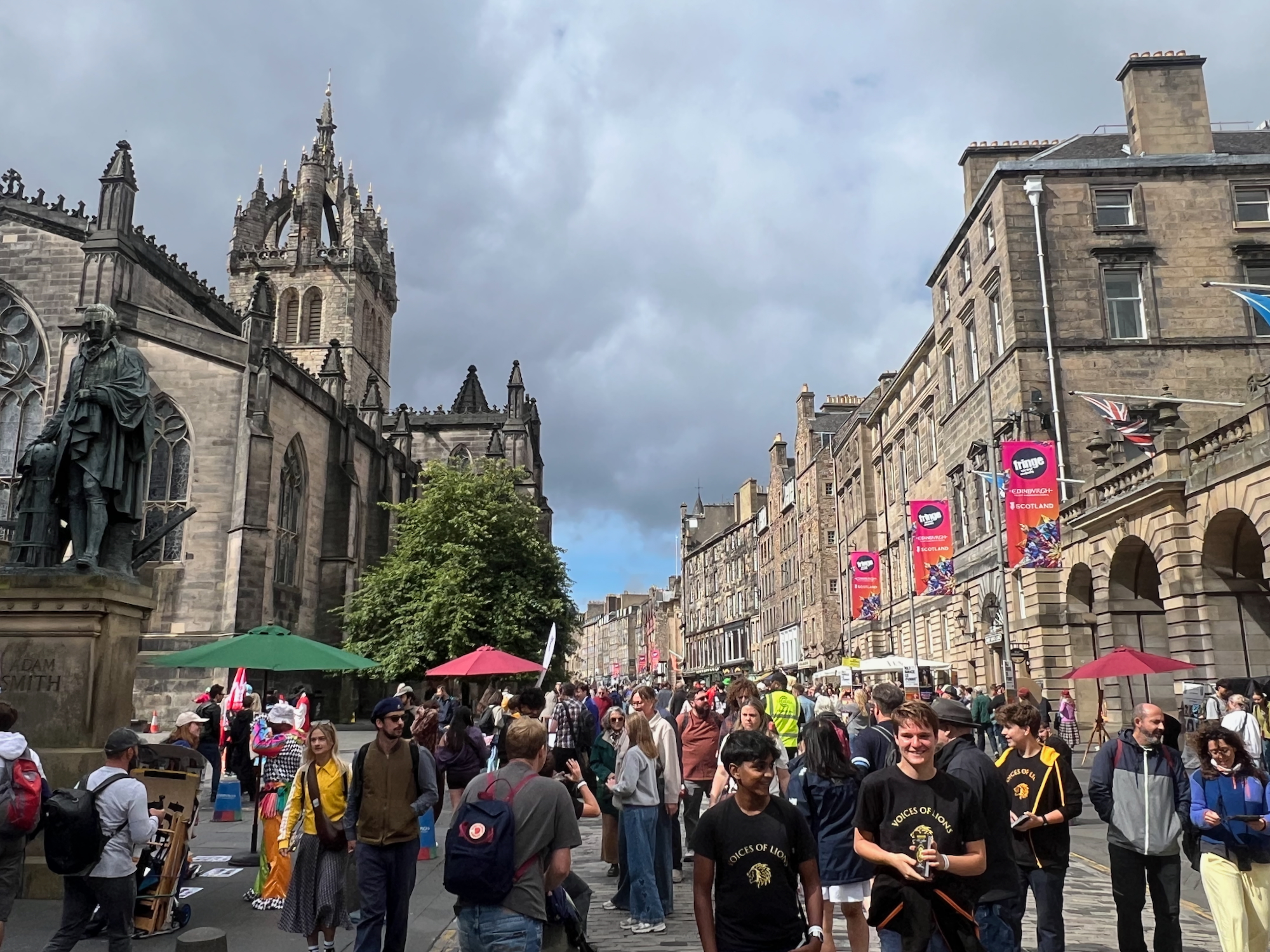
One of the suggestions I had for a post about the Edinburgh Festival Fringe was, essentially, a survival guide. I thought this was a good idea when I read it, but I wasn’t convinced I was qualified to write it: last year I got horribly burnt out by the end of the month, and had a horrible cold by the end to boot. For whatever reason, though, this has been a much calmer Fringe, and a much more enjoyable one. So, here we go: a ten-part guide to having a fun Fringe, based on the 200 or so shows I’ve seen over six years of attendance.
Learn the secrets of the Old Town
Most Fringe venues are located in and around Edinburgh’s Old Town.1 There are two main east–west streets running through it: the Royal Mile, and the Cowgate. Unfortunately, these are at entirely different heights, with bridges crossing the latter, so it’s a bit of a three-dimensional puzzle trying to work out your way around.
The advice here comes in two strands. If you’re aiming for speed, the central section of the Royal Mile is best avoided. The trick here is to find the lesser-known cut-throughs that will help you get quickly from venue to venue. Many of these are the “closes” than run down either side of the Mile—despite the name, an Edinburgh close is typically open at both ends—but there’s also at least one cut-through only open during the Fringe. This is through Underbelly, Cowgate, from the top of Victoria Street to the Cowgate.
A lot of these, though, involve steep slopes or steps, and narrow passageways. So if you’re looking for accessibility… well, you’re still best avoiding the central section of the Mile. I’d also avoid South Bridge where possible, because it gets very crowded with all the tourists mingling with the people queuing for the bus stops. What I’d really like to recommend is a building with a lift that lets you get between the two levels… but I can’t actually think of one.2 The Independent’s accessible guide to Edinburgh suggests that “It’s best to plan your route in sync with the gradient of the city. Consider taking a tram or bus up to a higher point, […] then follow the streets as they gradually slope downhill”, which feels like a cop-out but it’s all I’ve got.
Find the WiFi
One of the other things you’ll need to find in the Old Town is somewhere with internet access, if you want any hope of buying any tickets while you’re out. This isn’t as easy as it sounds: the large number of people in a small area, coupled with the hilly terrain and thick stone walls of the buildings, seems to overwhelm my network, and I suspect most people’s. There are places with WiFi, but some of those networks can’t cope with the number of visitors either.
This goes hand-in-hand with finding somewhere quiet to sit down. There’s an argument that I shouldn’t suggest anywhere for fear I will destroy it as an oasis of calm, but I don’t think that my blog has remotely enough readers for this to be a problem. So… I’ve found that the National Library of Scotland and the Festival Theatre are both useful for this purpose, and both have cafés that don’t seem to attract the Fringe crowds.
Plan, but don’t plan too much
Then again, if you’re booking tickets on the day while you’re out, you’re probably having a more-stressful experience than you need to be: a little booking ahead goes a long way (especially if you can book more than six tickets in one go, so that the booking fee maxes out). If you’re wanting to go with the flow, be prepared not to find something you desperately want to see—not necessarily because it’s not there at all, but potentially because internet and the Fringe app aren’t on your side. That said, if you’re going to the Fringe over multiple days, planning too far ahead runs the risk that you’ll miss out on things you get flyered for, or shows recommended by people you see. This year we’ve mostly tried booking the night before or the morning of, and we’ve found that that’s worked well.
Embrace the awful
One other thing about booking an act or a show you’ve never seen before is that you can never guarantee that you’ll enjoy it. Every year there has been at least one show I’ve seen, and often several, that have been absolutely dire. But I think that, especially over a longer trip to the Fringe, that’s a quintessential part of the experience: in my opinion, if you see only good things, there’s a good chance you’re playing it too safe, and missing out on the unexpected discovery that can be a real joy of the festival (for me, that’s been Becky Price this year). Also, if there’s one thing I talk about more than the shows I loved, it’s the shows I hated—your reward for that painful hour of your life is that you can bore your friends with the story of it for years to come.
Audience reviews are (mostly) your friend
To be fair, though, you probably don’t want to go actively seeking out the shows you’ll hate. For this, you could look at professional reviews, but I’m unconvinced. To be honest, I was unconvinced before this year, but this was confirmed for me when I saw a show called “The Review Review Revue” (part of the Bedlam Late series), which talked about some fairly deep flaws in the whole system.
I tend to find the reviews on the website by audience members more reliable. It’s not perfect, because art is subjective, and comedy perhaps particularly so. But if a show has lots of good audience reviews, it’s usually a good sign. Conversely, people don’t seem to be particularly motivated to write bad reviews on the website—which I would argue is a good thing, in general, because of the subjective nature of it all—so if more than a token number of people are motivated to write about how much they dislike a show, it’s often a bad sign.3
Even better, find other people—preferably whose judgement you trust, or who share your sense of humour—to recommend shows to you. It’s become a cliché at this point that a performer, after wrapping up their show proper, will do a speech to the audience about how “the Fringe runs on word of mouth”, but there’s a reason it became a cliché in the first place.
Talk to people
Of course, you might be Fringe-going alone: because of work patterns, I usually end up going to at least one or two shows, and often more, without anyone else. I’ve written before, many years ago, about how there’s nothing wrong with that, but I accept that it can feel a bit awkward while you’re waiting for it to start. You’d be surprised, though, how often you end up chatting to people (if you and they both want to) in the queue, or in the venue while the pre-show music plays. Or even, in some cases, chatting with the performer(s) afterwards.4 It’s a live festival, after all: in some sense, the whole point is human interaction.
There’s more to Edinburgh than the Fringe
Sometimes, though, you do need to get away from it all. I’ve seen people recommend the Fringe shows in Leith; I can say I’ve never actively avoided a show because it was there, but I’ve equally never seen anything down there that I particularly wanted to see. In fact, I’d recommend Leith for the fact that most of the festival stuff is not going on down there: we spent a peaceful afternoon there on the second Friday of this year’s Fringe, and it’s normally only a short tram ride away.5 Similarly, it’s only about twenty minutes on the bus to Portobello, “Edinburgh’s seaside”. Both have a variety of shops and cafés whose prices are much lower than those in the venue clusters.
There is no link between price and enjoyment
Okay, I’ve got to acknowledge the elephant in the room here: the Fringe is getting progressively more expensive, for both performers and audience alike. There are a number of factors behind this, and I don’t know how you solve it. I’m not even going to try, because I’m woefully underqualified to discuss it—not least because one of the really expensive things is temporary accommodation in the city, and that’s not something we have to pay for. It’s also worth acknowledging, from the audience side, that “expensive” depends on how you look at it: hour-for-hour, compared to the West End, the Fringe is exceptionally good value for money.
What I do know, though, is that the most expensive productions are usually those with big budgets behind them, as you might expect. There is some great stuff in there, don’t get me wrong. But I’ve also paid through the nose to have a terrible time at the venues run by the “Big Four” operators (Assembly, Gilded Balloon, Pleasance and Underbelly). Meanwhile, I’ve seen small one- or two-hand plays, or sets by less-well-known comedians, which have been memorable for the right reasons; some, like Jake Baker, have become favourites that I will now see every year, even if they did start charging £20 a ticket. I haven’t done a statistical analysis on this,6 but I’m pretty sure there’s absolutely no correlation between how much I’ve paid for a show and how much I’ve enjoyed it.
“Free” isn’t always the best deal
Of course, if you pay nothing for a show, it’s arguably infinitely good value. Quite a few shows at the Fringe are billed as “free and unticketed”.7 This works pretty much in the way it sounds: you turn up, watch the show, and (in theory) you can leave without paying a thing, although inevitably the performer will do a “bucket speech”8 at the end inviting you to donate money. And, if you’re anything like me, you will feel the social pressure to do so.
I’ve come to dislike this model. Partly this is because I often end up spending more than I intend to—if the performer suggests an amount you should give, I will usually give that, regardless of how much I actually thought the show was worth. This means that, sometimes, I come out feeling resentful and not going to see the performer in a future year. But the main reason is that it can be such a timesink, because it’s basically impossible to predict how early you need to get there to get in. I’ve had the problem both ways this Fringe, for the same show: one time where I turned up when the gate staff suggested based on previous days, and failed to get in; and one time where I made sure I would get in, and ended up being a queue of one until about five minutes before the show. Either way, you end up wasting time, either because you’ve planned to (in the latter case) or because you now have a gap to fill (in the former).
These days, instead, some shows operate on a “Pay What You Can” model, either instead of or alongside the turn-up-and-go model. This means a couple of different things depending on exactly how the show’s doing it, but it always means that there’s the option to buy a ticket in advance, which guarantees entry.9 As well as avoiding potential wastes of time, it also makes budgeting it easier—you can, after all, always donate more at the end if you really liked the show and think you underpriced it beforehand. It also alleviates the social pressure for those who genuinely can’t afford to give much: there’s no way of telling who did and who didn’t buy a ticket in advance.
What will be, will be
If you don’t get into a show you wanted to see, try not to sweat it too much. There are literally hundreds of shows about to start, at pretty much any time between about 11am and 11pm (possibly even later). And, yeah, I don’t buy the argument that, if you didn’t get into a free-and-unticketed show, you should just go to the one in the next door along. But you can find something else to do—even if there are no shows, you might like a nearby street performer,10 or an exhibition at a gallery, or even the café you go to. More likely, you will find a show to see. Yeah, it might not be as good as what you would have seen, but it might be something you love that you never would have seen otherwise. And that’s all part of the magic of the Fringe.
- I suspect someone with better Edinburgh knowledge than me could tell me exactly what counts as the Old Town in their opinion. I’m basing this on the boundary map of the World Heritage Site called “Old and New Towns of Edinburgh” (which is all you need, because the boundary between the Old and New Towns within that is fairly unambiguously the railway line. Based on that, a couple of the major venue clusters—George Square, the Pleasance—are outwith the Old Town proper). ↩︎
- The closest I’ve got is the Radisson Blu hotel, which does have a lift within its car park. But I’ve tried to get out of that car park at the lower level, and it felt like doing an escape room. ↩︎
- The main exception to this would be if the reviewers are clearly trying to make some sort of political point, or are just allowing bigotry to affect their judgement. ↩︎
- Try not to be annoying about it, though—they’re here professionally, and may have something else they need to be doing. ↩︎
- At the moment, because of an unstable fire-damaged building on Princes Street, the trams are only running from the Airport to the West End of the city centre. This is a bit of a hot-button issue locally for exactly the reason that it is discouraging footfall at the Leith end of the line during the city’s busiest season. It’s still only a short bus ride. ↩︎
- Future blog post idea? ↩︎
- Before I get into this properly, I need to clarify that I’m talking about this from the perspective of an audience member, because I’m aware there’s some very “inside baseball” stuff on the performers’ side about different models of free show. I am not qualified to discuss this either. ↩︎
- So named because, traditionally, they would have a bucket to collect the cash. These days almost everyone has a card reader of some kind. ↩︎
- In some cases, there’s a fixed-price ticket, but you can also turn up and queue, with a “bucket” at the end. In others, the tickets themselves are offered at various prices, with no difference in what you get. ↩︎
- Someone has to. ↩︎
Leave a Reply