
Admin note: the answers to last week’s quiz are now online.
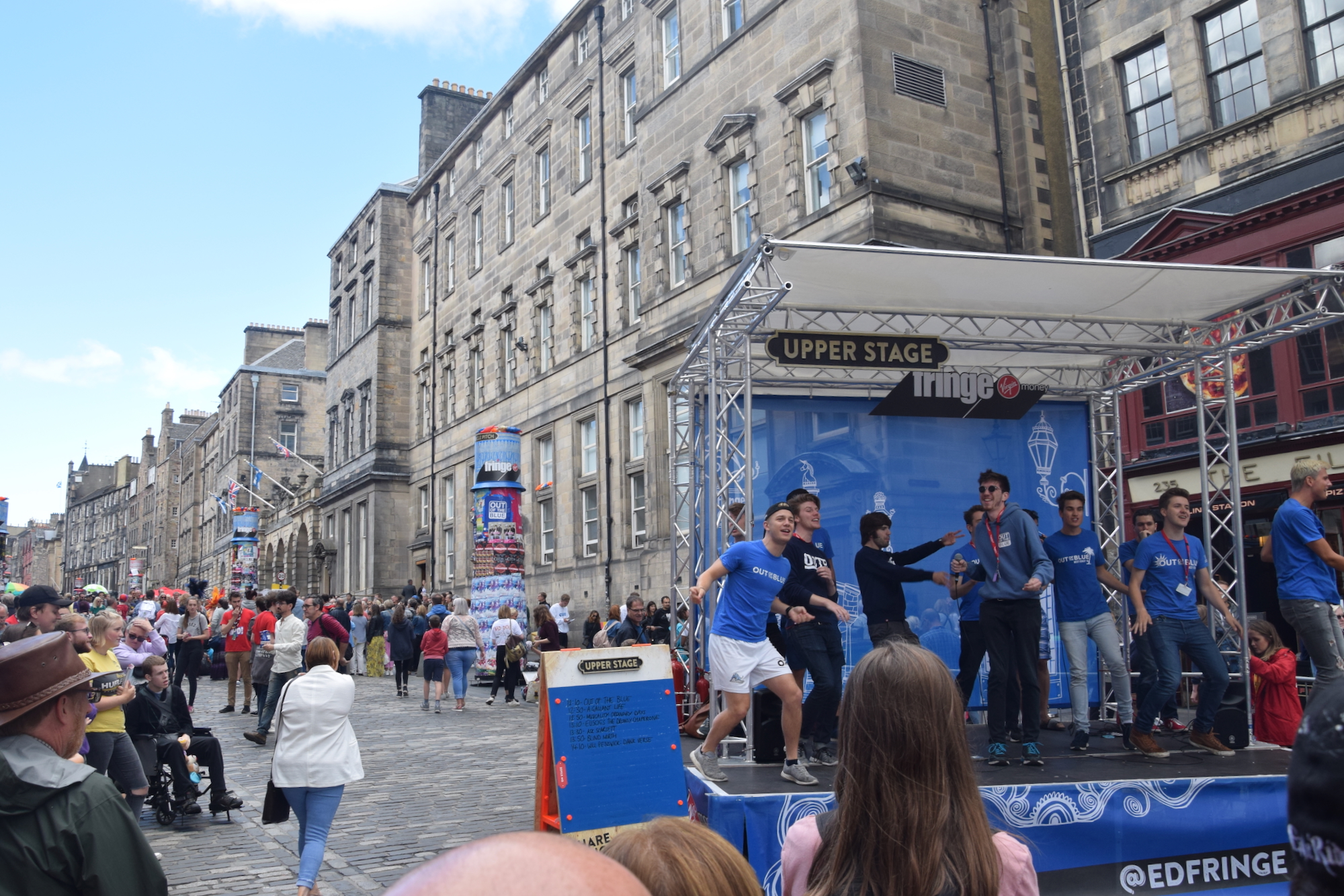
In a little under two weeks’ time, the world’s biggest performing arts festival comes back to Edinburgh. For 25 days in August, the city is the most exciting place in the world: crowds on every street, street performers everywhere, and, most importantly, literally thousands of shows to see. If you’ve not been, it’s probably hard to imagine, but pretty much every space going in the Old Town (and quite a few elsewhere) gets pressed into service as a performance venue—from assembly halls and lecture theatres all the way down to karaoke booths. What, for eleven months of the year, are the Students’ Association Potterrow building and the disused arches beneath the Central Library, become transformed into the Pleasance Dome and Underbelly Cowgate. And that’s not to forget the temporary spaces that get brought in: quite often these are shipping containers, but not always, as I know from the several times I’ve seen a comedy performance in a yurt.
It’s easy to get carried away. Last year I saw 55 shows, including one on every day of the official festival. This was too many,1 and I’m not eager to repeat the feat this year. But, even so, I will be spending a considerable amount of my free time there, and probably a little too much of my money as well.
This is only really possible because we live in Edinburgh. As you might imagine, accommodation prices rocket up during the festivals, which is increasingly a threat to the Fringe itself. I’m not sure how well-known this is—I certainly didn’t know before my first Fringe—but the festival on a large scale is unprogrammed.2 Individual venues can select their line-up if they want, but if you can find somewhere willing to host you, you pay the necessary fees, and you’re not doing anything illegal, your show can be part of the Fringe. That means that (even at the high-profile venues) performers generally have to self-fund. There are options for performers not to pay for the venue,3 and you don’t have to do anything illegal marketing for your show if you don’t want to.4 But you can’t get away from the fact that you need somewhere to sleep at night, and most places will charge you for that privilege.
So, yes, the Fringe has its flaws. But it’s still, quite possibly, my favourite time of year. Which makes it a little odd that I’ve never really written about it on here before.
The reason is that there’s only been one previous Fringe that I’ve been to while I’ve been actively maintaining this blog; that was my first one, in 2018. We didn’t live here back then—indeed, that was a couple of months before there even was a “we”—although it was on that trip that I fell so completely in love with the city that I knew I wanted to move here as soon as I could. The Fringe wasn’t all of that falling, but it was certainly part of it.
And I remember why I didn’t write about it on that trip either. See, the main things you can talk about when you write about a performing arts festival are, well, the performances. And I’m no theatre critic. I don’t think I have anything insightful to say about a show when it’s good. When it’s bad, I’m sure I could put together a half-entertaining rant, but then we come across another problem: I feel it’s too mean to make it public. Remember, people are investing weeks of their lives and sometimes thousands of pounds of their money to come to perform here. I appreciate that they’re unlikely to see it on my tiny little blog, but if it was a small enough show with a distinctive enough name, my review may well come up on the first few pages of Google results. I don’t want my poorly informed snark to make them feel like I presume it would.5
I do write capsule reviews of shows that I send to a few friends, and I’ve considered posting some of those but anonymising them. (I considered it for this post, in fact.) But by the time you’ve done that they’re not fun to read any more: at best, they’re clunky, and at worst, they’re banal. For that reason, I don’t plan to post them here this year either.
But the Fringe is such a big part of my life in August that I would like to write something about it. If nothing else, it will take up so much of my mental energy that I suspect I’ll be incapable of writing about anything that’s not the Fringe. But I’m not sure how.
And that’s where you come in.
My contact form is always open as a suggestion box. But, in particular, I’d love to hear your suggestions this week on how to write about the Fringe without just reviewing shows. Feel free to put them in the comments down below too. And, in a few weeks, I’ll hopefully be able to pay you back with some fun Fringe content.
- Which is easy to see when you work out the average: 2.2 shows per day. ↩︎
- Another thing that isn’t particularly well-known is that it’s not, strictly speaking, a comedy festival, but a performing arts one. Comedy is a huge part of it, sure, not least because in many of the venues the “stage” is barely enough space for a performer and a microphone. But there are also plays, musicals, spoken-word poetry slams, music gigs—you name it. ↩︎
- Which I’m not going to get into because this is a weirdly controversial topic, centred around exactly what is meant by the word “free”. ↩︎
- You kinda do, though—remember, there are thousands of shows competing with yours. ↩︎
- Similarly, I have never left a negative review of a show on the Fringe website. ↩︎
Leave a Reply