
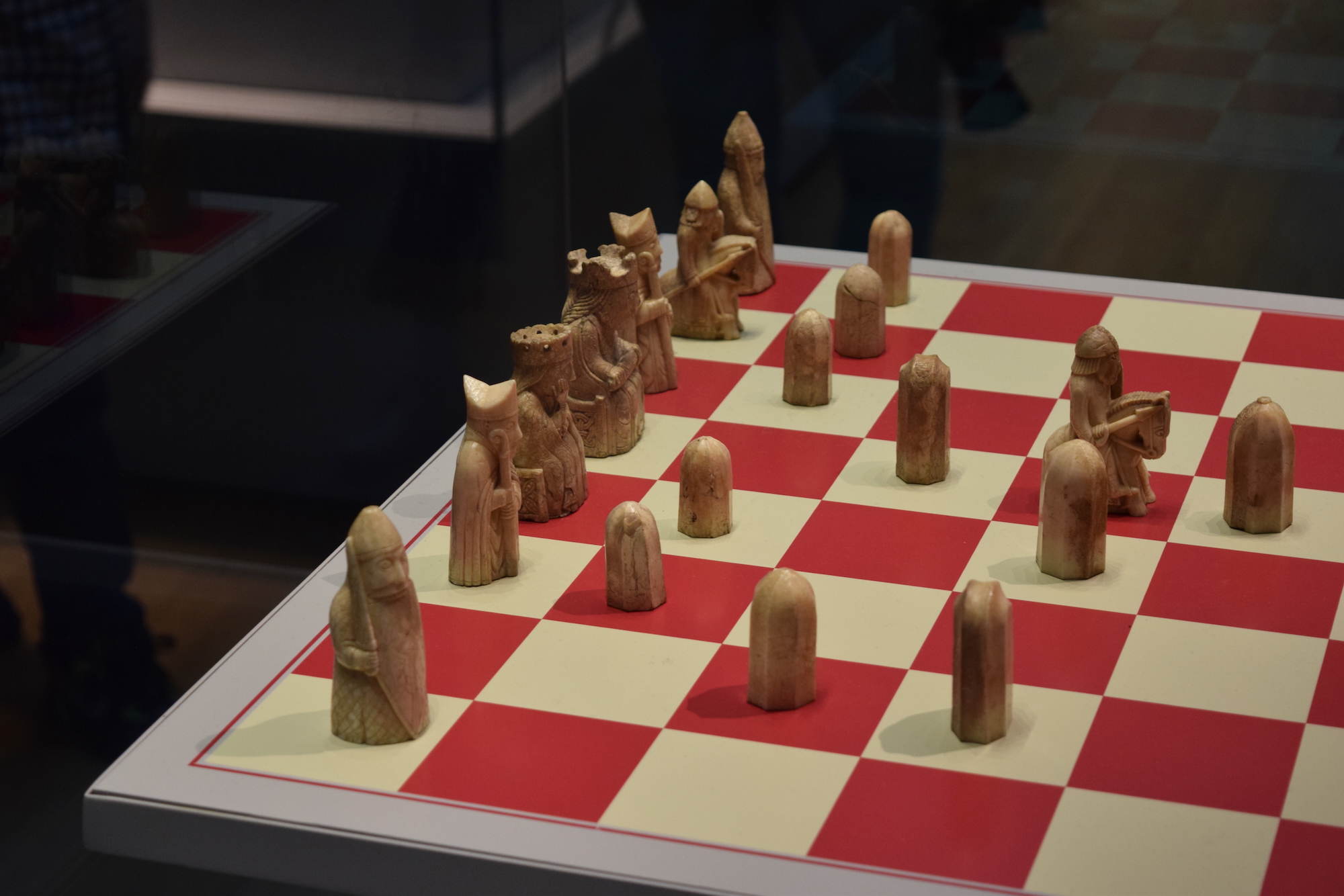
Last year, I went to Tabletop Scotland, a convention for games of the role-playing, war, card, and board variety. I was mostly interested in the board games side, and I left with four games: three second-hand from the board game exchange, and one brand new.1 Today I’m going to tell you about those games. Is this topical? No. Is this interesting? Hopefully. Could I have come up with a better idea for a post? I’ll let you be the judge.
But first, on the subject of ideas, a reminder that my suggestion box is always open.
Century: Eastern Wonders and Century: A New World
Century is a series of historically themed games, each set a century apart, which have some common pieces and mechanics—for instance, each has as a key component four different colours of cube as a resource you have to manage, although what real-world resources the colours represent varies from game to game. We already owned the first game in the series, Century: Spice Road, and my husband spotted the other two available in the exchange. Our motivation behind getting all three is that you can combine any subset of the games into a larger game containing mechanics from all of them, so if you have all three that gives you seven different possible games.2
I don’t want to spend too long on this, because there are many reasons I’m not qualified to review board games. Suffice it to say that the mix-and-match is cool, and the game is fun, fairly pacy, and not overly complex, although I’m not sure it handles its historical themes quite as sensitively as it could. Indeed, I only bring it up at all because of this diagram in the ruleset for the full game with components for all three: Century: From East to West, Part III.
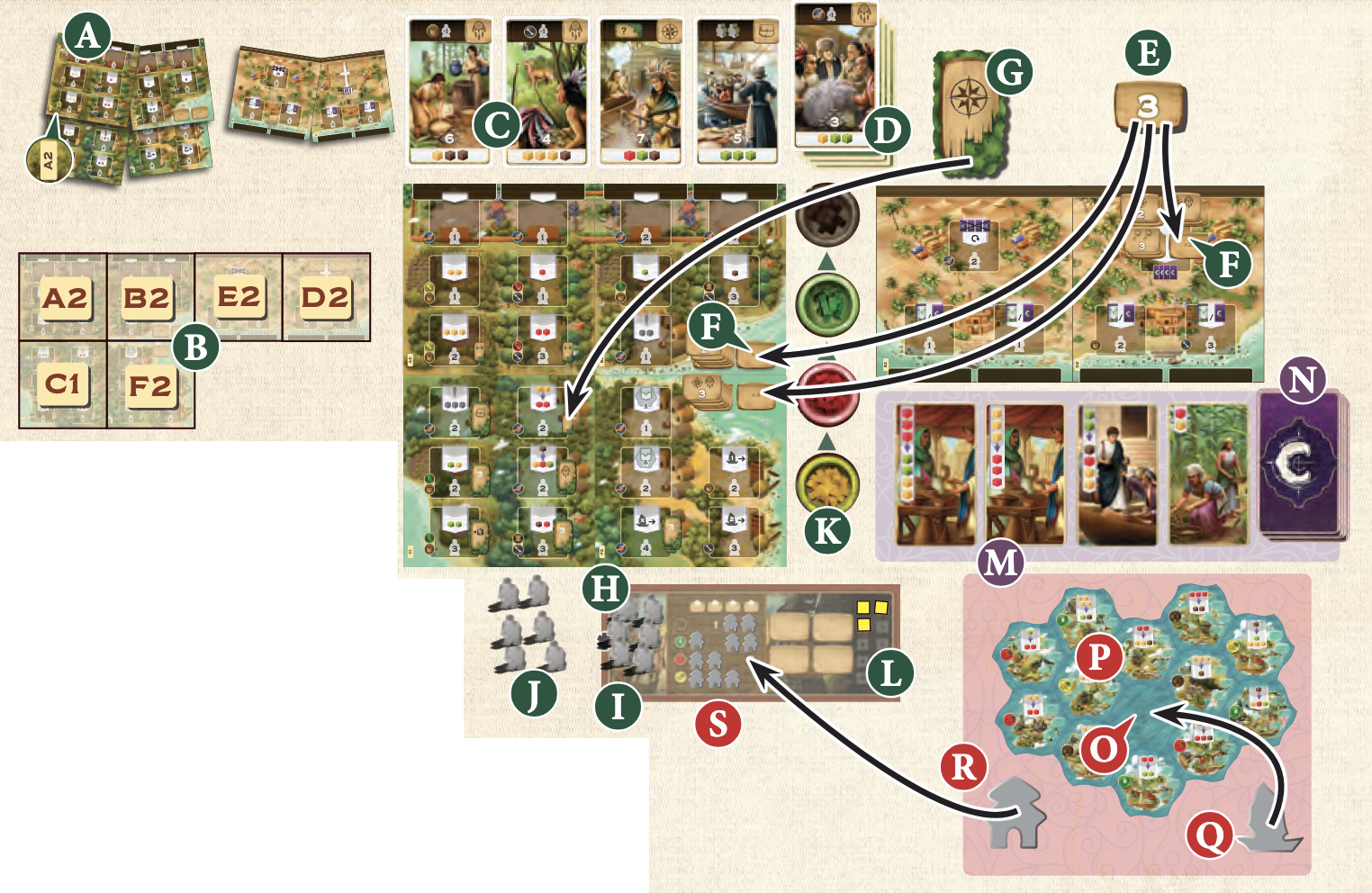
I put it to you, gentle reader, that this is an unhelpful diagram. It is particularly unhelpful because it takes up about 25% of the space for this version of the game, another 25% being the text explaining what it all means. You might remember where I said the game was “not overly complex”, and it’s not—this isn’t about how you play the game, it’s about how you set it up. The rules for the game are overleaf, except that they have to keep referring back to the rules for other versions of the game because there isn’t enough space left to go through everything you need to actually play.
Wait a second, though… I see spaces, and arrows showing where you should move things—maybe this is the game. Maybe it’s a word game, and you’re supposed to move the letters along the arrows to make a word, but you lose points if you lose the red letters, and get a special bonus point if you somehow get the purple letters involved even though they don’t have any arrows. In fact, I think if you try really hard, you can spell out “MORNINGTON CRESCENT”.
I told you I’m not qualified for this.
Kitchen Party!
This game was being sold off by one of the stalls for £2. A whole board game, for £2! The fact that they had whole stacks of it as-yet unsold didn’t fill the potential purchaser with confidence. But surely, however bad it might be, I’d be able to get 200 pennies’ worth of entertainment out of it. Surely!
The game is essentially “Name That Tune”, with some added challenges. That isn’t in itself a reason to write it off, since there are lots of great commercially sold board games that are based on pre-existing things: Scrabble was based on crosswords, Trivial Pursuit is just a quiz with more steps, and Cluedo was inspired by a “dress as your name” costume party gone horribly, horribly wrong. Sometimes these things loop around: it could be said that the culmination of the trend for boxed-and-sold adaptations of Werewolf was the spawning of a hugely successful TV show format, which can now itself be bought as a board game.3 Everything is derivative if you squint hard enough.4
So the problem isn’t that it’s derivative. It’s that there are, perhaps, two essential elements of “Name That Tune”, to wit: tunes, and their names. Kitchen Party! provides you with neither.
The basic gameplay is that you select a “record” at random—these being flimsy plastic discs representing categories—and then spin it on a provided spindle to select a subcategory. (In my experience, this is unreliable at actually moving more than a quarter turn or so, to a degree where the spinner from The Game of Life feels like a casino-quality roulette wheel.) You then get your phone out, and log in to whatever music app you choose, where you pick a song that fits the theme. Whoever guesses the song first wins points.5 The challenges are determined by a second set of discs, with points awarded if you complete the challenge and deducted if you chicken out.
Now, I know I paid £2 for this, and I accept that the suggestions of challenges are probably worth that. But the RRP is £24.99, and for that I was expecting at least suggestions of tunes you could play. Indeed, I assumed that this game had its own app—not uncommon these days—from the silver starburst on the box that reads “Play with SPOTIFY, APPLE, AMAZON & YOUTUBE MUSIC!” And I guess the cover text is technically true. It’s just that the game is compatible with those in the same way that a silent film is compatible with a sufficiently skilled pianist. In fact, there’s nothing stopping you playing this game with a sufficiently skilled pianist in place of any music-streaming service. I think this may be the optimal way to play, especially if this means I get to hear their choice for the subcategory “House Classics”.
I get that the idea is that you get to play the songs you like, rather than stuff the game selects for you. But then why introduce the spinner? Another thing we found with it was that it would sometimes land on a subcategory where the person choosing didn’t know any songs that matched. When I was that person, I just went on Apple Music, found a playlist they’d made that seemed to match, and played the first thing from that. I assume the reason that backup suggestions weren’t provided (say, on a pack of cards) was that there were too many diverse subcategories for that to be practical, and not because the game’s budget was eaten up making the “DJ deck” that you spin the records on. Admittedly, the challenges are provided for you, but some of them did seem like they’d be more fun if you were drunk,6 and the disclaimer of liability in the rulebook for any harm caused by playing the game rather put us off trying them.7
Did I get 200 pennies’ worth of entertainment out of it? I suppose so, if you count this post for half-a-crown or so. But for value-for-money it paled in comparison to the fourth game we got that day, for which we only paid 100 pennies more (albeit for a second-hand copy). And that game is…
… going to have to wait for another week.
- When I say “left with”, I should be clear that I bought them. Although I suspect this footnote makes it sound even more like I didn’t. ↩︎
- For maths fans: yes, the size of the set of all subsets of is eight, not seven. But that includes the empty set, and I’m not going to describe playing nothing as one of the games in the Century series. Philosophy fans may disagree, of course. ↩︎
- My first encounter with a “hidden saboteur” mechanic was a game called The Resistance: Avalon, an Arthurian-legend-based game which was a staple at the Oxford University Board Games Society, and which I played on my first evening there. I was assigned at random to be a “Minion of Mordred”; when asked on my first turn whether or not I was a “Loyal Servant of Arthur”, I hesitated, then said “I don’t know”. I think of this every time I wonder if I should apply for The Traitors. ↩︎
- Except this blog, which has never based a post on a pre-existing format. ↩︎
- Unless I’m misremembering—I gave this game away ages ago, and I can’t find the rulebook online—you don’t get any reward for people picking your song. The best strategy in this game is therefore to pick a song that nobody will guess. I thought of criticising the game for this, but it’s clearly not in the spirit of the thing. It’s also how quite a lot of casual games work: notably, as pointed out by a video that blew up in 2020, Hangman. Still, you could easily fix it by giving a bonus point to the person whose turn it is to pick the song if anyone guesses it. ↩︎
- We weren’t. ↩︎
- I really wish I’d kept this game long enough to be able to quote from the rulebook; I refuse to solve this problem by buying it again. ↩︎
Leave a Reply