
I wasn’t sure what I wanted to write for this post, so I asked for suggestions from friends. Since I really have no idea what I’m going to write here during quarantine, I thought I’d solicit ideas more widely. So, in a possibly risky move, I’ve set up my contact form to accept anonymous submissions. I’d love it if you would put your name to them, of course, but if your suggestion is… weird, I can understand why you wouldn’t. Anyway, please submit something. Anything. It’s not like I have anything better to do.
This week’s suggestion is, and I quote:
Why are so many traditional children’s songs utterly messed up. Why. Just why.
I wasn’t sure what they meant at first, so I asked, and they gave me a long list of examples. Let’s go through them, shall we?
“Oh My Darling, Clementine”
CN: suicide for this one.
In the churchyard near the canyon
Where the myrtle doth entwine,
There grow roses and other posies
Fertilized by Clementine.
So, if you don’t know this one, the story is of the daughter of a miner in the 1849 California Gold Rush, who drowns in a lake. His father, grief-stricken, takes his own life too. In some versions, the closing couplet sees the singer, who was Clementine’s love, goes off with her sister instead, though the original just has him musing that, now she’s dead, he won’t hug her any more.
So, I think the answer here is that this wasn’t written as a children’s song. The standardised version, written by a Percy Montrose, appeared in a book called College Songs compiled in 1887, described as “A collection of new and popular songs of the American colleges”. As always, then, it’s the students’ fault.
“London Bridge Is Falling Down”
London Bridge is falling down,
Falling down, falling down.
London Bridge is falling down,
My fair lady.
I don’t suppose I really needed to quote this one, though the lyrics do exist in many substantially different variations. I’m honestly not sure what my friend was talking about when they said this one was messed-up. Were they worried about the damage to infrastructure? Or concerned at the lack of building safety checks? Pass.
“Ring-a-Ring o’ Roses”
Ring-a-ring o’ roses,
A pocket full of posies,
A-tishoo! A-tishoo!
We all fall down.
So, the theory here as to why this one is creepy: the roses represent a rash, the posies are a supposed folk cure, a-tishoo is another symptom, and “we all fall down” represents death, the whole thing being a metaphor for the Great Plague.
That’s great (creepy, but great)—except that explanation only appeared in the 20th Century, long after both the Plague and the first recording of the rhyme, so scholars of these things think it’s generally baseless. Also, I don’t really want to think about plague-based nursery rhymes right now. Let’s move on.
“There Was an Old Woman…”
There was an old woman who lived in a shoe.
She had so many children, she didn’t know what to do.
She gave them some broth without any bread;
Then whipped them all soundly and put them to bed.
Well, that’s a hard “yikes” from me. According to Wikipedia there is an alternate Christian version published in 1978 by one Marjorie Ainsworth Decker, in which the old woman “kissed them all gladly” instead, so I’m clearly not the only person to object.
The origins of this one are a little murky—all the suggested people who could have been the “old woman” are just people who had a lot of children, and there’s no explanation for the rest. It’s just about child cruelty.
“Three Blind Mice”
They all ran after the farmer’s wife,
Who cut off their tails with a carving knife,
Did you ever see such a sight in your life,
As three blind mice?
This one first appeared in 1609. Supposedly the Three Blind Mice are the three Oxford Martyrs, who were burnt at the stake for their Protestant faith in 1555–56 on Broad Street (a cross in the ground now marks the spot), and to whom the Martyrs’ Memorial was eventually built at the south end of St Giles’. The “farmer’s wife” here is presumably supposed to be Mary I, the Catholic queen at the time (though it’s worth noting that, although she gets the “bloody” appelation, her younger half-brother Edward was just as virulently anti-Catholic as she was anti-Protestant).
Anyway, this doesn’t really stand up to scrutiny, as this blog post (by somebody who knows what they’re talking about a lot more than me) explains. In particular, the original version refers to “Dame Julian, the miller and his merry old wife”, the implication seemingly being that they themselves are the three mice; the modern form was reached in the early 19th Century when it was included in a book of children’s rhymes.
“Alouette”
Alouette, gentille alouette,
Alouette, je te plumerai.
Je te plumerai la tête, je te plumerai la tête.
Et la tête, et la tête, Alouette, Alouette, oh…
Or, translated from the French:
Lark, pretty lark,
Lark, I will pluck you.
I will pluck your head, I will pluck your head.
And your head, and your head, lark, lark, oh…
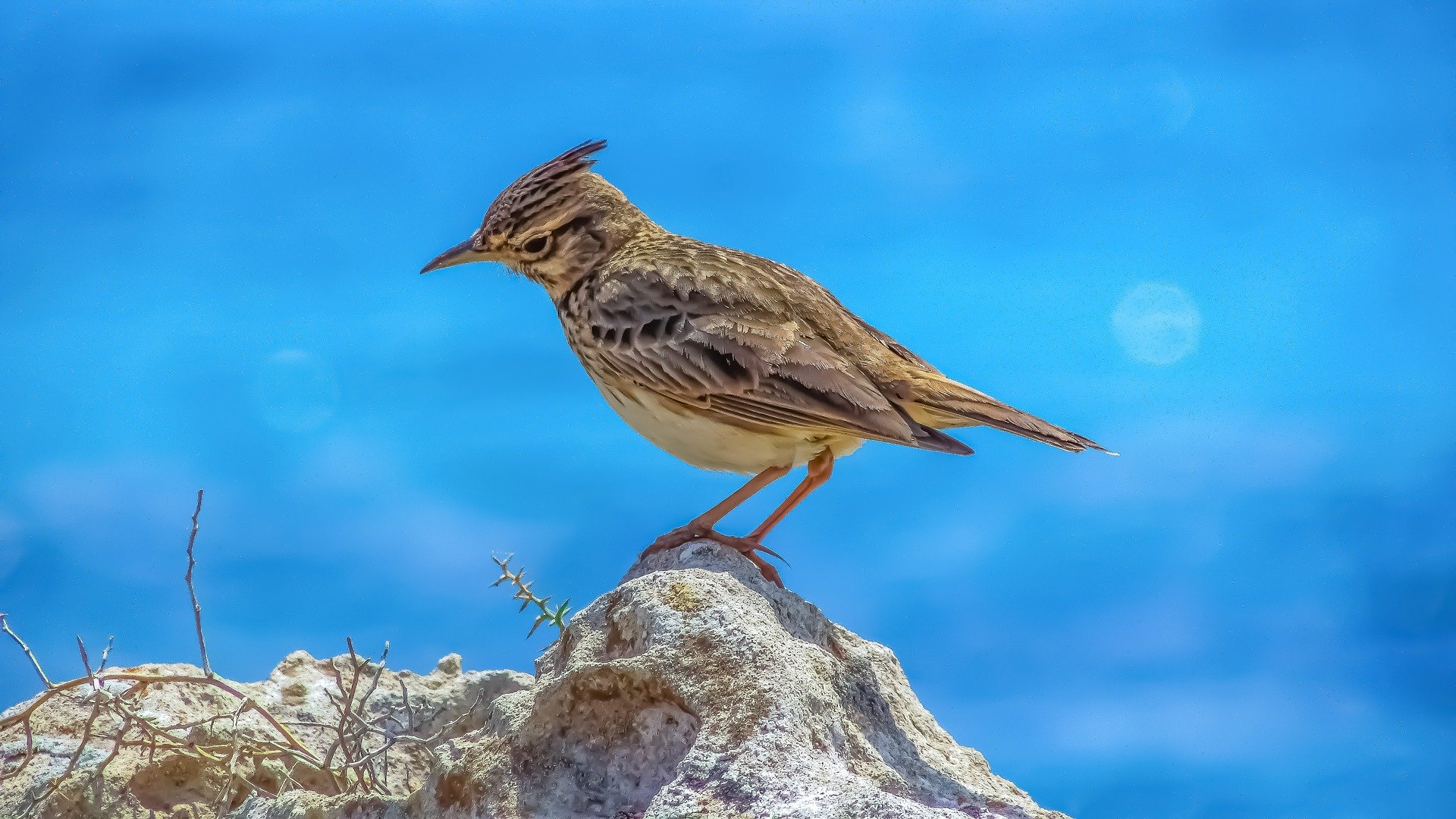
This one doesn’t sound as creepy in English because most of us just think about the sound, not what it actually means. This was first published in Canada, in A Pocket Song Book for the Use of Students and Graduates of McGill College (according to Wikipedia), so again we should blame the students. Bloody students.
***
So what have we learnt? Firstly, that most of these rhymes weren’t written for children. Even though their origins as political or satirical rhymes are often dubious, they often were folklore songs for adults before they entered the children’s canon.
Then, why did they become popular children’s rhymes? Well, I don’t really know what I’m talking about here, and this is a theory based on very little evidence. But, if I were to wildly speculate, I’d point to the works of Roald Dahl, which, if read as an adult, are somewhat horrifying, but which kids love. A lot of our instincts about what make these things disturbing come to us as adults, when we gain the ability to think more deeply about implications, and what not. For children, it’s just funny.
So anyway, I hope that answers your question, nameless friend. And please, if you have any ideas yourself for things I could write about, stick them in the contact form. They can’t be more troubling than some of these rhymes.
Leave a Reply